Thursday, October 5, 2006

Welcome to the Blogosphere, Title IX Blog!

I'd like to welcome the new Title IX Blog to the blogosphere. This blog is a group effort by Erin Buzuvis, a new law professor at the Western New England College of Law, Kristine Newhall, a Women's Studies graduate student, and Western New England law professor Sudha Setty. The blog already has some neat posts up on topics including James Madison University's athletics program cuts, the D.C. Circuit's recent decision affirming dismissal of the College Sports Council's challenge to Title IX's constitutionality, and NCAA policies on paternity leave.

The great thing about new blogs on sports law topics, like the Title IX blog and Jeff Standen's new Sports Law Professor, is that it gives us new folks with whom to engage in (hopefully enlightening or at least entertaining) argument.

Tuesday, October 3, 2006

NHLPA Sued in Federal Court by its Members

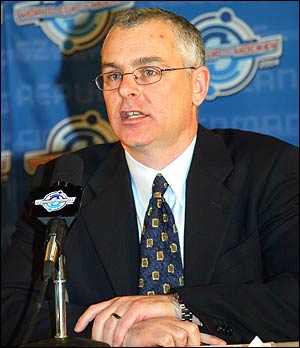
Yesterday, a group of dissident members of the NHLPA filed suit in federal court against the NHLPA, executive director Ted Saskin (shown on right), and former members of the NHLPA's executive committee, seeking the removal of Saskin, and also an award of unspecified millions of dollars in damages and punitive damages. ("Disgruntled NHL players ask court to remove union director"). In June 2005, the NHLPA accepted a collective bargaining agreement that ended the lockout and for the first time contained a salary cap, which ran counter to the views that Goodenow expressed in negotiations with the league. Shortly thereafter on July 28 2005, Bob Goodenow was dismissed as executive director and the union agreed to pay off his contract. That same day, Saskin was hired as executive director "despite the fact that Saskin was never properly nominated for the position by the executive board" according to the dissident group.

In an attempt to quiet the complaints after Saskin was hired, the union held a secret ballot among player representative executive board members to ratify Saskin's contract as executive director; 28 of 37 eligible ballots had been received and 24 of the 28 confirmed Saskin's position and contract as executive director. The lawsuit further alleges that, "despite express instructions from the executive board that no cap be negotiated, Saskin acting as primary spokesman for the NHLPA, agreed to a collective bargaining agreement containing a system which functions as a hard cap" that was whisked through the board in a conference call with just 12 hours notice and that Saskin and others withheld key information from union members including a side letter containing details of how the cap worked.

Players unions owe their individual members a duty of fair representation (DFR). It is well-established by U.S. Supreme Court precedent that a breach of the DFR occurs only when a union’s conduct toward a member of the collective bargaining unit is "arbitrary, discriminatory, or in bad faith".

While the press release doesn't disclose the legal claims being asserted by the dissident group, DFR is most likely one of them. The DFR standard is extremely difficult to meet, but DFR claims typically involve a situation in which one member of the union is claiming that the union didn't fairly represent his interests (i.e. by not filing a grievance on his behalf). In this case, there is a fairly large number of members that make up this dissident group (more than 100 according to Chris Chelios) and I think that is a significant factor that could have an influence on a court or jury. Another significant factor, if it can be proved, is that the board allegedly gave express instructions NOT to agree with the league on a salary cap and the union (with Saskin acting as the primary spokesman) went behind their back and agreed to it. The union will most likely argue that whatever was agreed to in the CBA does not single out, or treat differently, any individual member, and therefore it's not arbitrary or discriminatory. Basically, this dissident group must show that the union acted in "bad faith" by agreeing to a system that functions like a hard cap when (and if) the board previously made it clear that they did not want any cap. Federal courts usually retain jurisdiction over DFR claims.

Another claim this dissident group of players could be asserting is an unfair labor charge against the union claiming that the players were denied access to information and the right to vote with respect to both the salary cap issue and the hiring of Saskin as the new executive director. So regarding the cap issue, their argument goes, "we told you we didn't want a cap to begin with and you still agreed to it, but what's worse is that you didn't even keep us informed, disclose how it would work nor give us an opportunity to approve the details." The success of this claim will essentially depend upon the procedures outlined in the union's constitution and bylaws as it pertains to the disclosure of information, access to information, and voting with respect to collective bargaining issues and the firing/hiring of executive directors. But the NLRB usually has exclusive jurisdiction over these types of claims.

A third claim that is likely being asserted is that the union's hiring of Saskin was ultra vires -- beyond the scope of the union's authority and a breach of the union's constitution and bylaws. The court would have jurisdiction over this claim. But regardless of the legal analysis, it sure looks really bad when 100 plus players are suing their union in federal court. In fact, I don't ever recall this many players suing their union in federal court.

Message to Mark Martin: "Shit or Get Off the Pot"

I am getting fed up watching interviews with NASCAR driver Mark Martin. The man can't make up his mind about whether or not to keep driving Nextel Cup. He says he will retire. Then, he says he won't. Then, he says he might "semi-retire." WTF?!

I'm not a big believer in retirement. But in sports, it is something that has to be faced and accepted. I don't think Mark Martin is too old to race. Stock car racing is far more forgiving to maturity than something like tennis. I think if Dale Earnhardt had lived he would still be on the track today at 50+ years. And I think he would be as competitive as ever.

It won't bother me a bit if Martin decides to hang it up, but the man needs to make up his fucking mind and live with the consequences. I don't see how doublemindedness helps anybody.

Monday, October 2, 2006

Legal Implications of the Wonderlic Test

I just posted on SSRN a working paper: The Wonderlic Test for the NFL Draft: Linking Stereotype Threat and the Law. You will need a free SSRN account to read it, and you can get such an account here. I will be presenting on this paper later this month at Marquette University Law School, specifically at the First Annual Colloquium on Current Scholarship in Labor and Employment Law. Please note: my working paper is very much "working" and I will update it again in a couple of weeks. The paper is actually one part of a law review article that I am writing on the law and social psychology of intellectual and psychological testing of pro athletes, and it is also related to a book project that I am co-authoring with Jon Hanson.

If you get a chance to read the paper, I would greatly appreciate any feedback at mmccann[at]mc.edu. Thanks.

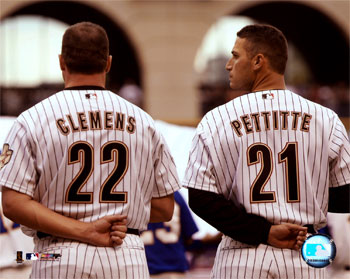
Does it mean anything if Clemens and Pettitte don’t sue?

The multi-sport steroids scandal of 2005-200? has involved a considerable amount of tea-leaf and between-the-lines reading. For instance, journalists (and occasionally bloggers) compare “before” and “after” photos of suspected users to make the case that they are scientifically enhanced. Mark McGwire—though he never admitted steroid use—is presumed guilty based on his pleading what has been called the “fourth and a half amendment” while testifying before Congress. Barry Bonds’s decision to sue the authors of Game of Shadows for illegally leaking grand jury testimony signaled to some that Bonds did not want to face a defamation trial where “substantial truth” would constitute a defense. Some have speculated that Lance Armstrong’s failure to denounce former teammate Floyd Landis even after Landis was proven a liar signaled that Landis had “the goods” regarding Armstrong’s own possible past use.

Yesterday, in the latest twist on L’Affair du Grimsley (see previous posts here, here and here), the New York Times reported the list of names that had earlier been “blacked out” of a report that included statements attributed to caught-red-handed HGHer Jason Grimsley. Among the names were some surprises. Pitchers Andy Pettitte, Roger Clemens, and former MVP Miguel Tejada were named by Grimsley. Pettitte and Clemens immediately denied the allegations; many have rushed to Pettitte’s and Clemens’s defense, although to some, the pitchers’ denials will no doubt ring as hollow as those of Landis or finger-waggerer Rafael Palmeiro.

Clemens has already threatened legal action “if it affects sponsorship of his charitable foundation”; so far, no similar threats from Pettitte or Tejada. But accused steroid users have explored suits before. Now laugable, Rafael Palmeiro made noises about suing Jose Canseco after being accused of steroid use. Marion Jones, the most prominent accused athlete really cleared of steroid use, is also noteworthy for having filed a defamation suit against her accusers (and obtained a presumably favorable settlement). Bo Jackson also filed suit against a newspaper that accused him of steroid use. If Pettitte and Clemens don’t sue, is there anything we can safely conclude? That is, could we “read” into a failure to sue the kind of confession we have all read in to McGwire’s non-denial?

The answer is no. At first blush the two seem to have an open-and-shut case for “defamation per se” against Grimsley, assuming Pettitte and Clemens, as they have claimed, never used steroids. A false statement concerning another’s capacity to adequately perform at his trade or profession or an allegation of criminal misbehavior involving moral turpitude are both defamation per se – per se in the sense that the plaintiff need not show actual damages (i.e., loss of a job, inability to get into the hall of fame). It is therefore a bit odd that Clemens threatened legal action only if his charitable foundation is threatened, since damage would not be a required element for a defamation per se suit.

The problem for Clemens and Pettitte? First, as public figures, they can only recover for defamation if the defendant had actual “malice” or reckless disregard as to the truth of a statement. In addition, some courts have found an absolute privilege bars defamation suits regarding statements made to law enforcement officers. So, given that their suits are likely losers (not to mention that Grimsley will likely be close to judgment proof after he pays his own legal bills), it will be hard to read much into a decision not to sue.
The Strait Jacket

My ambitions exceed my present resources. When this occurs, I feel constrained as if I am trapped in a strait jacket, and I am trying to punch my way out. It gets on my nerves. It is a restless feeling coupled with frustration. The upside is that it motivates me to accomplish goals which are replaced by other goals which leads to the strait jacket feeling again. In short, I am never satisfied.

Basically, I don't have enough time, money, or energy to do all the things I want to do. I keep lists of projects, but there are always challenges that come up when I try to accomplish them. For instance, I work a lot to produce free cash flow to put into a weekend project. But then, I don't have the energy to pull it off because I am exhausted from working so much. By the time I am rested up, I am out of time. Or I get distracted on side issues usually involving family and friends.

If there is one resource I value the most, it would be time. I can always expand my money supply or even my supply of energy. But time is time. I still have the same 24 as everyone else. No amount of effort on my part will give me a greater supply of time. So, I try and make the most of the time I have.

This was an issue for Leonardo and Edison. Both took catnaps in an effort to expand their time. I could take over the world if I didn't have to sleep ever again.

In terms of energy, I can also appreciate why MLB players use performance enhancing drugs esp. amphetamines. They have a grueling schedule, so that boost makes a huge difference. I limit myself to caffeine, but I can see the temptation in taking uppers in order to get more done. As it stands, I just accept the fact that I am always going to fall asleep during movies or gatherings. This is the price of chronic sleep deprivation.

So, what have I accomplished with all this work? Not much at all.

New Sports Law Scholarship