Thursday, November 29, 2012

Marvin Miller - The Most Significant Figure in Baseball in the Past 50 Years?

Professor Ed Edmonds
The following piece is written by Notre Dame Law School sports law professor Ed Edmonds, one of the best minds around on baseball and the law and founder of the Baseball Salary Arbitration website.

- - - - - - - - - - - - - - - - 

Marvin Miller - The Most Significant Figure in Baseball in the Past 50 Years?

There have been no shortage of articles this past week honoring the passing of the legendary leader of the MLBPA Marvin Miller at age 95.  Many writers have noted that he was possibly the most significant figure in baseball over the past half-century.  I certain agree that he belongs in any conversation about that topic, and I point to an earlier post on this blog by Howard Wasserman regarding his place in sports law history.  I will not attempt to go through the compilation of Miller’s many accomplishments because so many of you know and teach about this on a regular basis. 

Let me take up one point that comes together with the thoughts of Murray Chass, the long-time writer for the New York Times.  By the way, if you do not regularly read Mr. Chass’s writings on Murray Chass . . . On Baseball, I highly recommend it.  Murray Chass posits that perhaps Miller can now be elected to the National Baseball Hall of Fame because the owners and other management personnel will not be subjected to his acceptance speech or because their hatred for the man who led the players to some freedom over their playing careers and significantly better pay and working conditions would not allow them to vote into the Hall a man who so rightly deserves to be there.  I only need to mention the additional shun shown Miller when the Hall opened its doors to Bowie Kuhn.

How ironic is it that Barry Bonds, Roger Clemens, and Sammy Sosa appear this week for the first time on a Hall of Fame ballot?  We are finally at the point so many have waited for to determine how the voters will actually deal with the steroid era candidates.  There will be a renewed conversation about the integrity of the induction process if Bonds, Clemens, and Sosa are allowed the honor of enshrinement.  My point is a simple one:  If anyone is really concerned about the “integrity” of the membership in the Baseball Hall of Fame, the exclusion of Miller needs to be addressed.  Marvin Miller’s bitterness over his non-election sparked comments from him that he would not have accepted the honor in his final few years.  Perhaps now everyone can agree to do not only the honorable thing, but an honest thing.  To not have a plaque to Marvin Miller in the National Baseball Hall of Fame is a grievous oversight.  Let’s hope that it is remedied soon.

You Voted, We announce the results! Your thoughts on the Card Companies

We posted votes that took place for a week and we asked that you all participate. Well here are the results and findings from the votes. Seems that outside of Topps and Panini there is no other competition.

Your Favorite Card Company Is?

Out of 27 votes....

Panini 11 votes

Topps 11 votes

Upper Deck 5 votes

Press Pass 0 votes  


Card Company With The Best Bang (or Mojo) for your Buck(s)?

Out of 24 votes....

Panini 10 votes

Topps 10 votes

Upper Deck 3 votes

Press Pass 1 votes  


Card Company with the Best Use Of Social Media?

Out of 25 votes....

Panini 12 votes

Topps 8 votes

Upper Deck 5 votes

Press Pass 0 votes  


Card Company With The Best Overall Product?

 Out of 23 votes...

Panini 10 votes

Topps 8 votes

Upper Deck 5 votes

Press Pass 0 votes  


Card Company With The Best Promo's?

 Out of 20 votes...

Panini 12 votes

Topps 4 votes

Upper Deck 4 votes

Press Pass 0 votes  


Card Company With The Best Customer Service? 

 Out of 20 votes....

Panini 12 votes

Topps 5 votes

Upper Deck 5 votes

Press Pass 0 votes 


So I guess this leads us to ask..what should the other two companies that we put on this list (Upper Deck and Press Pass) do to fix things and gain more votes? And why didn't you vote on them?

It is in our opinion that Press Pass was low voted for because of their lack of licensing. They have pretty good customer service and they run some great promos on their Facebook page however don't really use Twitter to their advantage.

As for Upper Deck who might have at one point dominated this voting the lack of pro licensing, the customer service being not as strong as it used to be, and not as many giveaways as the top two companies could be some of the reasons. Their products still seem to be strong. But this is only our opinion and we would like to hear yours as well!

Next up, we are taking a poll vote on why you buy what you buy with another 6 or so questions. Hopefully our opinions and polls will help the card companies with what they need to work on. This poll will be taken down the road and we will keep you informed. Your participation is much welcomed!!

Celtics-Nets game brawl


Rajon Rondo, Kris Humphries, and Gerald Wallace all ejected for fighting in Celtics-Nets game.

Rajon Rondo, Kris Humphries, Gerald Wallace, KG, Kevin Garnett, New Jersey Nets, Boston Celtics


30 seconds remaining in the first half of the game between Celtics and Nets, Kris Humphries fouled Kevin Garnett on a jumper, hitting KG hard in the shoulder that sent him to the floor along the baseline. Rondo, who was near the hoop, immediately grabbed and shoved Humphries. More players got involved, including the Nets' Gerald Wallace, the Celtics' Brandon Bass, the jet, and a late-arriving Garnett.

Rondo, Humphries, and Wallace were all ejected, and all three, they can expect certain fines and possible suspensions in the next few days. Rondo finished with only three assists in 18 minutes, bringing his streak to an end at 37 games, which ties him at second all-time with John Stockton. Magic Johnson will continue to hold the record at 46 games.

Nets won the game 95-83.

Here is the full recap:


Rajon Rondo, Kris Humphries, Gerald Wallace, KG, Kevin Garnett, New Jersey Nets, Boston Celtics

Wednesday, November 28, 2012

Modern Family Review: "When a Tree Falls"


Yet again, Modern Family proves itself, the best comedy
on television, with plenty of huge laughs along the way.

The storyline revolved around, Claire and Gloria shopping,
Jay and Phil taking Many and Luke to a friend's party, Cam and
Mitch trying to save a tree from getting chopped down.

My favorite storyline though was Alex, trying for revenge against
her sister, by taking  a picture of her picking up trash during
her community service.

The picture of Haley's mug shot alone, made watching this
episode worth while.

I do hope they're going to do more with Alex, she a complex
character, who needs to be explored more deeply.

Phil beating up Jay with the oversize boxing gloves  was
another highlight.

Well done for another brilliant episode.

8/10

Some lines from tonight.


On one hand, Im upset i have to pick up garabage on
the other, I look cute in orange. (Haley)

Your a kid your not Nixon on the beach (Jay)

 Look I'm  Mexico again, does
 anyone care, I'm not from Mexico (Manny)

We need a birth certificate (Luke)

It will be finest moment ina few years I
 hope to have more friends and not have time for
this stuff. (Alex)

Lets get philyscial (Phil)

I would rather box my daughter husbands than my sons. (Jay)


Legal implications of the proposed ban on belly putters

I speak with David Dusek of Golf Magazine|Golf.com about the potential legal fallout of the US Golf Association banning belly putters and whether affected athletes, like Keegan Bradley, and putter manufacturers can sue. My take: any attempt to use the law to beat the ban would probably fail.

Here's an excerpt:

But McCann quickly adds that it's an unpersuasive argument. The USGA and the R&A would argue that they have decisive rule-making authority. They would also contend that it's reasonable for them to alter the rules, and the PGA Tour would argue that it's reasonable to abide by those rules. 

"Courts give leagues a tremendous amount of latitude in rules of play" he says. "It's one thing to say there is a new restriction on free agency and that it's not collectively bargained, or there is a salary cap change; it's another to change the rules of play. Courts are pretty deferential, and I think any type of lawsuit would be unlikely to prevail." 

McCann pointed out, however, that in the early 1990s, a group of golfers led by Bob Gilder joined Ping and won a favorable settlement from the USGA and the PGA Tour after Ping Eye 2 irons were banned. That club's square grooves had been ruled to have a performance-enhancing effect, but the players rebutted that argument by citing data that showed golfers using the club earned less than those who did not use it. The case ended in a settlement that allowed the club but required different grooves in future models. 

That precedent may seem to favor a player inclined to sue, but McCann cautions that the player would have to show statistics that indicated that belly putters were not providing an unfair advantage.

To read the rest, click here.

Against "Modern Energy Access"

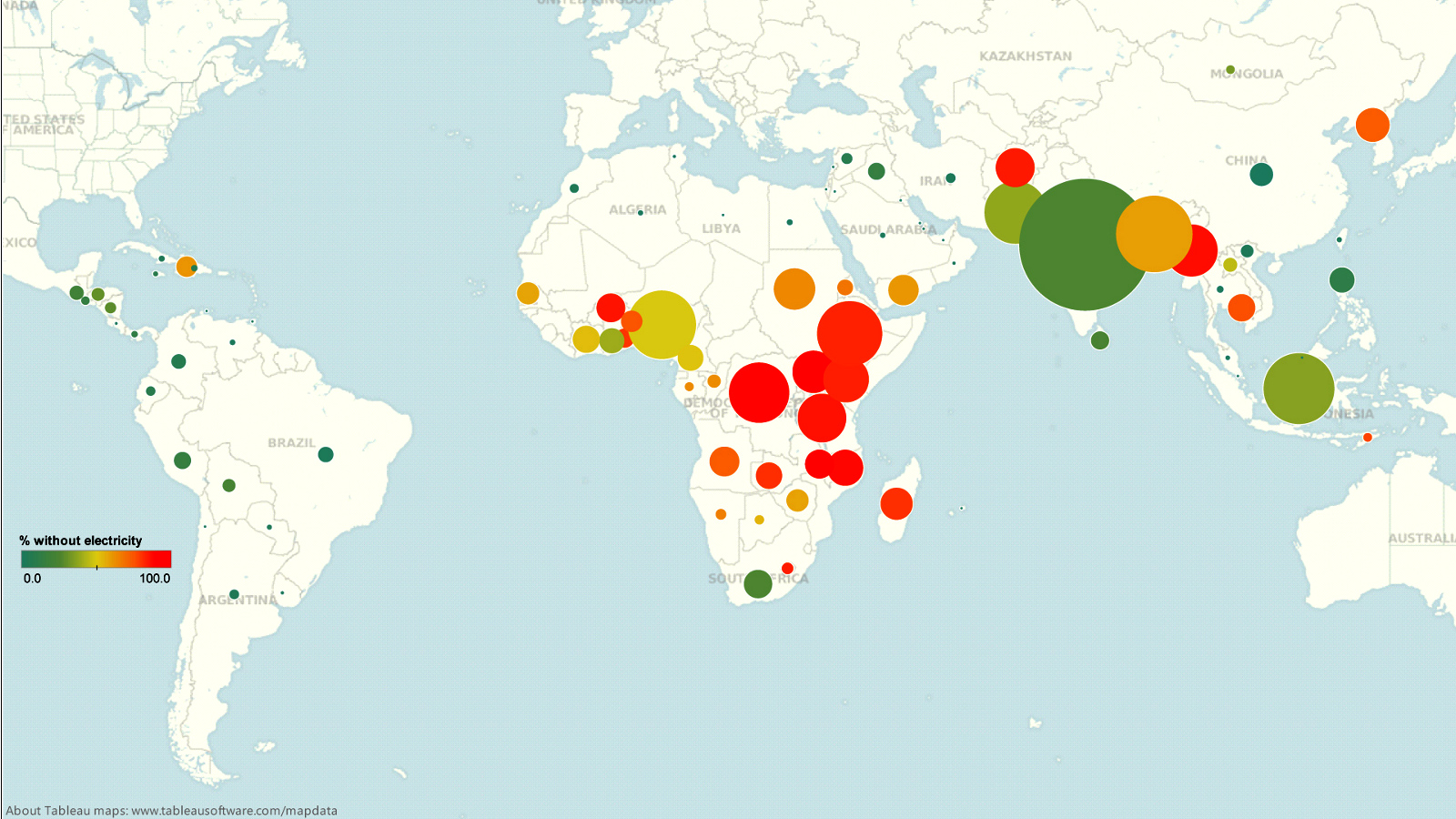
Access to energy is one of the big global issues that has hovered around the fringes of international policy discussions such as the Millennium Development Goals or climate policy, but which has been getting more attention in recent years. In my frequent lectures on climate policy I point out to people that 1.3 billion people worldwide lack any access to electricity and an 2.6 billion more cook with wood, charcoal, tree leaves, crop residues and animal waste (an additional 400 million cook with coal).

The "success" scenarios of climate advocates hoping to power the world with carbon-free energy almost always leave a billion or more people in the dark and several billion cooking with dirty fuels. Sometimes, magic is invoked to suggest that "electricity can be brought to everyone" without appreciably increasing carbon emissions. Of course, if we could bring electricity to the 1.3 billion without any access with no effect on emissions, then we could probably do it for 6 billion others.

There is a devil in the details which helps us to keep the energy poor out of view while we debate issues important to rich people, like climate change. That is the very definition of "energy access." The International Energy Agency explains some of the difficulties in defining energy access and gives its definition as follows:
There is no single internationally-accepted and internationally-adopted definition of modern energy access. For our energy access projections to 2030, the World Energy Outlook (WEO) defines modern energy access as “a household having reliable and affordable access to clean cooking facilities, a first connection to electricity and then an increasing level of electricity consumption over time to reach the regional average”. By defining it at the household level, it is recognised that some other categories are excluded, such as electricity access to businesses and public buildings that are crucial to economic and social development, i.e. schools and hospitals.

Access to electricity involves more than a first supply connection to the household; our definition of access also involves consumption of a specified minimum level of electricity, the amount varies based on whether the household is in a rural or an urban area. The initial threshold level of electricity consumption for rural households is assumed to be 250 kilowatt-hours (kWh) per year and for urban households it is 500 kWh per year. The higher consumption assumed in urban areas reflects specific urban consumption patterns. Both are calculated based on an assumption of five people per household. In rural areas, this level of consumption could, for example, provide for the use of a floor fan, a mobile telephone and two compact fluorescent light bulbs for about five hours per day. In urban areas, consumption might also include an efficient refrigerator, a second mobile telephone per household and another appliance, such as a small television or a computer.
I have found when you start talking in terms of "kilowatt-hours per year" people's eyes glaze over. And when I am lecturing about "energy access" students might look up from their smart phone, tablet or laptop to register a look of understanding: "Energy access -- yeah, I have that, gotcha."

Actually I want to tell them, you have wayyyyy more than that. To better explain this issue I have made up the following graph.
When "energy access" is used by organizations like the IEA, they mean something very different than what you, I or my students might take the term to mean in common parlance. (And note, this is no critique of the IEA, they have done excellent work on energy access issues.) The graph above provides a comparison of the 500 kWh per year household threshold for "energy access" used by the IEA to a comparable number for the United States (both numbers are expressed in per capita terms, so 100 kWh per person from IEA and data on US household electricity consumption here and people per household here).

A goal to secure 1.3 billion people access to 2.2% of the electricity that the average American uses might be characterized as a initial start to more ambitious goals, but it is not a stopping point (and again, IEA recognizes that energy access is a process, but this gets lost in broader discussions).

We do not label those who live on $1 per day as having "economic access" -- rather they are desperately poor, living just above the poverty line. Everyone understands that $1 a day is not much. Very few people get that 100 kWh per year is a pitifully small amount of energy. Therefore, I suggest that we start talking in terms of  "energy poverty" measured as a percentage of the average American (or European or Japanese or Australian or whatever energy rich context you'd prefer as a baseline, the results will be qualitatively the same). To use the IEA numbers, one would be in "energy poverty" with access to less than 2% of the energy access enjoyed by those in the rich world.

It is bad enough that the energy poor are largely ignored in our rich world debates over issues like climate change. It is perhaps even worse that our "success stories" often mean creating scenarios where the energy poor attain just 2% of the access to energy that we enjoy on a daily basis. The frustrating irony of course is that the issues that rich world environmentalists most seem to care about might be best addressed by putting energy poverty first, but that is a subject for another time.

LC training & Cool article from Swedish GS Championships

LC 2x20kg: 5,5
LC 2x28kg: 10 rounds of 1 minute at 5rpm, 1 min rests

Clean 2x28kg: 10

Bench press 80kg: 3x 3reps

I think I did not get as tired as last time when I did the 10x 5 template.

My next planned competition is Uddevalla Open Long Cycle competition the 26th of January 2013. It is an annual comp and now it is the third year. I think I will compete with 24kg bells in the -85kg class (IUKL rules).


Nice article from Swedish GS Championships
http://kalle.cafe.se/historien-om-den-lilla-pojken-fran-sorunda-som-vann-silver-i-sm/