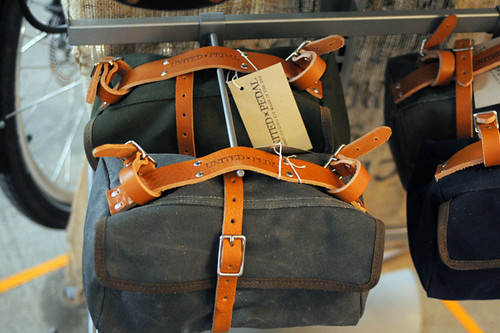
There once was a girl from West Medford
who could trackstand for hours without effort.
And then in one go,
some bags she would sew,
Dill Pickle bags have a cult status around these parts. "Brevet tested, randonneur approved," the bags are made by fabled long distance cyclist Emily O'Brien. Over the years I'd hear snippets of stories about her, told in hushed tones ("Don't you know she did Paris-Brest-Paris on an old fixed gear bike, subsisting on nothing but pickles and chocolate milk?").

Then I met and befriended Emily: the approachable, mischievous creature who I now have the fortune to ride with when she is not off doing things like this. And while everything they say about her is true (well, mostly - her fixed gear bike Archie weighs a mere 30lb, not 60lb as some would tell it!), the popular portrait leaves many things out. For instance, her music career. Her ties to Europe. Her tomato garden, yarn spinning and knitting. Her gloriously warped sense of humor. And, of course, her talent for bicycle-themed limericks. I hope she enjoys the one I composed in her honour (it was tough to find words that rhymed with Medford, but lines ending with Emily or O'Brien proved tougher still, so Medford it was!).


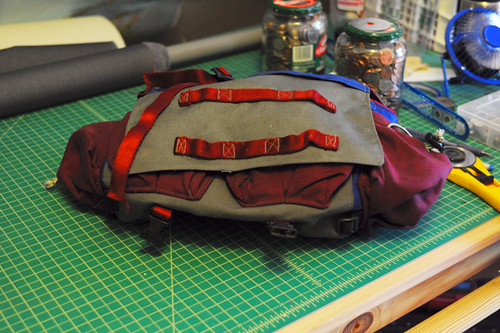
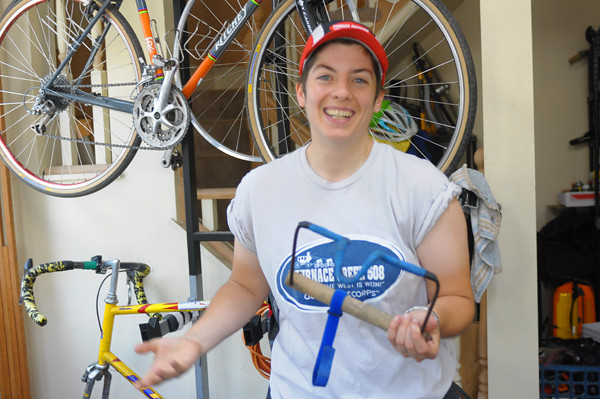
The workshop is in the attic. Two work stations with sewing machines. A table for measuring and cutting. Boxes with cloth and supplies. Rolls of fabric and ribbon everywhere. Patterns and mysterious notes taped to the walls. Iced coffee and popsicles on a hot summer day.

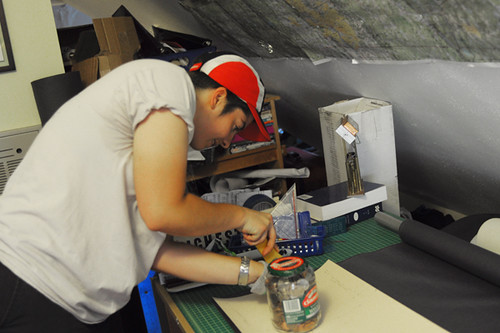
As I photograph, Emily starts to make a bag from scratch to show me her process, chatting easily all the while. She draws then cuts out a pattern. Soon she is at the sewing machine.
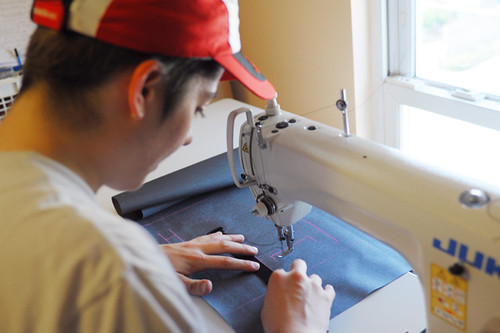
As I watch her fingers dance just millimeters from the needle, I remember the first - or maybe second - time we met up for a ride. Emily was drinking a smoothie as she serenely navigated her way through a busy intersection. I watched this with horror/awe from a bench across the road. I'd arrived early and was sitting there, eating, with all my things strewn across the bench. Upon reaching me Emily hopped onto the sidewalk and remained on her bike - trackstanding, while chatting, drinking her smoothie and gesticulating, both hands off the handlebars - for what must have been at least 5 minutes while I finished eating, refilled my waterbottle, put my gloves and glasses back on and got ready to go. The way she works reminds me of this: the easy multitasking; the amazing coordination. She works quickly and calmly, and she makes it look easy and natural.
For hours, we talk about design. Function vs form. Desire vs experience. Classic vs modern. We discover there are projects we would like to collaborate on. Camera bags! Handlebar bags! Quick-release briefcases! So many ideas.
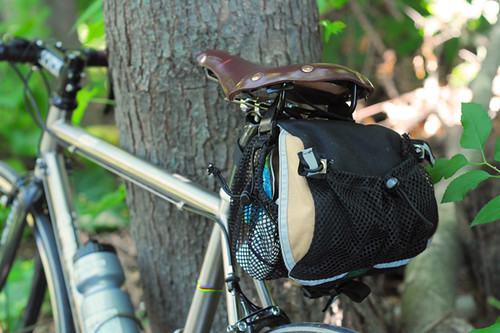

But after riding with the bag for a few weeks, I no longer want to change anything except the colour. The beauty of the small saddlebag, I realise, is that it maximises carrying capacity while minimising the profile and weight of the bag itself. In that sense, it is such a successful design, such a perfect balance of features (and lack thereof) that I cannot think of a single improvement without making the bag worse in some other sense.
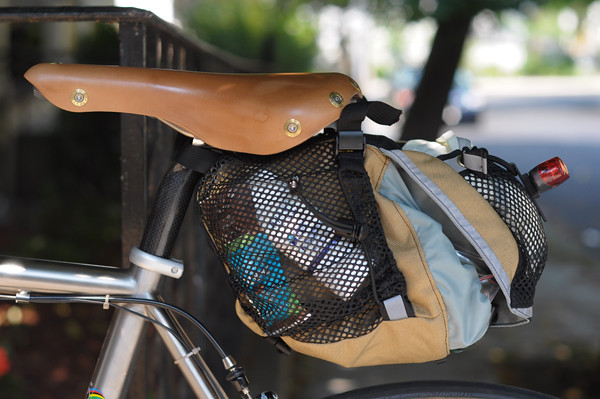
Made of lightweight, durable cordura, the bag cinches and expands while retaining a narrow, under-the-saddle profile. In its most compact form, it the size of a large saddle wedge. In its expanded form, it offers as much storage capacity as many full-sized saddlebags - without the bulk or the width.
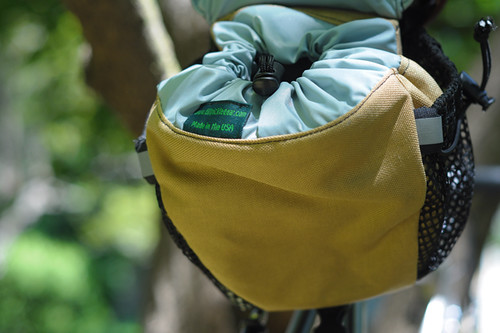
The drawcord allows the bag to expand or cinch as necessary.

Optional reflective loops are designed to carry a mini-pump across the top of the bag. The mesh pockets on the sides and top are optional as well, but the more I used the bag, the more I discovered just how much I liked using them; it was like having extra jersey pockets. Everything that is not water-sensitive can be stored in them, and they are easy to reach into while cycling. On long rides, I found it extremely convenient to stuff the mesh pockets with food: Not only was it easy to access, but the size of my bag diminished over the course of the ride, since the mesh is collapsible and almost weightless.

The bag's closure system is simple, quick, light, and replaceable in case of eventual wear or breakage.
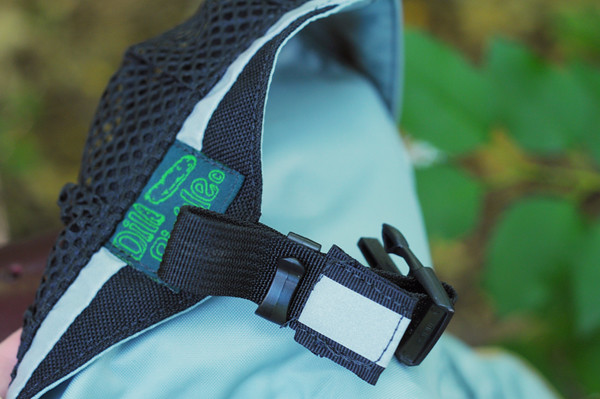
The strap is expandable, with the excess length folded over and held in place by a clip. It took me a bit to learn how to clip back the strap properly, and on my first ride it fell out and drove me nuts rubbing against the rear tire before I realised what it was (what is that sound?). But I did get it eventually.

The attachment system uses cam buckles, making attaching and removing the bag, as well as adjusting its position, very convenient. This is a useful feature for those who take their bag on and off, or switch it from one bike to another frequently, but don't want a permanently installed quick-release system. The bag can be attached either to saddle loops, or to saddle rails - making it compatible with a variety of saddles, including racing saddles.

At the end of my testing period, I had to admit that while the bag was somewhat more contemporary-looking than what I am normally partial to, its design and functionality suited my needs for a compact and easy to remove roadbike bag pretty much perfectly. As it happened, the bag was also just big enough to swallow my DSLR camera. I had been looking for a minimalist single camera carry system for a while, and this seemed like a good candidate. The only problem was padding. I have a 3-compartment camera insert from Zimbale that fits into wide saddlebags the size of the Carradice Barley and the Zimbale 7L bag. So I suggested Emily make a single-camera insert to fit the Dill Pickle Small Saddlebag. As Emily regularly makes padded inserts for musical instruments, this proved to be an easy task.

So now I have my own Dill Pickle bag, which is also the Small Camera Bag prototype. In construction it is more or less identical to the standard Small Saddlebag. For the exterior fabric, I chose olive-green cordura with reflective trim.


Besides, since my bike itself is pretty modern I think the aesthetic is appropriate. The proportions work pretty well, too.

For the waterproof interior fabric and the insert I chose gray, which looks almost sky blue next to the olive cordura.

The removable padded camera insert is made out of 3/8" closed cell foam. The flap tucks in for extra security. The zippered compartments inside the lid and bottom of the bag remain free for basic tools. Alternatively, tools can be kept in the mesh pockets if they do not require waterproofing (or wrapped in a plastic bag if they do).

The insert is shaped to the inside of the bag and will accommodate a range of "prosumer" grade DSLR cameras with small prime lenses. For example, my Nikon D90 with a 35 or 50mm lens fits with room to spare. Basically, this bag accommodates a scenario that I find myself in frequently: I am going on a fast ride and I want my bike to be unencumbered. But I also want to bring a "real" camera and get some nice shots. This setup will allow me to do just that, with minimal hassle. It won't fit an entire photographer's kit with multiple lenses, and it won't fit a huge zoom lens. But I can choose a small prime lens and I'll be able to get some quality shots without attaching more bag than I need to the bike.

One idea we toyed with when discussing the insert prototype was making an extra compartment for batteries, memory cards and the like. In theory the empty space around the lens leaves room for this. But ultimately we decided against it, because we wanted the standard insert to fit as many differently shaped cameras as possible. That said, custom inserts tailored to specific camera and lens combinations can be made as well - as can slightly larger, or differently shaped camera bags. But the beauty of this particular bag, is that it's the standard, compact small Dill Pickle bag made more versatile still with the addition of a removable insert. As I see it, the prototype insert is ready to go as a standard-production accessory.

Dill Pickle bags can come in many shapes, sizes and colours, and Emily is always game for custom orders. Of course as with everything, these bags are not for everyone. If you prefer leather, tweed and brass, there are other manufacturers who are more appropriate. What Dill Pickle bags are known for are their lightweight materials, function-first designs, and aesthetics that are highly customisable within those parameters. There are lots of cordura colours to choose from, as well as trim, ribbon, lining, and closure mechanisms.

The retail prices - starting at $170 for a small saddlebag - are what they have to be, considering the bags are handmade locally. The more affordable mud flaps are a mere $22 a pair. I would try some, but I almost never have fenders on my roadbikes (I know, I know).
What I will be trying soon is a new handlebar bag prototype and a couple of other interesting products. Emily lives in the next town over and our similar work schedules allow us to ride, talk and brainstorm together, which can yield interesting results when both parties are bike-obsessed. Who knows what contraptions lie ahead. For those interested, here are some shots of the Dill Pickle workshop, and more shots of the small saddlebags here.