Showing posts with label gender. Show all posts

Wednesday, September 19, 2012

The Risky Business of Attracting Women

Bikes Belong Poster, Interbike
On my way to Interbike registration yesterday, I walked by the Bikes Belong booth as they were setting up their new poster. I snapped a picture, uploaded it to Twitter, and received a flurry of hilarious reactions - ranging from "Where does she keep her keys?" to "Find Cipo and reshoot the scene!" 

Of course this is a reference to Elly Blue's "Is this thing sexist?" bike test. Modeled after the Bechdel Test for women in movies, the bike test asks: 
1. Are women present or represented at all?
2. Are the women presented as active subjects rather than passive objects?, and
3. If the gender were reversed, would the meaning stay more or less unchanged? (Or would the image become hilarious?)
Showing a woman pedaling a bicycle, the poster passes points 1 and 2. Assessing point 3 is trickier. Of course a poster of an identically dressed male would look ridiculous, but that's taking it too literally. What about a young male dressed in tight-tight cutoff shorts, a plaid shirt flapping open in the breeze, and a pained, sexy expression on his strategically unshaven face? I'd consider that the equivalent, in which case the meaning would indeed remain unchanged. So I say the Bikes Belong poster passes.

Still, images of women cycling in dresses and heels seem prone to rubbing us the wrong way. It is hard to describe what brings about the sense of unease, especially for those of us who actually wear dresses and heels on a bike. Often it boils down to subtle things: A coy facial expression, an unnatural posture, a too-conveniently billowing skirt... Point is, from a marketing perspective, images designed to attract women to cycling seem inherently risky. Too sporty or gender-neutral, and they can be read as "there is no place for femininity on the bike." Too feminine and they can be read as gendered, objectifying, or downright pornographic. The line between attracting women and offending them is blurry. 

Felt, New Roadbike Colours
And while the sphere of roadcycling seems far removed from transportational advocacy, the same basic theme arises - see, for instance, Bike Shop Girl's "The Bike Industry Needs More Women Like Liz Hatch". When speaking to Felt Bicycles later in the day, the question of colour and graphics came up as well. When I commented on the dark violet hue of Felt's new women's road model, the representative explained how difficult it is to develop a colour scheme for women's lines of bikes. On the one hand, there is now a great deal of criticism hurled at anything pink, pastel or flowery. On the other hand, gender-neutral colour schemes don't sell as well. Women want something feminine, but not too feminine. They do not want a caricature of "girl bike," but they do want it distinguished from the men's models. I have heard exactly the same thing from the manufacturers of athletic cycling clothing. There is now almost a stigma to producing a women's jersey with any trace of the colour pink or flowers on it. Yet there is demand for feminine styles. Designers have to get a lot more creative these days in coming up with those styles; hitting just the right note is tricky.

LAB, Interbike
Still, I believe the bicycle industry will keep trying. With women referred to as the "indicator species" for the success of transportational cycling and with the push for more women in cycling as a sport, the pressure is coming from all directions. As both manufacturers and activists struggle to figure out how exactly to market to women, we are likely to see some interesting results in the years to come. 

Thursday, June 28, 2012

Cycling Up an Appetite: Women and Food

When I was in graduate school, a friend was conducting a research study that involved interviewing female students with and without eating disorders. This proved to be more difficult than she anticipated. Of the young women she'd recruited though a randomised process, all but one showed signs of disordered eating: She did not have a sufficient control group. So she dismissed her initial participant pool and tried again, only to get a similar result. Eventually this caused her to change the direction of the investigation: Her inability to recruit a group of university women with no history of eating disorders in itself became the theme of her research.

Looking back at this 10 years later, I don't think that she or I would have qualified for the control group of that study either. While neither anorexic nor bulimic, our eating was not what I would now consider normal. We were hyper-aware of our calorie intake. We knew our precise weights. We paid attention to the times of day we ate. After a meal, we would keep a mental note of the amount of exercise we'd have to do to compensate for it. The truth is, eating at that age for many of us was an inherently conflicted experience, the effect of food on our bodies ever-present in the backs of our minds. We were not fashion models and we were not athletes; we were university students. For most of us, it was not about our looks but about maintaining control in a competitive and stressful environment.

It was also a matter of having lost our natural appetite regulation mechanisms. We counted calories because we genuinely had no idea when we were truly hungry and when we were not. Our hunger and satiation signals were so out of whack with reality that we no longer trusted them. At age 12, feeling hungry simply meant I needed to eat something. But by age 22, this connection had become severed. There was nervous hunger, cravings for comfort food during all the endless studying, emotional eating. Lack of appropriate satiation signals could lead to overeating unless we were vigilant. And so we were, and it made us miserable.

How did this become the norm for so many women? Most likely it began with dieting during our teenage years and spiraled from there. We did not see it as abnormal, because we were neither puking up food nor outright starving ourselves. We were simply "eating healthy," watching our weight, making sure we maintained whatever clothing size we saw as being appropriate for our body types. But in truth we were suffering, and did not know how to put an end to it. In retrospect, I cannot believe how normalised this was in my generation of university women. Most of my female friends, acquaintances and colleagues had these issues and hid them with various degrees of success. Countless male friends have told me that they've never had a girlfriend who was not "weird" about food.

I cannot pinpoint exactly when things began to turn around for me. Possibly it was moving to a large city in my late 20s where I was suddenly doing lots of walking - not for exercise, but as a natural part of living and getting around. But riding a bike was what really accelerated the process of getting my appetite instincts back on track, so the connection is a strong one for me. Experiencing my body as a useful machine and not just as a bothersome appendage to my brain was what really did it. Through cycling I began to think of food as fuel. If I wanted to ride, I had to eat. And at age 30, for the first time in what must have been 15 years, I was once again able to eat when hungry and stop when full, just like I did when I was a child.

Since I began writing this blog, I have spoken with many, many women cyclists who describe similar experiences. Regaining trust in their hunger and satiation instincts for the first time since their pre-teens has been a gift more dear than they can express. And while cycling is not the only way to achieve this, it is certainly a great way, both fun and practical. Here's to all the women out there, cycling up an appetite.

Monday, January 2, 2012

Overthinking the Pink

Morning Light
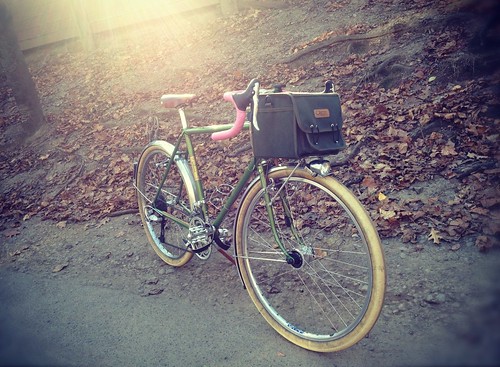
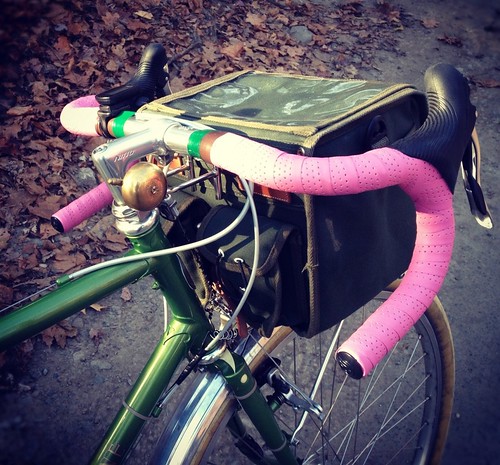
A couple of weeks ago I got the inexplicable urge to redo the handlebars on my Rivendell with pink bar tape. I don't know. One day I was looking at the bike and suddenly felt that the earthtone and twine thing was getting kind of oppressive. The bike wanted to break free. With the streets growing more dreary with each passing day, a burst of colour was sure to break up the monotony. And that it certainly has: Now I feel as if I am riding a bike made of watermelon, or an enormous piece of tourmaline. It's nice and cheerful.

Of course, unlike other cheerful colours, pink is somewhat charged with meaning because of its associations with stereotyped femininity. So I was not entirely surprised to receive an email from a reader eager to discuss my new handlebar tape. She was disappointed that, while my choice in bicycle colours and accessories had hitherto been "the antithesis of girly," now here I was reinforcing the industry stereotype of women wanting pink on their bikes.

Watermelon Bike
Heavy stuff. And as usual I find myself disagreeing and agreeing all at the same time. On the one hand, there is Elly Blue's post about "reclaiming pink." There is also the fact that originally, pink was considered to be a colour for boys. Finally, there is the Maglia Rosa of the Giro d'Italia - shouldn't that association trump the girly one?

On the other hand, I've heard too many women express frustration at the fact that the bicycle industry slaps pink colour schemes and floral motifs on everything that is designed for female cyclists ("shrink it and pink it") - from bike frames, to panniers, to cycling jerseys. I too find this annoying. But having thought about it for a couple of years, I suspect the real frustration here is that women-specific bicycles and products are oftentimes worse in quality than those designed for men. So the pink and flowery stuff, in combination with the inferior quality, is seen as a slap in the face: "Our marketing team believes you care about pretty colours and flowers more than you do about substance, so that is what we are selling you." 

Watermelon Bike
Ultimately, I think that pink is a more versatile colour than we give it credit for, particularly in the context of cycling. It is really all about presentation. I will probably not keep the pink bar tape on this bike in the long run, simply because it overshadows the elaborate lugwork that really deserves the starring role here. But for now I quite like it, stereotyped or not.

What comes to mind when you think of pink bicycles or bike related products - Giro or girly? or something else entirely?

Wednesday, November 30, 2011

Discussing Our Bodies in Mixed Company

Women Wheelers!
image via kaputniq

Yesterday I came across a series of delightfully entertaining illustrations by kaputniq, modeled after a Victorian instruction manual for lady cyclists. "Women Wheelers! Don't say 'Feel my muscle,'" warns one. "Don't ask 'Do you like my bloomers?'" admonishes another. While things have changed since Victorian times, in some ways maybe not so much. When I wrote a post on female saddle discomfort some time ago, I received comments and emails from male readers indicating that they were made uncomfortable by the topic. To a lesser extent, the same happened when I brought up the subject of bras in a recent post, and likewise whenever I mention my leg muscles or (heaven forbid) butt in the context of cycling.

During the time I have spent around those who ride bikes, I have observed that male cyclists are not shy about discussing their bodies - be it in real life (conversations that take place in bike shops and at various cyclist gatherings) or on the internet (discussions in forums and blog comments). Thanks to this, I know all about their "taint" and their infertility worries, and how they have to move stuff out of the way when dismounting a bike with a tall top tube, and so on. No big deal. It's a good thing that men feel free to share such things. 

However, female cyclists are unlikely to discuss their bodies in a similar manner, except in the vaguest of terms. Until very recently there was virtually no public internet dialogue about female-specific bicycle discomfort, and I rarely hear any such talk out loud. I don't think I'd be out of line in saying that it is still considered inappropriate in our society for women to be "immodest" - which is how discussing our bodies in mixed company is perceived. If a female mentions her toned legs, let alone her private parts, even in the context of cycling it can easily be interpreted as flirtatious or sexually provocative - whereas if a man does the same it is interpreted as merely clinical.

Despite the double standard, it is clear that female cyclists want to discuss these topics - and to do so using concrete terminology instead of polite abstractions. There is a growing feeling that information is unavailable to us because of our own embarrassment to share that information with each other, supplemented by a palpable male discomfort (or excitement - which is more intimidating?) when we do share it. While I am not the right candidate to spearhead a revolution in this regard, I am relieved to see that there is one underway. From the frank discussion of yeast infections on bikeskirt, to Elly Blue's article on menstruation in Grist, to an entire compilation of female writings about their bodies and cycling coming out in zine format (Our Bodies, Our bikes - order your copy here) it's as if a floodgate has opened, so to speak - mixed company be damned. Let's hope the trend continues. It should not be any less socially acceptable for female cyclists to discuss their bodies than it is for male cyclists.

Monday, June 20, 2011

Vehicles of Equality

[image via cnn]

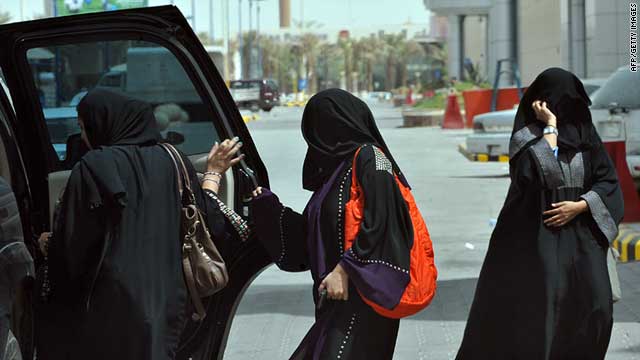
Last week many of us were following the #women2drive campaign in Saudi Arabia - a move organised via social media, where about 40 Saudi women drove cars in protest of their country's ban on female drivers. Saudi Arabia is the only country where it is currently prohibited for a woman to drive. The ban has become a symbol of gender inequality, while driving has become a symbol of freedom and women's liberation. It is unclear as of yet what effect the protest will have on Saudi policy toward women drivers. Meanwhile I've received an email from a cycling activist, asking whether I thought bicycles would at any point be incorporated into the movement.

[image via wn]

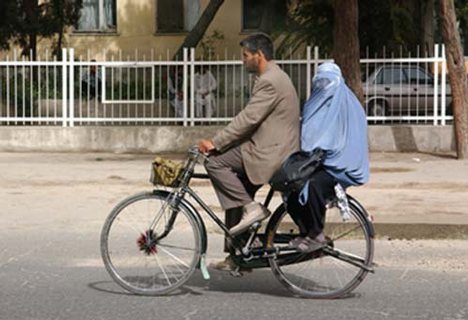
To clarify, women in Saudi Arabia are not permitted to cycle just as they're not permitted to drive. That is, they are allowed to be passengers on a bicycle, but not operators. The point of the ban is to prevent women from going off on their own, and so it applies to any vehicle that facilitates travel. However, I doubt that Saudi women will be getting on bicycles and staging a #women2ride movement any time soon. While in some cultures there is now a trend to associate cycling will freedom (freedom from dependence on fuel, from being stuck in traffic, from having to find parking, from hour-long commutes, from financial strain, etc.), the bicycle does not symbolise any of those things in Saudi Arabia. Neither does it symbolise travel, in the contemporary sense: A car can travel further and more efficiently if fuel is not an issue. In order for a group to protest not being able to engage in an activity, that activity has to be perceived as desirable. And I just don't think cycling has that status in Saudi Arabia.

[image via rfe/rl]

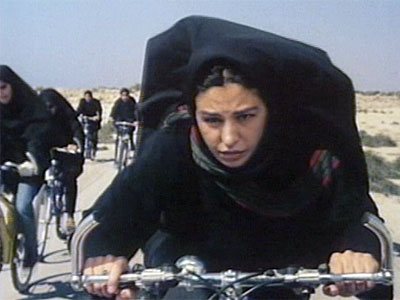
There are other issues to consider as well. Operating a bicycle is deemed "too sexy" by some government and religious figures in conservative Middle Eastern countries. In Iran there is technically no travel ban in effect for women, but the Iranian Women's Cycling Team was stopped by the police while training last October and told that the activity is not permitted in public, as it is too provocative.

There is also the question of safety. Driving in protest is safer than cycling in protest, as on a bicycle a person is more vulnerable to recognition, apprehension, and potential attack.

[image via bikehugger]

While in Western cultures the bicycle became a symbol of gender equality in the Edwardian era, I don't think that this can be applied to today's situation in countries where basic women's rights are being debated - particularly in the Middle East. The circumstances are too different. Should cycling activists feel threatened by the #women2drive initiative? I think that would be highly misguided. But the question of how to make bicycling more accessible to women in this region is worth considering.

Tuesday, March 8, 2011

On Bicycles, Women and Politics

[image via Mattijn]

Today is the 100th anniversary of International Women's Day - what began as a European political movement in 1911, but evolved into what is now more like a "women's appreciation day," or, in the former socialist countries, a sort of Mother's Day and Valentine's day rolled into one. As ironic gestures, friends have sent me cards with messages such as "Woman, With Your Daily Acts of Goodness You Inspire Us!" showing a Polyanna-esque maiden feeding forest animals amidst flower blossoms.

[image via I am Cheapskate]

Though I am fairly well versed on gender in the academic sense,  I did not personally care much about gender "issues" until I became interested in bicycles and cycling. Something about the latter turned the former into a more poignant topic, and I find myself writing about gender-oriented themes here that would not have been on my mind a few years ago. I feel vaguely unsettled about the way female cyclists are perceived and depicted by the very cycling community they belong to. I get the same feeling of unease from the pictures on Copenhagen Cycle Chic as I do from that Woman's Day card showing the angelic girl feeding forest animals.

[image via Julie Tjorneland]

Equally distasteful to me is the school of thought that women cyclists "bring it upon themselves" by being all sexy and frivolous on their bikes wearing skirts and high heels. If they want to be taken seriously as cyclists, they must don practical shoes and high-vis wear. It's been decades since similar rhetoric about women has been acceptable in Western society. But apparently the cycling community is an exception.

[image via R A C]

Besides, don't roadies and tri-athletes wear far more revealing clothing than women going grocery shopping in a dress and heels? At the heart of it, it's really all about how one chooses to twist it politically, which in turn is based on personal preferences and prejudices.

[image via macfred64]

And what is the difference between politics and personal philosophies? Let's Go Ride a Bike has a post today where they ask "Is bicycling political?" - which I think is more or less a trick question: a contemporary truism, whereby any "no" answer will inevitably be demonstrated to be just as political as a "yes" answer. It reminds me of the arguments I had in college with people who would tell me that being a woman is political, whether I wanted it to be or not. According to those arguments, everything I do is inherently political because I am a woman, and I have no way of escaping that. But don't I?

I think that in order for the political question to be addressed meaningfully, we have to distinguish the way others perceive us from our inner world - and while the two are connected, they are not one and the same. Any action on our part, as well as our very existence, can be perceived as political by others. But if we don't experience it politically, then it is a basic human right for our inner experience to be recognised as valid. A woman's cycling and her gender may be politically perceived by others, but they may not be politically experienced by her - with both points of view having equal merit.

Tuesday, February 1, 2011

The 'Lady's Bicycle': Descriptive, Offensive, or Merely Obsolete?

[an unsuccessful attempt at parody]

There has been some discussion lately about how appropriate it is to refer to diamond and step-through frame bicycles as men's and ladies' bikes. After all - gender roles are flexible these days, women are no longer expected to wear elaborate skirts, and a low standover height can be convenient for everyone. So why use gender specific terminology? Am I just intentionally being quaint?

Well, not exactly. You see, when a bicycle model exists in both diamond frame and step-through designs, the latter is usually not just about lowering the standover height. It is also about taking the female anatomy into account. For example, have a look at the pictures below and see whether you notice anything interesting.

[image via Gazelle USA]

These are the Oma and Opa versions of the current production Gazelle Toer Populair bicycles. If you look closely, you will notice that the Oma on the left has a considerably higher headtube than the Opa on the right. This is done in order to set the Oma's handlebars higher, so as to accommodate the typically shorter torsos and arms of female cyclists. The bikes are named "Grandma and Grandpa," because they are, in fact, gender-specific. The expanded headtube tactic is used by many manufacturers on their step-through models, while others use the alternative tactic of shortening the virtual top tube. Either way, more often than not the step-through version of a given bicycle model is designed for the female body. This is not to say that men cannot or should not ride step through frames, but only that step-through frames are typically optimised for female proportions.

Of course, one could ask: Why confound gender-based anatomical differences with preferences for standover height? After all, some women may prefer diamond frames, while some men may prefer step-throughs. That is where statistics and market research come in. Most manufacturers cannot afford to make two versions of diamond frames and two versions of step-through frames within the same model. And statistically, women are considerably more likely to wear skirts and are thus more likely to prefer a step-through transportation bike. Therefore, it makes more sense to optimise the step-through design for the female anatomy, while optimising the diamond frame design for the male anatomy. Naturally, there will be some females who prefer the diamond frame and some males who prefer the step-through. Furthermore, not every woman has a short torso and not every man has a long torso. But when it comes to manufacturing decisions, it's all about tendencies and probabilities - not about individuals.

And speaking of statistics, perhaps we could indulge in another poll (a weekly tradition?). No purpose for this other than my own curiosity, and possibly yours:


In my own vocabulary, I use terms like "lady's bike" or "woman's frame" when I am referring specifically to the bicycle's suitability for females - be it anatomically, or in terms of their ability to accommodate skirts. On the other hand, I use terms such as "step through," "loop frame," and "mixte," when I am describing frame geometry. And while some worry that referring to bicycles as "women's bikes" makes them seem inferior or less valuable, I am not on board with that line of thinking. After all, what is considered "standard" frame geometry in the industry, is in fact optimised for the male anatomy. We are female, we are wonderful, and we need bicycles designed for us. To me, that is neither offensive nor obsolete - it's just common sense.

Monday, January 10, 2011

The Mary Poppins Effect?

Lately, there has been some discussion in the comments about whether drivers display more courtesy when cyclists ride upright bicycles and dress in "regular" clothing. One reader wrote that "the uprightness [is] more visible and [the clothing] maybe less offensive to your average driver... The images generated revolve around Mary Poppins. Only a monster would do anything mean to Mary Poppins" (Christopher Fotos, December 10, 2010). Do you agree?

When Bike Snob NYC poked fun at the Tweed Ride last week in his typically colourful manner, I was laughing my head off about the associations with colonialism and Civil War re-enactments: I never found Tweed Rides appealing for precisely those reasons. But I disagree with his conclusion that nice clothes on a bike are generally "not traffic calming." It's one thing to be dressed in what appears to be period costume, joined by dozens of others who have done the same while taking a joyride through the city. It's another thing entirely to be cycling to work in a suit and a wool overcoat, because that is what you normally wear to work.

Speaking solely from my own experience, I'd noticed as soon as I started cycling for transportation that drivers are nicer to me when I dress "normally." And since having begun to ride a roadbike recreationally, the difference between how I am treated on the roads when on a bike with drop bars, wearing "sporty clothing" and my hair tucked away, in comparison to how I am treated when on an upright bike in "city clothing," with my work bag in the basket and my hair visible, is notable. The majority of the time, when a driver is rude to me or impatient with me, I am on my roadbike - which is odd, since I am faster on a roadbike than I am on an upright bike, and thus should be less "in the way."  To me, this just confirms that drivers' perceptions of how annoying a cyclist is, are entirely subjective. You can be going 10mph and somehow this might be okay, or you can be going 25mph and they might still be annoyed.

In part, I think the idea of not wanting to harm Mary Poppins is valid - in the sense that a cyclist dressed "normally" looks more human to the driver. The way people process each other visually and emotionally is governed by a complicated system of simulation and self-recognition (this is actually my research specialty, so I've spent a lot of time thinking about it!). And from that point of view, it makes sense to speculate that the more "I am human! I am you!" signals we give off when cycling, the more empathy a driver will feel towards us. Dehumanisation, on the other hand, makes it easier to cause harm to another human being - because we fail to simulate their emotional state and relate to their suffering. And dehumanisation is facilitated by things like uniforms (one reason it is easier to kill soldiers and war prisoners, than civilians), or anything else that obscures individuality and hides signs of "humanness".

But in addition to the Mary Poppins effect, I think that there are also implicit "right of way" rules that are present in the driver's mentality, from which "normally" dressed cyclists benefit. I am not suggesting that this is right or justified in any way, but I get the impression that drivers are enraged by the associations with leisure and recreation that a road cyclist's attire evokes. The cyclist is on the road because they are "going for a ride." The driver, however, is on the road because they "need to be somewhere." So the reasoning follows, that the person who needs to be somewhere clearly has more valid reasons to use the limited road space than the person who is going for a ride, which is why the presence of the road cyclist causes annoyance. On the other hand, when the cyclist's appearance suggests that they are also engaging in transportation and "need to be somewhere" just like the driver, their presence on the roads seems more justified. This is just a theory, but the fact that drivers will shout things like "Get a job!" to roadies, but will ask me "How long does it take you to get to work?" at red lights when I am dressed up, gives it some plausibility. They associate the "normal clothes" look with going to work, and they associate the sporty look with recreation.

All of this is, of course, entirely speculative and none of it is to say that cyclists should strive to dress in any particular way in order to secure the driver's compassion. Only the certainty of criminal prosecution can reliably deter a driver from causing harm to a cyclist, and I hope to see that become the norm in the US in the near future. Until then, let's hope that drivers can find a way to see Mary Poppins in all of us, whether we are dressed in lycra, tweed, or something in between.

Wednesday, December 15, 2010

User Friendly Interface

Now that it's winter, I find that strangers talk to me more than usual about cycling - typically when they see me locking up my bike. Over the past couple of weeks, several women have told me that they'd love to ride a bike, but find the logistics daunting: having to buy lights and figure out how to mount them; constantly getting flats (something they remember from previous cycling experiences); having to figure out how to carry their handbag, struggling to mount the bike in business attire, and other similar concerns. Their misgivings are fueled by the perception that cycling will complicate their lives - compared to walking, or taking public transportation, or driving.

What frustrates me about this, is that all of their concerns can be addressed with the right bike. As I explain about step-through frames, dynamo lighting, tires with puncture-protection, dress guards, chain cases, and panniers that attach to the bicycle's rack in seconds, I can see the ladies' faces light up as they eye these features hungrily.

One woman tried to step through my frame in her skirt-suit and squealed with delight when she was able to do it. She had never tried anything other than a mountainbike before. She said: "I knew you had a special type of bike! It's got this... user-friendly interface!" That phrase echoed in my mind for some time.

Even though I enjoy learning about bicycle design and own multiple bikes on which I constantly experiment, I am first and foremost a "transportation cyclist." My main priority is to have that one bike that is reliable, comfortable, and as low-maintenance as possible. The bicycle I use for transportation needs to make life easy for me. It needs to minimise the extent to which I think about it and tinker with it - so that I can focus on work and life itself, not on the bicycle.  Skirt suit? Heavy bag?  Dark outside? Raining like crazy? The "user friendly interface" on my machine accommodates all of these scenarios.

Many manufacturers are making what they are calling "transportation bicycles" nowadays, but not all of these bikes work for everyone. When a woman wearing a skirt suit walks into a bike store and says she would like to start cycling to work, my hope is that the salesperson will point to the section with the right kind of bicycle for her - rather than saying "Well, you won't be able to do it wearing that!" A user-friendly interface means that we should all be able to do it. Holiday wish: more elegant, practical, comfortable bicycle options for the women in skirt-suits who feel out of place in bike shops. It's getting better, but we aren't there yet.

Monday, December 6, 2010

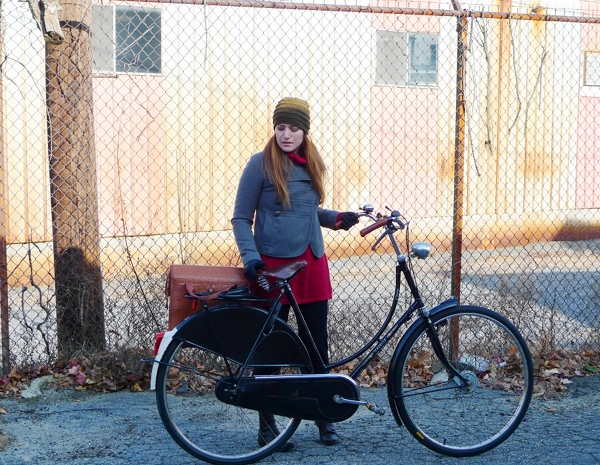
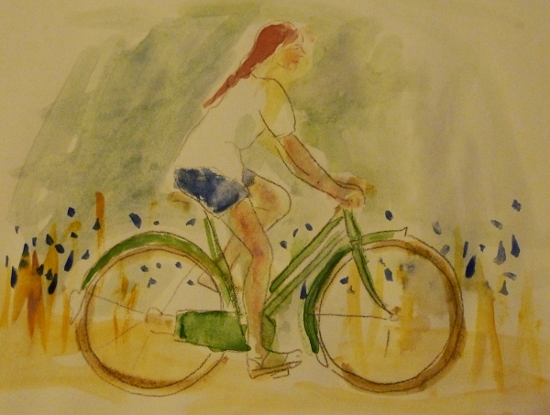
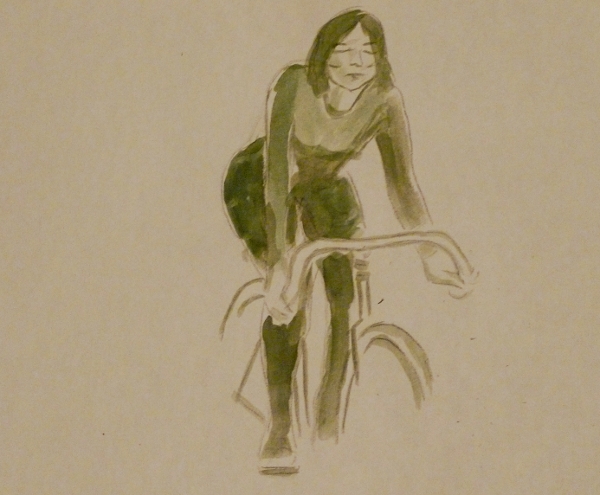
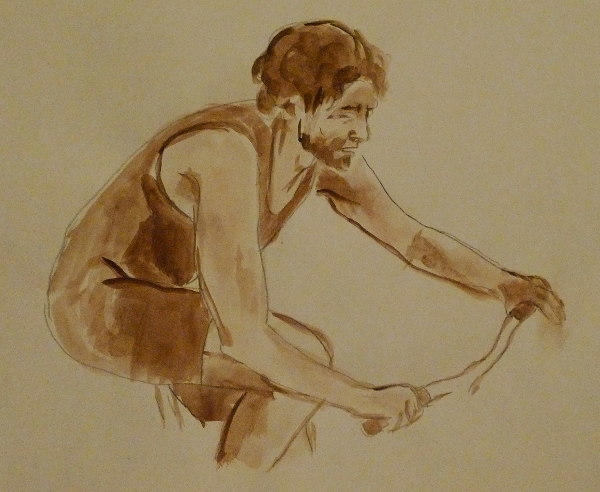
Bicycles and the Human Figure: Do We Look Better on a Bike?

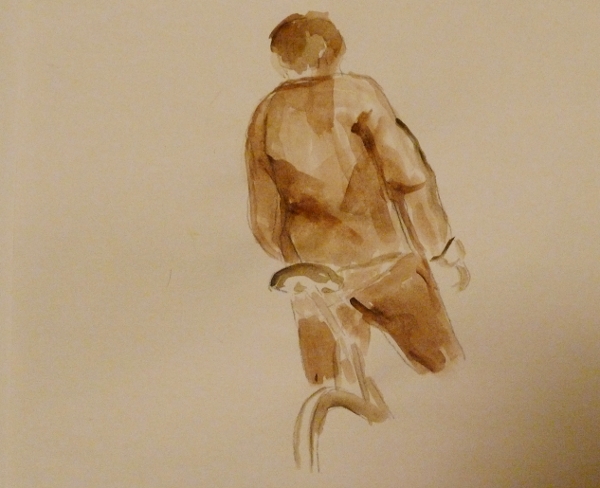
I have never drawn or painted bicycles before, but am now starting a commissioned painting that will include two female cyclists - so I've been making figure drawings and sketches of people on bikes. It has been interesting to study the postures our bodies adapt while cycling - and especially interesting to note the inherent attractiveness of those postures. 

When it comes to the female figure, our positioning on a bicycle tends to really accentuate the waist-to-hip ratio - which, according to evolutionary psychology, is the greatest implicit indicator of "femaleness" to the male.

Cycling also tends to make the legs look longer and leaner - another evolutionary measure of attractiveness, for both genders (researchers believe that long legs may have been indicators of hereditary longevity).

When we cycle, the muscle tone in our arms and legs is accentuated - a general sign of health. In males, this can also serve to suggest strength - which, according to evolutionary psychology once again, females are pre-disposed to respond to.

Finally, being on a bicycle raises the figure higher off the ground, literally making the cyclist seem taller - another advantage for males. The added height also makes the cyclist more noticeable, regardless of gender - placing their body on a moving pedestal of sorts.

Of course, these things aren't simple formulas and there are many factors to consider in addition to the evolutionarily built-in heterosexual responses to each other's bodies. But generally speaking, there is a great deal of evidence that our postures and body language implicitly communicate sexual appeal and social roles to others. Maybe "you look better on a bike" is not just a catch phrase!

One thing my cycling sketches have taught me, is that drawing the human figure on a bicycle is not easy -  which makes it especially admirable that Mr. Rick Smith is able to do it nearly every single day with his comic Yehuda Moon and the Kickstand Cyclery!

As you may have heard, the folks at the Kickstand are having a Virtual Alleycat Race, powered by cycllelicious. If you are taking part, then you have arrived at the Lovely Bicycle checkpoint. You are probably looking for the link to the next checkpoint, but hang on - you're not getting it yet!

Here is what to do:

1. To qualify for the Best Checkpoint Comment Prize, please leave a comment on this post with your name and registration number. The comment must be left between 10am Eastern Standard Time on December 6, 2010 and the same time on December 13, 2010.

2. Lovely Bicycle is having its own mini-contest as part of the Alleycat, and the winner will receive a Mystery Prize. What the mystery prize is I cannot tell you, but if you like bicycles and art you might enjoy it. To take part, tell me what you like best about the way you - or others - look on a bicycle (this does not have to be physical - be as creative or abstract as you like). Please include your name and race number, so that I can identify you! The most compelling comment will receive the Lovely Bicycle Mystery Prize. Only Alleycat racers are eligible for this contest.

3. You would like the link to the next checkpoint now, yes? You shall have it just as soon as you answer a few questions [link disabled - the Alleycat is over, thank you for taking part!].

If you haven't registered for the 2010 Kickstand Cyclery Virtual Alleycat Race yet, register here now!

Saturday, November 27, 2010

Musings on MUSA Knickers

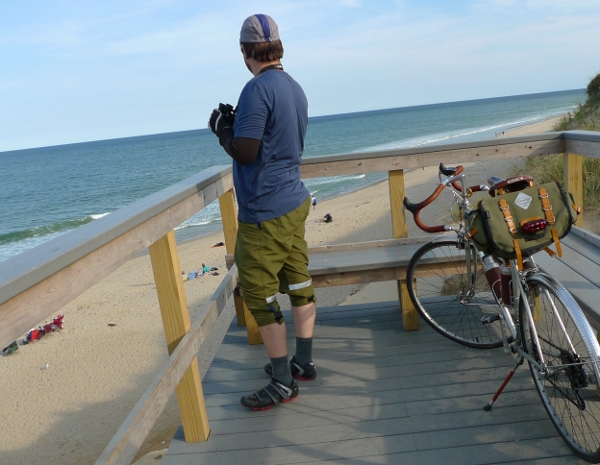
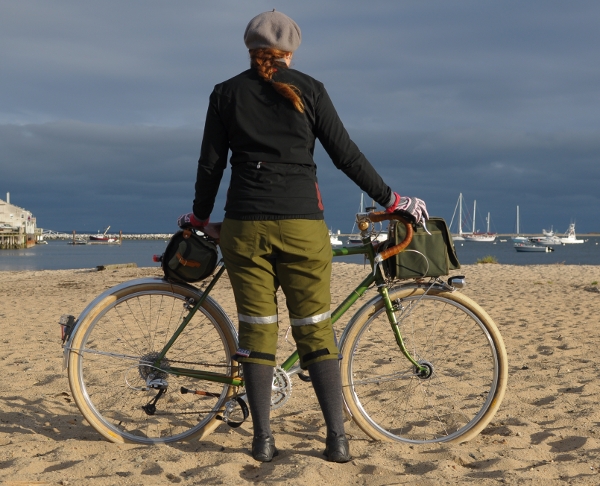
Musa is a Rivendell  house brand that stands for "made in USA." Under this label, Rivendell produces a line of clothing and accessories, including the knickers and pants that are designed specifically for cycling, but are described as being wearable "anywhere when formal wear isn't called for." The Co-Habitant ordered both the knickers and the long pants over the summer, because he was wearing out all his regular pants on long rides, and he thought these would be more durable. He immediately loved them and kept recommending them to me - until I finally bought a pair of knickers myself a couple of months later. Our impressions of this product are somewhat different, and put together they will hopefully be informative for both genders.

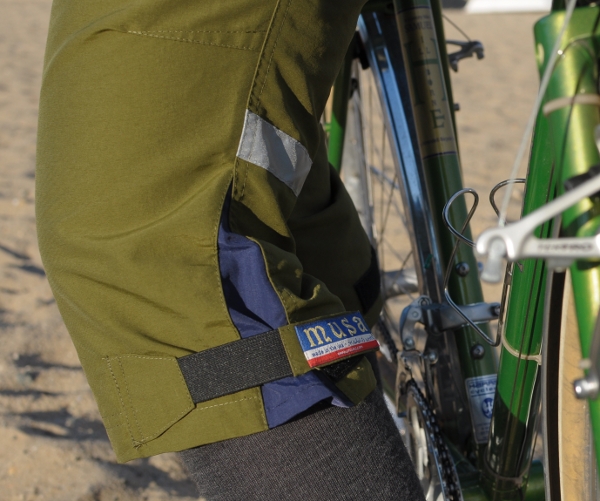
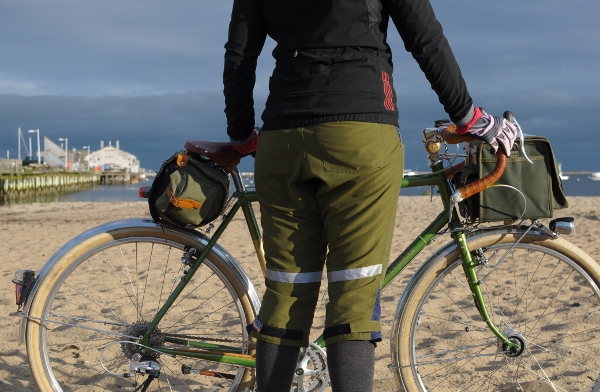
Made of lightweight, breathable, and durable nylon, the Musa knickers work well for cycling, because they feature a roomy gusset in the crotch area, adjustable-width cuffs with velcro straps, and reflective strips.

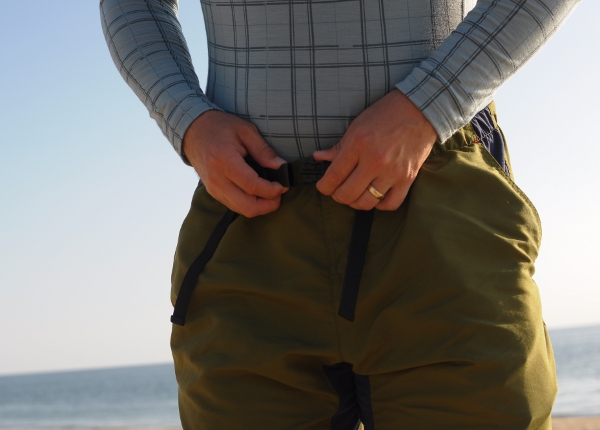
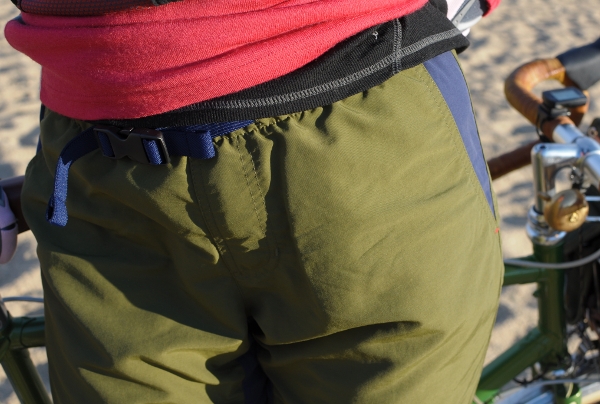
The adjustable waist closes via one of those nylon belts and plastic buckles you see on hiking pants.

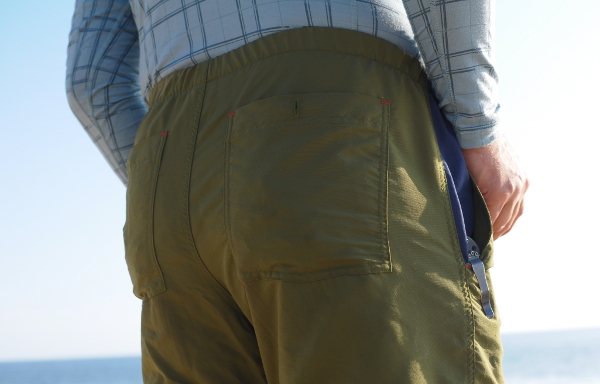
The pockets are deep and cut in a way that stuff doesn't spill out of them while cycling - a useful feature for those who like to keep small items on their person while on the bike.

The Co-Habitant normally wears pants with a 34" waist, and the XL Musas fit him well. They are relaxed, but with a tailored look to them. The cut is flattering to the male body.

The pants and knickers are currently available in olive, gray, black and blue. The Co-Habitant has the olive knickers (pictured) and the gray long pants. The knickers he wore mostly over the Summer and early Fall; the pants he continues to wear now, including off the bike. His feedback is that his Musas are extremely comfortable and useful. Not only does the seamless gusset protect from chafing during long trips, but the pants regulate temperature well in both hot and cold weather, and are a lot more durable than the trousers he wears off the bike (one problem with cycling long distance in regular clothing, is that the clothing can get ruined from rubbing against the saddle and from sweat). For those men who do not want to wear tight, padded cycling shorts, but want something cycling-specific that looks decent off the bike, these are a good option. I do not quite agree with Rivendell's description of them looking like "normal" pants. They are definitely quirky. But I find this particular quirkiness attractive.

Moving on to my own experience with the Musa knickers (and in case you are wondering - no, we do not wear them at the same time!), my main reason for buying them was the gusset. I cannot ride a roadbike for more than 20 minutes while wearing anything with seams along the crotch, and finding pants without seams in that region is not easy. So seeing how happy the Co-Habitant was with his Musas, I finally ordered a pair for myself. Rivendell describes these knickers as unisex and has a size chart for women. Going by the waist measurements on the chart, I initially ordered an XS. However, I could not pull them on over my hips, so I exchanged them for a Small. The Small went on over my hips fine, but fit me overly loosely petty much everywhere else.

Sometimes a loose fit can be flattering, but with the Musa knickers luck was not on my side. The sagginess in the butt distorts the shape of my body in a way that just doesn't look good, and extra material bunches up around my inner thighs.

The knickers are also overly loose in the front. It is as if the fabric won't lie against my body right - bunching up in all the wrong places. This leads me to conclude that the pants were simply not tailored with a female waist-to-hip ratio in mind. While I am not the curviest woman in the world, I do have a narrow waist and comparatively wide hips - a combination that makes it difficult to get the sizing right.

But fit and sizing issues aside, the Musa knickers do have a number of features I find useful. The gusset is huge and there is not a single seam between me and any part of the saddle, which is excellent. The nylon material really is very light and breathable, as well as wind-resistant, mildly water resistant and fast-drying. The fabric does not pill or degrade after prolonged contact with the saddle  - and having worn through several pairs of leggings and shorts over the past year, such durability is welcome. The pockets are staggeringly deep - though the feature is wasted on me, as I prefer to cycle without too much stuff in my pockets. The expandable width cuffs with velcro closure are clever, if a bit finicky (I had to redo mine a few times to get them to feel right). As other owners of these have noted, the pants were shiny and slippery in the beginning, but this went away after a few long rides.
All in all, the Musa pants and knickers are excellent if you want to wear something comfortable and durable on a roadbike, and if you are male. If you are female, consider the issues with fit and compare how the pants look on a male vs a female body. For me, the gusset and other positive features are worth it - but only because I found no better alternatives. And I would never wear these knickers in a context other than on a roadbike, which does diminish the value of what was meant to be a "wear them anywhere" design.

Thursday, October 14, 2010

Do Women Want Custom Bicycles?

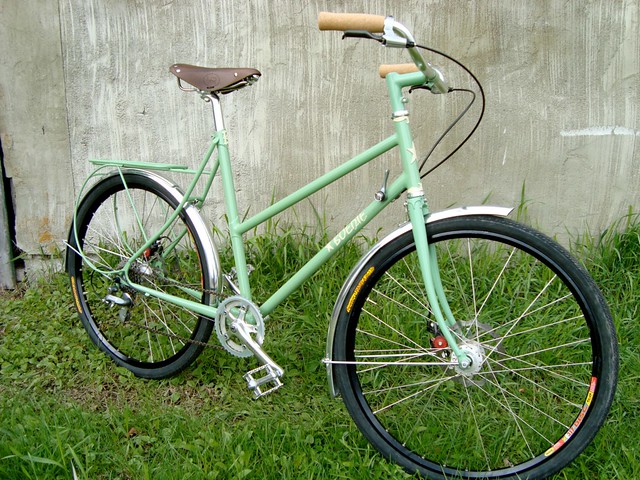
Not surprisingly, my beautiful mixte by Royal H. Cycles has been making quite a splash. People ask about the bicycle, and when I say that it was custom built the reactions are interesting. Several men (including framebuilders) have asked whether it was a gift from my husband or boyfriend - meaning, whether he was the one who ordered the frame for me, interacted with the builder, etc. Others have asked whether the framebuilder is my boyfriend. And others still have noted the amazing amount of detail for a women's frame and asked whether it was built as a NAHBS bike (show bike) - which is mostly where one would see such a mixte. When I explain that I was the one who ordered the frame, thought up the criteria for it, specified the design features, etc., all without a male intermediary, this is met with amazement. And having thought about it, I doubt this has anything to do with sexism. Rather, I think it is about statistics: According to the framebuilders I have talked with, women do not typically take the initiative to order custom hand-built bicycle frames. The more common scenario, is that a male framebuilder builds the bicycle for his female significant other, or a male bicycle lover orders it for his spouse. 

[image via mapcycles]

Thinking about that has made me wonder how women feel about handbuilt bicycles. Do they want them? Or do they perceive the process as either too daunting, or not worth the money or time it takes? 

[image via JP Weigle]

At NAHBS and other handmade bicycle shows, mixtes and step throughs have become increasingly popular over the past several years. One might even say that it is now almost de rigueur for classic framebuilders to include a mixte in their portfolio. Does this not mean that there has been an increase in demand for ladies' bikes? 

[image via Boedie Cycles]

To an extent, I am sure there has been some increase in demand (and here again we must differentiate between women ordering the bicycles versus their spouses ordering for them). But for the most part, I believe the appearance of women's bicycles at handbuilt shows is mainly symbolic - reflecting the increasing number of women cycling for transportation in American cities. 

[image via YiPsan Bicycles]

Additionally, a mixte frame is more challenging to build than a diamond frame. It involves more elaborate brazing and lugwork - giving the framebuilder the opportunity to truly show off the extent of their skills. When done right, a mixte can embody elegant design at its most stunning. 
[image via antbike]

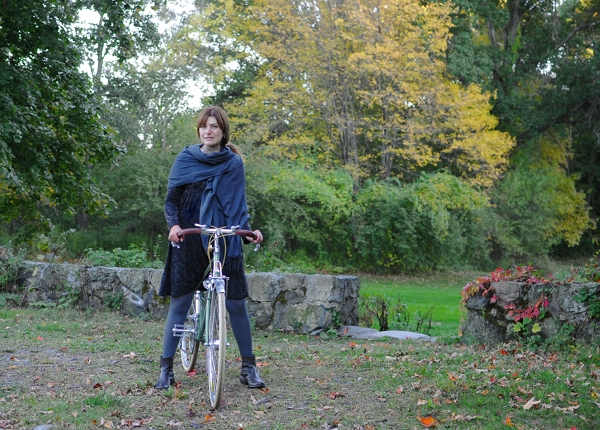
So what about the ladies? Do they ever call up a framebuilder and order a bike for themselves? I am not saying that it never happens, and a few builders in particular (ANT, for example) seem to attract female customers. There is also the "lady framebuilder" Sweetpea, which caters specifically to women. But overall, it isn't typical. If you browse framebuilders' websites and flickr accounts that include narratives about recently made bicycles, you are more likely to find descriptions such as "this mixte was commissioned by Joe for his lovely wife Mary" than "this mixte was commissioned by Mary". Will this change as the number of female cyclists grows? I hope so! It would be fun to argue with another female about seat tube angles and lugwork. 

Monday, June 28, 2010

Do We Care If They See Our Underwear?

[image via velo-mama]

Ah, the topic of underpant visibility whilst cycling in a skirt! It is truly one of which we lady cyclists never seem to tire. Some enthusiastically discuss methods of tying down the skirt so as to curb its treacherous revelations. Others advocate wearing leggings. But as I cycled to various meetings in different parts of Vienna today in insane mid-day heat, I suddenly simply did not care. And neither, I noticed, did any of the Viennese ladies on bicycles around me. And, more importantly still, neither did the men.
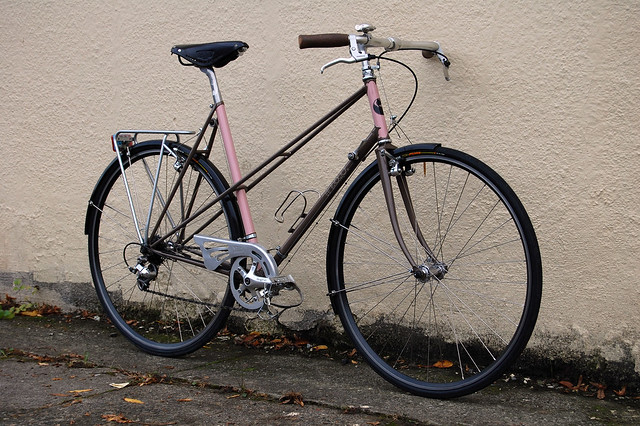
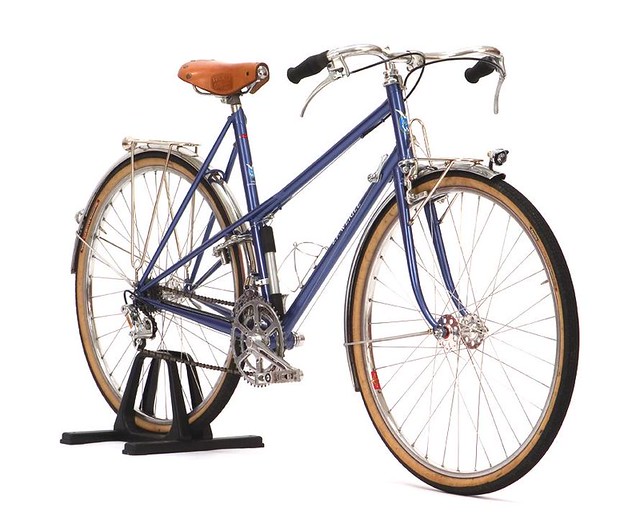
[image via eva-lu]

Noticing this made me think about why it is that we tend to be so concerned about whether our underpants are showing as we cycle. Is it a personal sense of modesty? Or is it because of how men look at us? For me, I have to say it is the latter. In the US, if I am not wearing leggings under a skirt while cycling, it is almost inevitable that a man will shout something at me or meaningfully look at me in a way that I find unpleasant. That is why I wear leggings, and not because I am inherently ashamed to show my underwear. Despite the theoretical progress in gender relations, I think it is unsafe to evoke a curiosity about my anatomy in strange men.

By comparison, in Vienna the men don't seem too interested in examining women cycling in skirts. Perhaps it is a deep-rooted cultural difference when it comes to gender relations, or perhaps it has something to do with the fact that there is a nudist beach just down the river. Whatever the reason, it is a welcome relief. If they don't care, then honestly - I don't either. If only that sense of liberation were enough to deal with this horrible heatwave!

Sunday, May 16, 2010

'So My Husband Wants Me to Get a Bike...'

Since the start of the Spring season, I have been getting emails from women that read something like this:
My husband/boyfriend is a cyclist and he wants me to get a bike so that we can ride together. I am not very good at cycling, or sports in general. What bike do you recommend? My husband/boyfriend sent me a link to your blog and said that you would know.
Nice. Notice that the phrasing is not "I would like to get a bicycle so that I can accompany my husband/boyfriend on rides," but that the desire and intent are attributed entirely to him. This is something he has probably been convincing her to do for a while, and finally he sent her to my website, as if to say "See? Other women can do it!" (Great way to make her hate me, fellows!)

Of course if he does succeed in convincing her to buy a bike and join him, I can already see how that will go. He: the man dressed like a professional racer on a $2,500 road bike. She: the woman in ill-fitting bike shorts, cotton tank-top and sneakers, on a $600 hybrid. He: stern and professorial, explaining the importance of proper cadence and posture in a tireless monologue. She: red in the face and panting, sneaking longing glances at the families picnicking on the grass. Eventually it ends in bickering and tears - or worse, a fall. I see this on the local trails all the time. Please, don't be that couple.

If you are a cyclist and want to share your favourite pastime with your spouse, that's fantastic. But please understand that in order for someone to enjoy cycling as much as you do, the interest must come from within - and that you are essentially killing any chance of that happening by pushing too strongly or making the person's first cycling experience too difficult and stressful.

So what should you do instead? Well, for starters don't try to be your spouse's teacher or mentor. Unless she has absolutely never pedaled a bike before, there is no need to "instruct" her, as tempting as that may be. Even if you think she is "doing it wrong", leave it. She did not sign up for a bicycle course; she just wants to have fun with you out in nature. Give her that, and she will associate cycling with the nice time she had - and therefore will want to do it again.

Also, even if you have been cycling since age 5 and can compete in timed half-centuries in your sleep, consider downplaying your prowess and adapting a "leisure cycle" mode. Don't kit up. If you have an old beater bike, ride that when you are together instead of your super-fast roadbike. I would even go so far as to suggest buying an old vintage upright-ish bike for yourself, to match the level of the bike your spouse will be riding. This will even out the playing field between the two of you and will make you less intimidating.

In general, I think that getting your spouse to cycle is not about what she should do to keep up with you, but about what you should do to make her comfortable with her current level of skill. If it's going to work, that's the only way. Only if she enjoys cycling, will she become motivated to improve her skills, and perhaps will even start asking you for advice - giving you plenty of opportunity to play "coach" when the time comes for it. But that initial enjoyment is key, and it is up to you to set things up in a way to make it happen. Think about it from that perspective, start slow, let her figure things out for herself... And perhaps before you know it, your special lady might delight you by becoming a bona fide obsessed cyclist, entirely on her own accord. She may even start a blog.