Showing posts with label Interbike. Show all posts

Sunday, December 2, 2012

The Return of the Camping Bike

Velo Orange Campeur Decals
The idea of bike camping has been creeping into our insular little bicycle culture for some time now, but I confess to being rather dismissive of the trend. Sure, some people go camping by bike. But so much so as to create demand for camping-specific bicycles? Nah, I thought. But seeing the decals on the new Velo Orange "Campeur" model at Interbike earlier this year really brought it home for me: Camping bikes are for real. The now in-progress long term review on the Gypsy by Trade blog has further fueled my curiosity. 

Le Campeur
The camping-specific bike is not a new concept. The original French campeurs, popular through the 1940s-1960s, were designed for cyclo-camping - a variation of cyclo-tourisme involving shorter trips and heavier loads. Typically these bikes were built with 650B wheels and wide tires. Front and rear low-rider racks were standards features. 

French Fender Day
Frames in larger sizes were often built with supplementary diagonal stays, to prevent flex. 

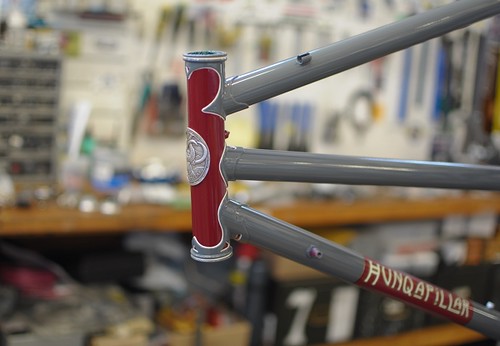
Rivendell Hunqapillar
Today, Rivendell offers several "diagatube" bicycle models based on a similar premise. This is fitting considering that the current popularity of bike camping is in no small part due to Rivendell's promotion of what they call the S24O: the sub-24 hour overnight trip. The idea is that you set off after work, ride to a local camping spot, spend the night there and return in the morning. Whereas full-on bicycle touring requires considerable time commitment, even the busiest of people can manage the S24O. There are now blogs and a flickr group dedicated to the practice. 

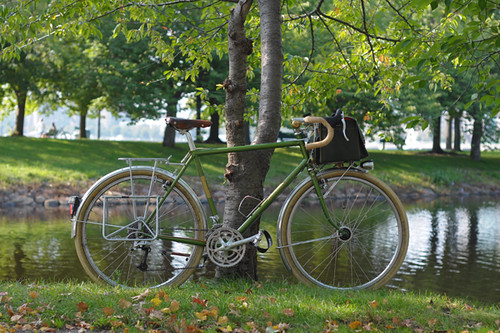
Rivendell by the River
So what is the relationship between bike camping and a camping-specific bike? In a sense, any bike that can carry camping gear comfortably will be suitable for the job. Beyond that, it mostly depends on the length and terrain of your route. Touring bikes equipped for wide tires, fenders and racks - such as the Surly Long Haul Trucker and a number of Salsa and Rivendell models - have made popular choices. There has also been a trend to convert vintage touring bikes to 650B wheels (for extra tire clearance) and use them in this capacity with the addition of front and rear racks. But a camping bike could also be a transport bike, even a cargo bike or a capable folder for that matter. There is no precise definition.

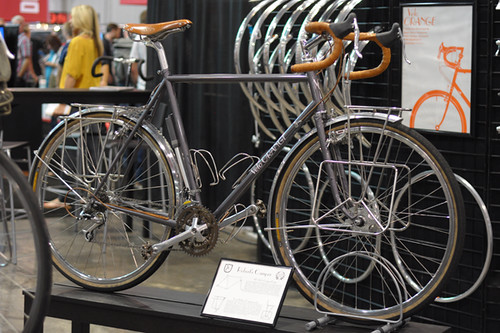
Velo Orange Camping Bike
So what can we expect from a camping-specfic bicycle model? A number of features come to mind: robust tubing to accommodate the weight of gear, long chainstays for pannier/heel clearance in the rear, eyelets for front and rear racks, clearances for wide tires and fenders, and a reliable braking system. The VO Campeur is additionally interesting in its low-ish trail front end geometry, which some believe to be helpful for carrying a considerable front load. 

Will camping bikes take off? The concept of bike camping already has, so it's really a matter of whether the campeur is sufficiently distinct to carve out its own niche. I suspect the concept inspires and attracts a slightly different crowd from those who would go for a standard touring bike, and that's kind of interesting in of itself to observe. Personally, let's just say I am happy to live vicariously through others' bike camping adventures, while traveling light myself. But to the bike campers out there: What is your bicycle of choice, and do you see value in a bike that is optimised for camping?

Monday, October 15, 2012

Who Makes Your Bottle Cage?

Bob Poor, King Cage, Interbike
So... do you know who makes your bottle cages? It might seem like a silly question. I mean, of all things, one is not about to seek out some super special artisanal cages, right? Well, recently I learned that mine were just that: made by Ron Andrews and crew, by hand, in Colorado. I feel a little embarrassed that I did not know this about King Cage bottle cages, but the truth is I didn't. I bought mine because they were available at local bike shops, reasonably priced and reputed to be good. I like them, but I assumed that like most things they were mass produced in Taiwan. Until there I was, walking around Interbike. And there he was, a guy wearing a crown and twirling around all manner of cage-like contraptions. Several minutes into our conversation, it finally dawned on me that this person actually makes my bottle cages. I also learned of his connection to the Fat City Cycles clan and our local New England framebuilders. He asked me how this guy and that guy were doing. I get ridiculously excited by encounters like this.

King Cage at Interbike
Of course it's generally impossible to be at the King Cage booth and not get excited. It is like a miniature circus. A wind-up monkey dances across the table, inserting a tiny water bottle into a miniature cage instead of banging cymbals. 

King Cage at Interbike
Items such as stop motion animation booklets and huge titanium back scratchers are demonstrated with enthusiasm. 

King Cage at Interbike
An under-the-saddle titanium cage, with titanium flask sporting an #OCCUPYBIKESEAT decal. There was much more, and the booth was a bit like a parallel universe. Soon I craved every crazy accessory made by King Cage. But I limited myself to snagging a set of titanium cages at special Interbike prices, before they were all gone. My roadbike was very pleased to receive these!

King Cage at Interbike
Ron Andrews started out making cages in titanium, and still offers these in addition to the more popular and affordable stainless cages. He also offers titanium tire levers, stainless toe cages, and top cap mounts (pictured above) that make it possible to attach a bottle cage to a bicycle's stem. All of these items can be bought from the King Cage website directly, as well as at many bike shops. 

King Cage at Interbike
Other than a Nitto cage I once received as a gift, all of my other bottle cages have been by King Cage. They are advertised as lightweight, non-marking and super strong, and after 3 years of use I have not experienced anything to contradict that. I use them with both plastic and (twine-wrapped) stainless steel bottles, and it's always a good fit. I can't fully explain why it made me so giddily happy to learn that these simple cages - widely available and relatively inexpensive - are made by hand by a friend of friends. Maybe it's precisely because they are such small accessories, and many of us don't give them much thought. It is heartening to know that somebody does, that somebody has made them their life's work with such dedication and panache. 

Thursday, October 4, 2012

Bruce Gordon Was Nice to Me

Bruce Gordon, Interbike
I spotted him in the shadows, at the back of the exhibition hall. It was unexpected. This was Interbike after all, not NAHBS. But there he was, behind a big beautiful red bike with Bruce Gordon decals, underneath a banner with the mysterious word SOPWAMTOS (which, I soon learn, is the Society of People Who Actually Make Their Own Sh!t). A broad-shoulderd, slightly slouchy, gray-haired man with the face of a Soviet literary dissident circa the 1960s. I would give anything to have the writing skills to describe Bruce Gordon's facial features and expression. But alas, I must struggle. Coyly suspicious? Exuberantly grumpy? Playfully defiant? Something like that. 

Bruce Gordon, Interbike
If you don't already know, Bruce Gordon is a framebuilder out in Petaluma, California. One of the best, they say. One of those guys who has been at it for decades, one of the legends. At a loss for words from the bizarre charm of his physical presence, I blurt out something generic about being pleased to meet him. In reply he laughs with a bitterness that is masterful in its combination of sincerity and theatrics. "If I could go back and do something else with my life, trust me I would!" he snorts. "So... want a bike?" Out of curiosity I ask about the wait list. "I am all caught up," he says, "no wait list. You can go ahead and write that on your blog" (the last word is accompanied by a playfully-scornful - or maybe not so playfully, this is ambiguous by design - roll of the eyes. But who cares. Bruce Gordon has no wait list? Okay, I will write that.)

Bruce Gordon, Pointy Brakes
Next we discuss his famous Dangerous Pointy Brakes, which I'd recently tried on one of Pamela Blalock's bikes and discovered to be surprisingly functional (unlike most other cantis I've tried). He was pleased to hear this. For a small fortune the brakes could be mine. Alas I had neither the required sum, nor a bike on which these superior brakes could go. But yes, I would mention them on my "blog."

What can I say. I could have moved along at that point. But I don't know when to quit. And no, that's not even it. In truth, I was a little smitten. I wanted this man to keep talking. I wanted to study his face and figure out what or whom it reminded me of.  

Bruce Gordon, Interbike
So I stuck around, touched the bike, asked questions. He quickly grew suspicious of how much I seemed to know about frame geometry and such. "Oh don't tell me. You're planning to become a framebuilder!" I assured him that I was not, but confessed that I might be building a frame for myself shortly. Nothing serious. Just to give it a try. But becoming a framebuilder, no. I understand the amount of training that requires; I know that earning a living that way is next to impossible. "You're damn right it's impossible." And thus began a speech about the horrors and deceptions of the pipe dream of becoming a framebuilder that claims hopeful innocents of my generation by the dozen. Bruce Gordon's opinion on the matter is basically a more extreme version of this. "If I could save just one young person from becoming a framebuilder, I would die happy," he tells me. I believe him, and promise to never become a framebuilder. 

Bruce Gordon, Interbike
He eyes me with sadness and shakes his head. He asks what I used to do for a living before the tragedy of succumbing to bikes. I tell him briefly, and soon we are talking about bikes as one would talk about a disease. He tells me some personal stuff, I reciprocate. We commiserate. Before I know it, the conversation begins to resemble the sort of jaded, weepy, vodka-fueled exchange that takes place at around 3 in the morning. Except this is Interbike, high noon, and I am sober.

Bruce Gordon Was Nice to Me
The following day, I walked by the booth again and gave Bruce Gordon an uncertain wave. I genuinely did not think he'd remember me; it was as if our conversation the day before had been something I'd imagined. But he did remember. And then he gave me this pin. It's a limited edition. The regular one reads "Bruce Gordon was rude to me." 

And that is my story of meeting Bruce Gordon. You should buy one of his bikes. I hear they are good and he's all caught up on his wait list.

Friday, September 28, 2012

Spectator Sport

Cross Vegas
"So I hear you are into cyclocross," said Martina from Clever Cycles as we chatted on the second day of Interbike. I responded with genuine amazement. "Me, into cyclocross? What makes you say that?" And then I remembered that I'd spent the previous evening live-posting a continuous stream of blurry snapshots from Cross Vegas - "the biggest cyclocross race in America." I gave up two other industry events to attend this thing. I guess it did seem like I was pretty into it! But as I was quick to explain, I am only interested in watching, not racing. In fact, of all the forms of cycling out there, cyclocross is the one I am least likely to actually take part in (it combines every aspect of cycling I am terrible at!). Moreover, I had never before been able to tolerate - let alone enjoy - watching sports of any kind. So what makes cyclocross so appealing?

Molly Hurford
As it happens, Molly Hurford has just written a book that seeks to answer that very question. It's called Mud, Snow, and Cyclocross: How Cross Took Over US Cycling. Having borrowed a copy from the Ride Studio Cafe library, I finished it just days before Interbike. Aside from providing historical context, Hurford's book helped me make sense of my own feelings toward this bizarre sport. As race promoters all over the country have discovered, cyclocross is in many ways the perfect spectator event. And so I thought it might be interesting to describe it from the point of view of someone who is purely a spectator - and a fairly clueless one at that.

Chris Kostman of AdventureCORPS, Cross Vegas
To do this, I will backtrack to last year's Interbike, where it all started. I had zero interest in attending Cross Vegas, but tagged along with Chris Kostman, who insisted I should at least stop by ("Come on, you can't go to Interbike and not see this!"). We drove to a giant field on the outskirts of town filled with tipsy people and flooded with electric light. In the distance I could see a colourful blur of bicyclists making their way through an elaborate obstacle course. As the sounds of cowbells and screams filled my ears, I remember wondering: "What am I doing here?" Five minutes later I was leaning over a barrier, ringing a cowbell and having a shockingly great time. And that's pretty much your typical "my first time watching 'cross" story. No one intends to like it, but inevitably they do.

Cross Vegas
This year we arrived to the spectacle of Elvis performing on stage before the start of the elite races. 

Cross Vegas
Visitors wandered around purchasing water, beer and cowbells. 

Cross Vegas
Cyclists rode around the grass warming up. Bicycles were being adjusted.

Cross Vegas
Before the crowds became too dense, I got the chance to survey the empty course. Winding around the grassy field, it did not look too technical, though there were lots of tight turns and a couple of short steep hills.

Cross Vegas
And, of course, these. I still remember how stunned I was when I first saw the riders hop right over them without breaking stride. How is this possible?

Cross Vegas
And then the race began. First the women's elite race; the mens would be next. Watching the hoard of riders charge cross the start line, the excitement of it all came back to me. I got goosebumps.

Cross Vegas
The thing is that at a cyclocross race, you can stand so close that you feel the energy of the riders wash over you like a wave.

Cross Vegas
And this wave is not some abstract poetic concept. It is very real, visceral. Even if you know nothing about race tactics and don't follow the background stories of any of the riders - just standing there and feeling so much human power and speed happening inches from your own body is a physical rush.

Cross Vegas
Watching track racing is more abstract in comparison, because the riders are further away. And with road racing you can only witness a small portion of the course at a time. But with cyclocross, all is laid out right in front of you in close proximity. The course winds around the spectators; it intertwines with them. There is a feeling that everything is happening everywhere, all at once.

Cross Vegas
Pressed against the barrier, I can see the riders' flushed faces, gritted teeth, twitching fingers, razor-burned legs. The physicality and rawness of it are overwhelming.

Cross Vegas
And then there are the technical parts that differentiate cyclocross from other forms of cycling. The obstacles, the vertical uphills, the dismounts and remounts, the bouts of running with the bike. No matter how graceful the rider, there is an intimate awkwardness to these struggles that makes us feel as if we are witnessing something private that perhaps we are not supposed to be witnessing.

Cross Vegas
Equally intriguing, is when a group of riders is so synchronised in their movements, that the dismounts and remounts appear to be done in choreographed unison - like a staged ballet.

Cross Vegas
And of course there are things like this - at which point it is the crowd's chorus of gasps that seems choreographed.

Cross Vegas
Watching first the women's, then the men's race, I noticed differences. The men stuck in larger, tighter clusters while the women were more strung out after the first lap. There were also difference in demeanor and body language - too subtle to describe, but nonetheless there. Watching the two races were separate experiences.

Cross Vegas
As the lead group of riders made its way through the course, spectators would rush to position themselves in different spots. This too was interesting to watch.

Cross Vegas
Through the elbows of others, I could see the anticipatory face of each rider as they crossed the finish line. 

Cross Vegas
What struck me was how much they seemed to be savouring the moment, rather than rushing through it. There was a performative, theatrical element to it.

John Watson/ Prolly is Not Probably, Cross Vegas
Photographers were everywhere, capturing the action with impressive lenses and flash units. John Watson's Cross Vegas photos on Prolly is Not Probably are especially worth a look.

Cross Vegas
While my low-light snapshots are far from professional quality, they do reflect my experience of the event as a spectator: dark and chaotic, punctuated with bursts of light and blurs of colour. 

Cross Vegas
I am not sure whether any of this really explains what makes watching cyclocross fun. It is an evasive quality, but ultimately it is about entertainment - genuine entertainment. You don't even have to like sports or racing to enjoy it - though you might surprise yourself by developing a taste for beer and cowbells.

Cross Vegas
Accessible and awe-inspiring in equal measure, cyclocross strikes the perfect balance between a country fair, a bicycle race, and an alcohol-fueled block party. While the circus of Cross Vegas examplifies this more than typical races, it truly is the ultimate spectator sport.

Wednesday, September 26, 2012

Head to Toe

It struck me that there seemed to be at least as much focus on clothing and accessories at Interbike this year than on bicycles and components. Not that I am against cycling clothing. I support the idea of looking nice and being comfortable on the bike. That said, I felt that for all of its variety, most of the clothing exhibited was deeply unsatisfactory. Put simply: too much embellishment, not enough substance. While I obviously appreciate aesthetics, I wish there had been a greater focus on construction, fabrics and other meaningful aspects of garment and footwear design. Still I'd like to mention some tidbits from the show that I found noteworthy, interesting, or funny.
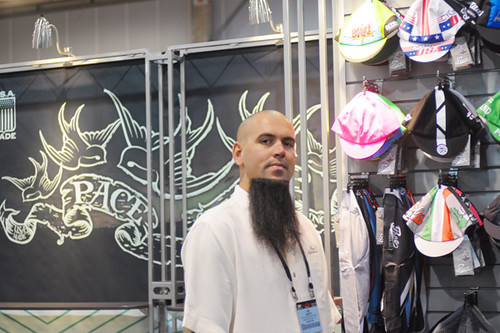
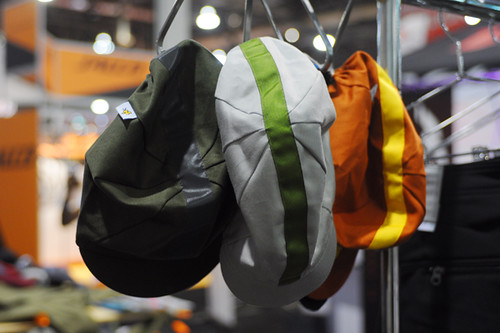
Pace Cycling Caps
There were lots of manufacturers exhibiting cycling caps, but not all caps are created equal. While some consider the cycling cap to be a novelty item, for me it performs the very real function of soaking up sweat and keeping the sun off my forehead (applying sunscreen directly to the forehead makes it leak into my eyes). And a good fit is key, so that the cap does not shift under a road helmet. For me that means 4-panel construction, which not many manufacturers seem to offer. Happily, one of the first booths I happened to walk by was that of Pace Sportswear - the makers of my favourite cycling cap (white cotton, 4 panels, rainbow stripes, perfect!). Lots of bike shops carry Pace caps. They are simple, classic, inexpensive, and happen to fit my large head just right. What I didn't know was that the caps - all Pace clothing in fact - are made inhouse, in California. I also did not know about their background. The Colombian-born founder and cyclist, Jorge Saavedra, began making custom caps for Campagnolo in 1978. Does this make them one of the oldest cycling cap makers still in business, I wonder? In any case, it was great to meet the manufacturers of one of my favourite pieces of cycling clothing.

Swrve Cycling Caps
Swrve had another flattering 4-panel design on display in a variety of muted colours and with the interesting addition of reflective ribbon. These too are California made, at prices that won't break the bank. 

Swrve
I was intrigued by the experimental fabrics at Swrve: tissue-thin summer weight wools, as well as silk and linen blends. In my experience, it is fairly difficult to come up with a truly summer-weight wool blend for a hat, but this feather-light fabric felt promising.

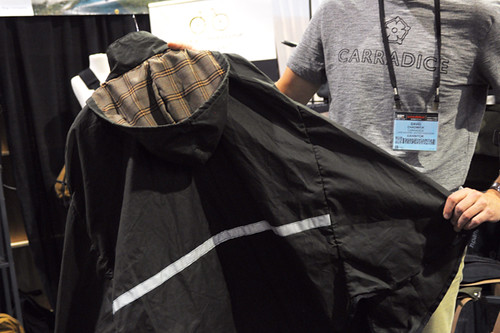
Carradice Cape
Moving downward, one trend I am noticing as far as cycling clothing for commuting, is a growing mania for capes and cloaks (see Iva Jean, Cleverhood). The waxed cotton cape from Carradice is classic and beautiful, though on the heavy side. While I appreciate the capes aesthetically and envy those who wear them gracefully on and off the bike, frankly I am terrified by their expanse of fabric and never fail to get tangled in the ones I try. I would love to see more normal, lightweight, breathable raincoats adapted for cycling.

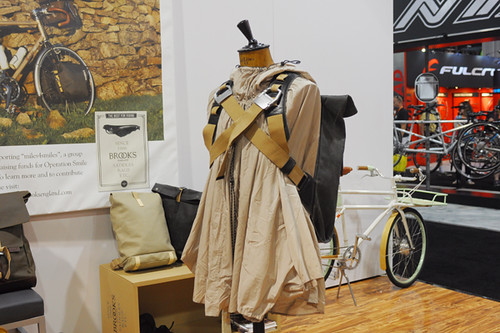
Brooks England
The dramatic, paratrooper-esque cloaks in the Brooks booth were certainly show stoppers, and I've just learned that their new Cambridge Cape retails at $160. Other outerwear pieces are pricier. Generally speaking, I must say there has been some behind-the-scenes backlash against expensive outerwear. I appreciate the work that must go into the high-cost products, and I appreciate them being out there as conceptual/ inspirational pieces. But there need to be more options on offer that are a step below the haute couture price range that much of the classic cycling rainwear seems to fetch.

Swrve Crotch Gusset!
Swerving back to Swrve on the theme of trousers, they were the only manufacturer I saw displaying cycling pants with a proper crotch gusset. I might have to try a pair of these soon, as well as their cordura-blend jeans. As far as clothing for transportational cycling, Swrve definitely impressed me the most overall with their combination of fabric innovation, technical features (tailored, vented jackets) and "this looks like normal clothes" aesthetics.

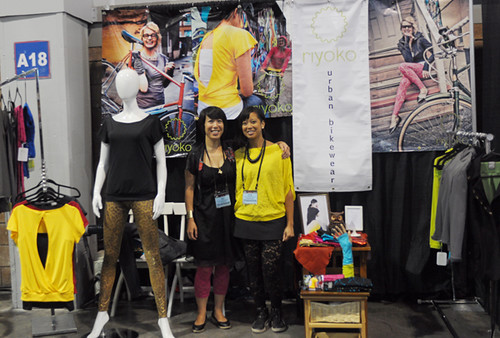
Riyoko Urban Bike Wear
Examplified by the Riyoko booth was the trend for colourful, "spunky" bike fashion. I notice that ideas of women's urban bike wear tend to involve leggings and arm warmers. And I get it: Leggings are stretchy; arm warmers add versatility to a short-sleeved outfit. But it's a very young look and few grown women can wear this to work unless they are in the creative or fitness industries, or maybe IT. Still, I like their lace leggings and tailored jacket.
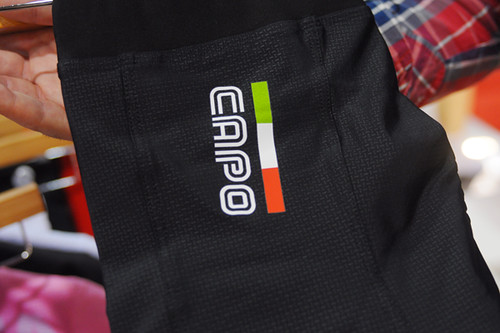
Capo Women's Line
And as far as women's roadie clothing, the brand that stood out for me was Capo. The new women's line looks nice enough (black, white, navy, or Giro-pink with subtle colour accents), but what got my attention were the technical features. For starters, Capo is one of the best at preventing "sausaging" effects at the waist and thighs by using wide elastic bands. Further, there is no polyester in the tops or shorts, only nylon/spandex blends - which means those sensitive to polyester but not lycra (more common that the other way around) can wear them against the skin. But my curiosity was really peaked by the description of the abrasion-resistant weaves used in the new line. I have a baffling talent for destroying my cycling clothing, especially shorts, by snagging it against everything in sight. So something like this - if it really works of course - would be pretty useful.

Capo Women's Line
Also - and probably this is just the contrarian in me, as I've never been a fan of pink - I found myself drawn to this pink cycling jersey. The colour has now gone so dramatically out of favour with women's cycling clothes manufacturers, that no one wants to touch it. Yet Capo takes a stab at it - and manages to make the pink look aggressive rather than girly. But colour aside (it is also available in black and white in fact), the jersey is interesting in that it is made of a complex mesh that feels like all holes when you have it on, yet does not look transparent. I am curious how it would feel in comparison to the lightweight wools I now wear. 
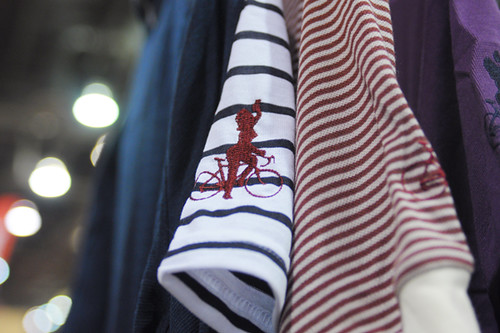
Cafe du Cycliste
Also represented was the trend for what I would call hybrid road/urban wear - roadcycling clothing that is made to kind of, sort of pass for European street clothes. Some of the merino and striped jerseys from Cafe du Cycliste looked rather nice, but my concern is that the urban touches will diminish the garments' preliminary function as roadcycling clothing while still not truly passing for "normal clothes" off the bike. While I haven't tried anything from Cafe du Cycliste specifically, I have some samples from VeloBici and Vulpine that I will review in that context soon. 
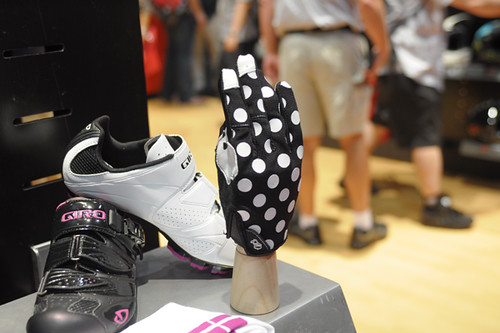
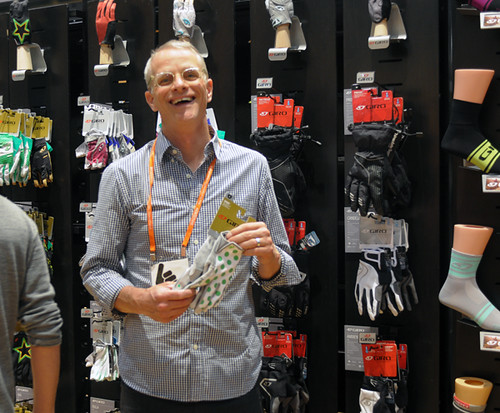
Giro Polka Dot Theme
As far as cycling gloves, the trend I saw - at least for women - was for a greater selection of lightweight full-finger gloves, such as these from Giro's new women's line. I like the idea, because the tips of my fingers always manage to get burned or scraped somehow when I am on the bike for long, but in the past my hands have always gotten too hot in full-finger gloves. I'll try some and see if they do any better than the ones I tried 3 years ago.

Giro Polka Dot Theme
And if you are wondering about the polka dots, this was actually a huge aesthetic theme at Interbike. Also, stripes. And the colour purple. It's as if manufacturers all brainstormed and came up with the exact same answer to the question of "How to replace pinks and florals in women's clothing?" But I tease. To be honest I actually like the stripes and polka dots. As far as the purple, it depends on the shade. 

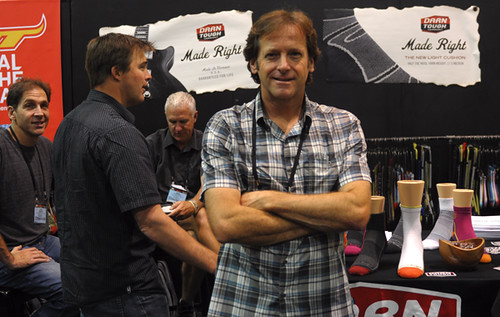
Darn Tough
One clothing trend that was impossible to miss was the colourful explosion of cycling socks. It seems like every sock manufacturer suddenly decided to introduce a cycling-specific design, and at the same time every cycling-related company decided to add socks to their line of accessories. Everywhere I looked, I was greeted by socks and more socks, stunning in their variety of fabrics, textures, thicknesses and colours. Cycling sock lovers rejoice, for these days we are truly spoiled for choice.

Darn Tough
As far as wool cycling socks, the manufacturer that truly wowed was Darn Tough - made in Vermont, USA. That was just a small swatch of their sock display in the previous picture; their new line of lightweight cycling socks is impressive.

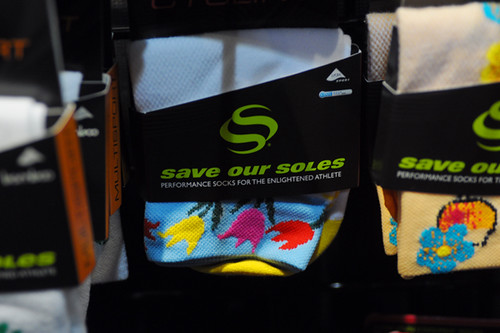
Save Our Soles Cycling Socks
More aggressive in its styling, Save Our Soles presented a floor-to-ceiling display of cycling socks in every wild pattern imaginable. This company is like the Hallmark card of athletic socks.

Save Our Soles Bottle Guard
They also displayed these wine bottle guards. You know, for those times when you're carrying a wine bottle home from a club ride in your bottle cage. 

Velo Orange Socks
Promotional socks were popular as well, including these new wool-blend ones from Velo Orange. 

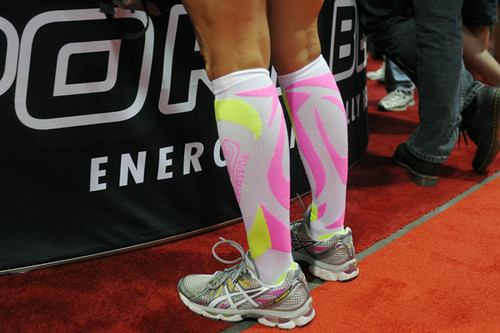
Compression Socks
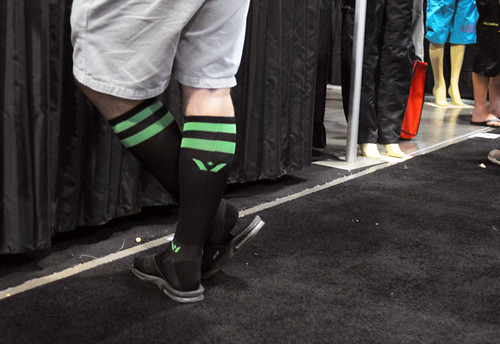
One trend that I hope someone could explain to me, is the compression socks. People were wearing them, in all sorts of crazy colours. 

Compression Socks
With otherwise normal outfits. While walking around the floor of Interbike. Thoughts? Seriously, I am not making fun - I just want to understand!

Outdoor Demo
As far as cycling shoes, everyone was talking about the new Fizik line, with its streamlined looks and feather-weight construction. With my romance with clipless pedals in full swing, I am open to being swept up by some fantastic new shoe. But the thing is, my Mavic Cyclo Tours weigh 360 grams, cost $100, feel great, and are in great shape after nearly 6 months of wear - including getting soaked in the rain and caked in mud several times. That pretty much keeps my eye from wandering. 

Interbike Fashions
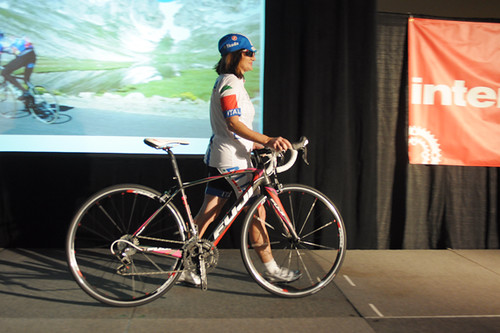
While I've probably confused and frustrated some of you by mixing up commuter and roadie attire, I was impressed to see that Interbike kept them separate. While last year there was one fashion show (here is my coverage of it), two separate shows were held at this year's event: one for "city fashions" (commuting) and the other for "technical fashions" (road and mountain biking). I stopped by the latter, and it wasn't bad: The announcer named the manufacturers, and the models' backgrounds were nicely tied into the narratives (I think all were racers or endurance riders). I think that having separate shows for these categories was a very logical solution.

Interbike Fashions
It was also neat to see the designer Sheila Moon modeling her own clothes.

Interbike Fashions
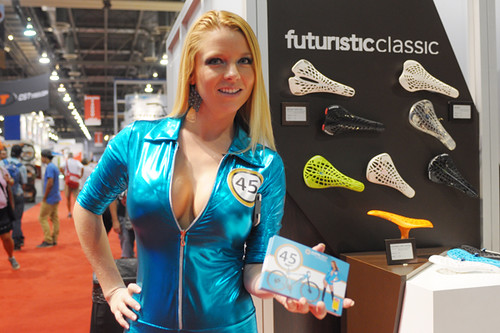
Of course a discussion of clothing at Interbike would not be complete without acknowledging the Vegas Glamour Girls hired to promote some of the products. They were very friendly, very nice to me, posing for pictures and doing their job. Reactions to these ladies (from both genders) were mixed - some were drawn to them, others embarrassed to go near them. The outfits ran the gamut from string bikinis to shiny rubbery rompers. Oh and compression socks with heels! Well, that's Interbike and Las Vegas for you.