Tuesday, November 14, 2006

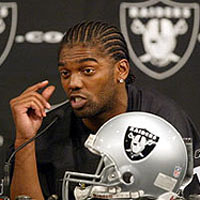
Randy Moss and Dropped Passes: Stone Fingers or Workplace Unhappiness?

Oakland Raiders' wide receiver Randy Moss had an interesting explanation when asked why he has dropped so many passes this season:
"Maybe because I'm unhappy, and I'm not too much excited about what's going on, so my concentration and focus level tends to go down when I'm in a bad mood. So all I can say is if you put me in a good situation and make me happy, man, you get good results."
It would be easy to criticize Moss for those remarks. People hate it when others, especially those they don't know, make excuses for under-performing. In that same vein, employees often feel implicit pressure to show up and do a good job at work, even if they are feeling under-the-weather or simply sad.

This seems especially true in the context of professional sports. Just think about what frequently happens when a player "takes too long" to come back from an injury: the player is derided by fans and media as "soft" or "weak." Players' earning capacity can be adversely affected when they develop a reputation for "not playing hurt," a point raised by Sports Illustrated's Peter King in a column about former New York Giants cornerback Phillippi Sparks.

Sometimes coaches supply the same criticism. New England Patriots' fans know that all-to-well from 10 years ago, when they heard Bill Parcells' ungracious reply to a question about rookie wide receiver Terry Glenn's hamstring injury: "She's making progress." Oakland Raiders' coach Art Shell seems just as skeptical about Moss. When asked about Moss attributing his unhappiness to his poor play, Shell said, "You're paid to play a game you've played for many years and that you love and once you hit the field, you compete. That's the way Art Shell sees it." Aside from referring to himself in the third-person, Shell probably said what a lot of coaches would say: toughen up, Randy!

But if you think about it, don't Moss's remarks make some sense? After-all, we can all relate to being distracted and affected by personal matters or difficult workplace environments, and it's a lot harder to do things in those settings. So why shouldn't Moss use unhappiness as an excuse?

Legal scholars have been thinking about these very phenomena. Just a few weeks ago at the colloquium on labor and employment law scholarship at Marquette Law School, I heard Temple Law professor Peter Huang deliver a talk on the implications of happiness research on employment law, a subject that he is writing an article about with Marquette Law professor Scott Moss (no relation to Randy!). One such implication is that employees are more likely to discriminate others in the workplace when they are unhappy. So happiness really does matter.

That point has also been made over at Health Law Prof Blog, where Cincinnati Law professor Betsy Malloy cites a study of attorneys' happiness which found:
Lawyers are 3.6 times more likely to be depressed than members of other professions, and it’s not just because their jobs are more stressful. For most people, job stress has little effect on happiness unless it is accompanied by a lack of control (lawyers, of course, have clients to listen to) or involves taking something away from somebody else (a common feature of the legal system).
Books have also been devoted to how happiness can affect our job performance. Daniel Gilbert's Stumbling on Happiness is perhaps the leading book on the topic. Gilbert incorporates a great deal of social psychology, and explains how what we think makes happy really doesn't, and that actually does make us happy is often beyond our consciousness.

But back to Randy Moss. We know that unhappiness can impair workplace performance, particularly when it is accompanied by a lack of control (and Moss has the not-so-magnificent Andrew Walter as his quarterback: he of the lowest quarterback rating in the NFL). So is Moss really making an excuse or is he just being honest? Would we rather him say that he is "fully responsible" for the dropped passes when in fact his emotional health may be a real cause? If his fingers were broken--a physical injury--we would certainly understand the dropped passes, so why not let an emotional injury also excuse those drops?

NFL Wins Insurance Dispute Over Maurice Clarett Case

The legal bill associated with fighting off Maurice Clarett's challenge to the NFL's age restriction? Just eight hundred and fifty thousand dollars, according to a New York Appellate Division opinion released today in NFL v. Vigilant Insurance Company, 2006 WL 3290617 (N.Y.A.D. Nov. 14, 2006). Vigilant issued an "executive protection insurance policy," which provided
the NFL with claims-made liability coverage and defined "Loss" to include indemnification for defense costs. The insuring clause required Vigilant to pay for "all Loss for which [the NFL] becomes legally obligated to pay on account of any Claim first made against the [NFL] during the Policy Period ... for a Wrongful Act." The policy defined "Wrongful Act" as "any error, misstatement, misleading statement, act, omission, neglect or breach of duty committed ... by [the NFL] before or during the policy period."
However, the policy contained an "employment exclusion", relieving the insurer of responsibility
"for Loss on account of any Claim made against [the NFL] ... for any Employment Practices."
Vigilant denied that it was responsible for the costs of defending Clarett's antitrust suit on the ground that the suit concerned the NFL's employment practices and was thus subject to the insurance contract's employment exclusion. The NFL sued Vigilant in New York state court, arguing that the exclusion applied only to employment law claims (such as FLSA claims, employment discrimination claims, and the like), not to antitrust disputes.

After a lower court granted Vigilant's motion to dismiss, the appellate division reversed. The court opined that
Clarett's antitrust claim against the NFL did not arise from any actual or prospective employment relationship with the NFL, as it is undisputed that NFL players are employees of individual NFL teams, not the NFL itself.
Interpreting the exclusion against the insurer, the court ruled that Vigilant's motion to dismiss should not have been granted.

Monday, November 13, 2006

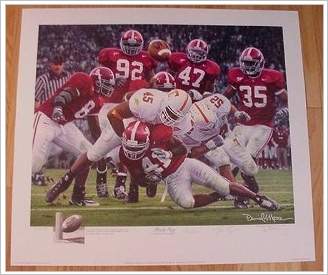
Alabama Suing Sports Artist Over Crimson Tide Artwork (Update)

This Sunday’s New York Times included a nifty front page article on a pending lawsuit against Birmingham sports artist Daniel A. Moore filed by the University of Alabama. Our own Greg Skidmore covered this dispute back in April ’05 in this post. Moore has made what appears to be a pretty good living painting action shots of Alabama football games. His gallery’s web site is called Alabama Crimson Tide Prints.

As Greg predicted, Mr. Moore has now moved to dismiss the case by arguing that the University lacks a right to control depiction of events of historic or public significance.
Mr. Moore has asked Judge R. David Proctor of the Federal District Court in Birmingham to dismiss the case on First Amendment grounds. His brief cited a decision of the federal appeals court in California ruling that a trademark owner “does not have the right to control public discourse” if “the public imbues his mark with a meaning.”

After the citation, Mr. Moore’s lawyer, Stephen D. Heninger, added a parenthetical aside. “Who could argue with a straight face,” he asked, “that the cultural significance of Alabama football has not assumed such a role?”
The problem for Mr. Moore, is that unlike in other cases favoring artists’ rights, which may have involved slightly more transformative expression, his Alabama football paintings tend to be similar to the photographs he uses to compose his work.

I’m not sure I share all of the sentiments expressed in the article. For instance:
“This lawsuit is the equivalent of the Catholic Church suing Michelangelo for painting the Sistine Chapel,” said Keith Dunnavant, an Alabama alumnus and the author of “Coach: The Life of Paul ‘Bear’ Bryant.”
The difference, of course, is that Michelangelo was commissioned by Pope Julius II to paint the Sistine Chapel, whereas Mr. Moore has not been commissioned by the University of Alabama.

Another questionable suggestion:
James Glen Stovall, who taught journalism at the university for 25 years, said only one sort of person would support the suit.

“I can see why, if you’re sitting in a roomful of lawyers, you might come to that conclusion,” Mr. Stovall said. “But no one outside of that room would say: ‘Hey, that’s a good idea. Let’s sue Daniel Moore.’ ”
To me, that does not give enough credit to the University’s claims. The University
seemed to take particular offense at Mr. Moore’s use of his paintings on merchandise like coffee mugs and calendars.
What’s really driving this case? Probably not Mr. Moore’s sale of a $25,000 watercolor or a $100 print, but rather his sale of a $2.00 coffee mug that eats into the University’s merchandising revenues. My guess is that, if the University survives Moore’s current motion to dismiss, the case will be headed towards some sort of settlement in which Moore ceases the sale of mugs and other trinkets emblazoned with his art in exchange for being allowed to continue selling the big ticket items.

Sunday, November 12, 2006

Tony and the Chase

The recent success of Tony Stewart and his failure to make the Chase pretty much shows what such a contrived piece of crap NASCAR's playoff is. I preferred the old system but with a minor change--make victories count more. As it stands, Smoke is the best driver out there. This season will go down as one of his best, and the Cup champion will be largely overlooked. The Chase is a joke.
 

Saturday, November 11, 2006

Blog Overhaul

I've made a few changes to the blog here. Most are minor, but the most noticeable one will be my changing the flag at the top to one without the confederate battle eblem. I did this because I was concerned that some readers might think I am a racist or a member of the KKK. I'm not either of these.
 
For me, the confederate battle emblem is a sign of regional affiliation. I am a southerner, and I feel no shame in this. I love where I am from. But with that said, I must also acknowledge that the emblem is also considered racist by both hate groups and black people. I would prefer to avoid this mixed message. This doesn't mean that I am taking a turn towards political correctness because I will continue to say whatever the fuck I feel like. But I do not believe in racial collectivism, and I don't want to send the message that I am.
 
I am still working on the Alma Jean story which a lot of people are eager to finish reading. I am trying to get this done between my many other projects, but I am getting back to regular writing after a layoff. I think many of you will be satisfied with the result of my efforts.
 

Thursday, November 9, 2006

Subscribe to Sports Law Blog through Google

You can now subscribe to Sports Law Blog through your personal Google homepage or Google Reader. Here is the link:

Add to Google

If you add Sports Law Blog to your Google homepage, you can drag its content into your main Google page, or you can keep it under a separate tab. If you use Google Reader, you will need to create a free Google account.

Thanks to Robby Forbes, Editor-in-Chief of the Virginia Sports and Entertainment Law Journal, for alerting us of this Google option. We are clearly not the most "technical"/computer guys around, so we always appreciate suggstions that would improve our blog and would be easy for us to implement.