Sunday, November 29, 2009

CRU on Global Temperature Data

The Times had an article yesterday reporting the old news that CRU did not have in its possession the original station data from some locations that comprise its global temperature index. I am quoted in the Times article as follows:
“The CRU is basically saying, ‘Trust us’. So much for settling questions and resolving debates with science,” he said.
The quote comes from a blog post I put up last August when CRU announced that it did not have some of the original station data. Here is the full context of my quote:
CRU has in response to requests for its data put up a new webpage [NOTE: Apparently this page is no longer up on the CRU emergency server] with the following remarkable admission (emphasis added):
We are not in a position to supply data for a particular country not covered by the example agreements referred to earlier, as we have never had sufficient resources to keep track of the exact source of each individual monthly value. Since the 1980s, we have merged the data we have received into existing series or begun new ones, so it is impossible to say if all stations within a particular country or if all of an individual record should be freely available. Data storage availability in the 1980s meant that we were not able to keep the multiple sources for some sites, only the station series after adjustment for homogeneity issues. We, therefore, do not hold the original raw data but only the value-added (i.e. quality controlled and homogenized) data.
Say what?! CRU has lost track of the original data that it uses to create its global temperature record!? Can this be serious? So not only is it now impossible to replicate or reevaluate homogeneity adjustments made in the past -- which might be important to do as new information is learned about the spatial representativeness of siting, land use effects, and so on -- but it is now also impossible to create a new temperature index from scratch. CRU is basically saying, "trust us." So much for settling questions and resolving debates with empirical information (i.e., science).
Today I received an email from a climate scientist of CRU-email fame complaining about my quote in the Times. He says that the national meteorological services have the original data, suggesting that I was misrepresenting the situation. I replied to him as follows:
I would suspect that there are some very profound disciplinary differences in the handling of data here between the community I am from and yours. If, for instance, an economic research unit were releasing analyses of global economic activity in support of policy claimed to not hold the original country data -- instead saying, well the countries have it -- that would be highly problematic.

My advice to you and your colleagues is that the defense that you present in your email to me is not a very good one. Rather, I suggest instead being open and simply saying that in the 1980s and even 1990s no one could have known that maintaining this data in its original form would have been necessary. Since it was not done, then efforts should be made to collect it and make it available (which I see CRU is doing). Ultimately, that will probably mean an open-source global temperature record will be created. If you believe -- and I see no reason to suspect otherwise -- that such an open-source analysis will confirm the work of Jones et al., then you should be welcoming it with open arms.
Obviously, CRU should have taken these steps long before the present circumstances, but regardless, they are now moving towards greater responsiveness and transparency. When the data is available in its original form those skeptical of climate science can then do the temperature math themselves out in the open where everyone can see their work. If the global numbers come out as CRU has presented over the years, then it will strike a blow to skepticism about global temperature trend records produced by CRU and restorse a good deal of credibility to this area of climate science. At that point, the fellow who emailed me and his colleagues can rightly boast of their integrity and say "told ya so." Until then, a defensive, circle-the-wagons approach is probably not the best course of action. But old habits die hard.

Saturday, November 28, 2009

Eduardo Zorita on Climategate

Eduardo Zorita, a climate scientist at the GKSS Resaerch Center near Hamburg , Germany, has posted these comments up on his website:
Why I think that Michael Mann, Phil Jones and Stefan Rahmstorf should be barred from the IPCC process
Eduardo Zorita, November 2009

Short answer: because the scientific assessments in which they may take part are not credible anymore.

A longer answer: My voice is not very important. I belong to the climate-research infantry, publishing a few papers per year, reviewing a few manuscript per year and participating in a few research projects. I do not form part of important committees, nor I pursue a public awareness of my activities. My very minor task in the public arena was to participate as a contributing author in the Fourth Assessment Report of the IPCC.

By writing these lines I will just probably achieve that a few of my future studies will, again, not see the light of publication. My area of research happens to be the climate of the past millennia, where I think I am appreciated by other climate-research 'soldiers'. And it happens that some of my mail exchange with Keith Briffa and Timothy Osborn can be found in the CRU-files made public recently on the internet.

To the question of legality or ethicalness of reading those files I will write a couple of words later.

I may confirm what has been written in other places: research in some areas of climate science has been and is full of machination, conspiracies, and collusion, as any reader can interpret from the CRU-files. They depict a realistic, I would say even harmless, picture of what the real research in the area of the climate of the past millennium has been in the last years. The scientific debate has been in many instances hijacked to advance other agendas.

These words do not mean that I think anthropogenic climate change is a hoax. On the contrary, it is a question which we have to be very well aware of. But I am also aware that in this thick atmosphere -and I am not speaking of greenhouse gases now- editors, reviewers and authors of alternative studies, analysis, interpretations,even based on the same data we have at our disposal, have been bullied and subtly blackmailed. In this atmosphere, Ph D students are often tempted to tweak their data so as to fit the 'politically correct picture'. Some, or many issues, about climate change are still not well known. Policy makers should be aware of the attempts to hide these uncertainties under a unified picture. I had the 'pleasure' to experience all this in my area of research.

I thank explicitely Keith Briffa and Tim Osborn for their work in the formulation of one Chapter of the IPCC report. As it destills from these emails, they withstood the evident pressure of other IPCC authors, not experts in this area of research, to convey a distorted picture of our knowledge of the hockey-stick graph.

Is legal or ethical to read the CRU files? I am not a layer. It seems that if the files had been hacked this would constitute an illegal act. If they have been leaked it could be a whistle blower action protected by law. I think it is not unethical to read them. Once published, I feel myself entitled to read how some researchers tried to influence reviewers to scupper the publication of our work on the 'hockey stick graph' or to read how some IPCC authors tried to exclude this work from the IPCC Report on very dubious reasons. Also, these mails do not contain any personal information at all. They are an account of many dull daily activities of typical climatologists, together with a realistic account of very troubling professional behavior.

Mike Hulme on Climategate

These comments by Mike Hulme of UEA (location of CRU) were originally posted at DotEarth:

The key lesson to be learned is that not only must scientific knowledge about climate change be publicly owned — the I.P.C.C. does a fairly good job of this according to its own terms — but the very practices of scientific enquiry must also be publicly owned, in the sense of being open and trusted. From outside, and even to the neutral, the attitudes revealed in the emails do not look good. To those with bigger axes to grind it is just what they wanted to find.

This will blow its course soon in the conventional media without making too much difference to Copenhagen — after all, COP15 is about raw politics, not about the politics of science. But in the Internet worlds of deliberation and in the ‘mood’ of public debate about the trustworthiness of climate science, the reverberations of this episode will live on long beyond COP15. Climate scientists will have to work harder to earn the warranted trust of the public - and maybe that is no bad thing.

But this episode might signify something more in the unfolding story of climate change. This event might signal a crack that allows for processes of re-structuring scientific knowledge about climate change. It is possible that some areas of climate science has become sclerotic. It is possible that climate science has become too partisan, too centralized. The tribalism that some of the leaked emails display is something more usually associated with social organization within primitive cultures; it is not attractive when we find it at work inside science.

It is also possible that the institutional innovation that has been the I.P.C.C. has run its course. Yes, there will be an AR5 but for what purpose? The I.P.C.C. itself, through its structural tendency to politicize climate change science, has perhaps helped to foster a more authoritarian and exclusive form of knowledge production - just at a time when a globalizing and wired cosmopolitan culture is demanding of science something much more open and inclusive.

Blue Collar Ambition

I have been experiencing a lot of frustration when it comes to the issue of careers. I have had so many thoughts swirling in my head, and I am not alone. These same issues have been on other forums and blogs that I read. I will see if I can break them down.

Generalization vs. Specialization

Wise Bread had an interesting article here on the subject of being a jack-of-all-trades or a master of one. I am in the generalist camp. I think specialization will make you a huge roll of cash if your specialty is in high demand, but you will pay it all back when the market for your skill reverts to the mean and craters. This happened with the computer sci people who made it big during the 90's building the internet, and then found themselves downsized as that same internet enabled companies to hire people in India to work for half the salary of their American counterparts.

The specialization route demands ever more specialization as people train and acquire more education in ever narrowing directions in a vain attempt to maintain their place in their niche. This is why we have so many people in graduate school learning shit applicable to only narrow fields. The result is a glut of higher degrees and mounting student loan debt. This can't go on forever. If you factor in costs of education and the job market volatility, I don't see these specialists being better off than generalists though they make huge dollars in the fat years. They pay it all back in the lean years, and the lean years always come.

I recommend generalization. The result will be lower pay but more consistent employment.

Blue Collar vs. White Collar

I am someone in the unique position of having a foot in both the blue collar and white collar worlds. I work a job that does not require a degree, but I find it more lucrative and personally rewarding than the jobs I could get with my degree. Granted, your typical middle manager will make more than I ever will, but as Taleb pointed out, middle managers are merely lucky coin flippers paid for taking credit for things they did not achieve and fired for taking blame for disasters they did not cause. I am also mystified by the entry level managers who work for less pay than their own employees. The reason for this disparity is simple. Entry level managers take a paycut in the hope of gaining entry into the casino. They take one step backward to take two steps forward. What they don't realize is that a step forward could find themselves stepping on a landmine.

Middle management is not skilled labor. Middle managers produce nothing of value. They make no decisions of any great importance because they are mitigated and ignored as they go down the chain or get overruled by someone up the chain. These people can be fired and not replaced resulting in a positive to the company's bottom line as the company saves money on not paying their bloated salaries. (I worked for a company where a multi-million dollar operation was saved by the brains and balls of a maintenance tech who got written up by a middle manager for not following company policy. Basically, he used a paperclip to fix a relay instead of waiting the week or so it would take for the replacement part to ship. Insanity like this only exists in large companies where office politics and the CYA principle matter more than satisfying customer demands and making profit for owners and shareholders. FWIW, that manager got fired later while the tech accepted an offer for more pay from another outfit.)

I see the white collar world as a world of bullshit. This is a world where an exec spends a bunch of time crafting the perfect PowerPoint presentation for the next big meeting that will amount to nothing. Some part of him yearns to make something of value. But satisfaction eludes him. Meanwhile, a metal fabricator puts a perfect weld on a tank that will hold solution for a factory somewhere. No one will care about that weld unless it breaks, but he cares. It is because his work matters.

People look down on blue collar people or anyone else who has dirty hands at the end of the workday. They place a premium on status which is why we have the bullshit of the white collar world. I can appreciate an accountant, a computer programmer, or an engineer. But these people have more in common with electricians and plumbers than they do with the pointy haired boss in Dilbert. There is a division between the labor and the corporate political class, and you are either on one side or the other. You will either take your plays from Machiavelli or Adam Smith.

Middle managers are useless parasites. This realization quells one's ambition. My own ambition is simply to work hard and be skilled across a variety of fields. I care less about high pay than I do about consistent pay that comes from being able to get a job no matter what economic turmoil may ensue.

The Education Bubble

A college education is free. All you need is a library card. This realization has done a great deal for the expansion of my mind. I am smarter than the average person, and this includes those with advanced degrees. This is because I read. That's it. College education amounts to charging people for reading books. Only dumb people pay to read.

A degree merely confers status on the one holding the degree. It is supposed to signify accomplishment in a field of study, but grade inflation has made this dubious. In addition, a Harvard grad with a C average will make more than a State U. grad with a 4.0 for knowing the same information. It's like owning a Lexus which is a Toyota with better marketing.

In technical fields and the blue collar world, this bullshit does not exist. If you don't know what the fuck you're doing, you can't fake it in these fields. In addition, these worlds often have accomplished workers with no sheepskin whatsoever. The only thing that matters is skill which is the way it should be.

The greatest value in education today is technical training. The tuition is surprisingly cheap, and the return on investment is much higher than having an MBA. This training almost always comes with a guaranteed job. Learning electronics at your local voc ed school will be a better investment than a mathematics Ph.D.

To tie this in with my earlier thoughts on generalization, I envisioned what I call the "Blue Collar Ph.D." Essentially, this is the combination of skills and technical knowledge resulting in a whole greater than the sum of its parts. For instance, imagine an industrial maintenance tech who is also a certified welder and a diesel mechanic and knows carpentry, plumbing, electrical wiring, etc. This may seem like an impossible task and a lot of stuff to know, but I don't see it that way. Blue collar types are supposed to be stupid, but we know better. But the time and money committed to the blue collar Ph.D. is considerably less than you would spend on a real Ph.D. or an MD, or a law degree. Plus, you become more employable the more you learn.

Entrepreneurship is for Suckers

I would love to run my own business, but as Virginia Postrel points out, entrepreneurship is the province of lucky fools. These people are not brilliant or brave so much as lucky and stupid. They have more in common with the lottery players who finance many government expenditures with their ignorance of simple odds.

Taleb made the same points when he said you were better off being a venture capitalist than being an entrepreneur. This stings for me because I see entrepreneurship as being the best way for an average guy like me to make it rich. But Taleb is rich and is not an entrepreneur unless you count starting a hedge fund as a business. I don't.

The best place to put capital is not in a startup but in a diversified portfolio of investments. Whether or not it is Taleb's treasury bond/options strategy or index funds like I prefer, you want to spread your bets and stop envying lucky fools.

The Work Ethic

I read a lot of blogs and books about business, economics, and personal development. Except for Larry Winget, none of them talk about the work ethic. Here's a handy formula for you:

HARD WORK + SIMPLE LIVING = WEALTH

There is a lot of conjecture about why the USA has become the wealthiest nation on the planet. We talk about freedom, innovation, and the like, and I agree that free societies are better than unfree societies. But why? This is because they are more productive. It begins and ends with production. You achieve more by doing more. Unfree societies decline because they steal this motivation through taxation and regulation.

The great dream of people is wealth without production. Everyone wants to live at the expense of everyone else. This isn't just a political thing but a social thing as well. I haven't read in any of the literature that the surest route to success is to spend more time working. But it is.

The mentality is that work is for suckers, and people that work hard are pathological and clinically insane. But I notice these people don't make much money, or they think the way to make money is to "get over." In other words, if you want to be rich, don't be the sucker. Be the fucker who sticks it to the sucker. Sad shit.

Simple living is also condemned. People have leisure time which necessitates leisure activities requiring expensive toys. These would be boats, ATVs, RVs, motorcycles, jet skis, etc. Blue collar people are especially susceptible to this as I see most of these items for sale on the lawns of houses in working class neighborhoods.

When I have free time, I like to spend it with a low cost book. I might splurge on renting a DVD from Blockbuster, but my leisure activities are cheap. My rule is to do nothing that requires purchasing expensive equipment.

Conclusion

The bright red vein running through all these topics and insights I've discussed here is status. People want status, so they spend money and labor on getting advanced degrees, promotions to meaningless jobs with titles, starting businesses that are ovewhelmingly doomed to failure, and living large to impress their friends and families. People crave status and pay a premium to get it. My insight is that we should consider not paying this premium anymore. Work hard instead. Acquire job skills that are marketable and produce something of real value. And live simply. The result of these choices should lead to less stress, greater satisfaction, and financial stability in your life.

Metropolitan

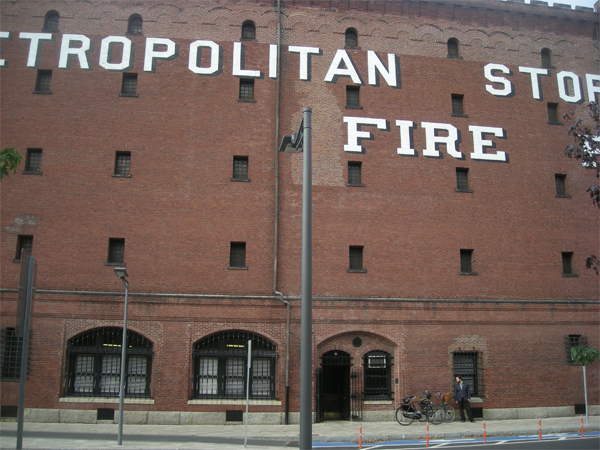
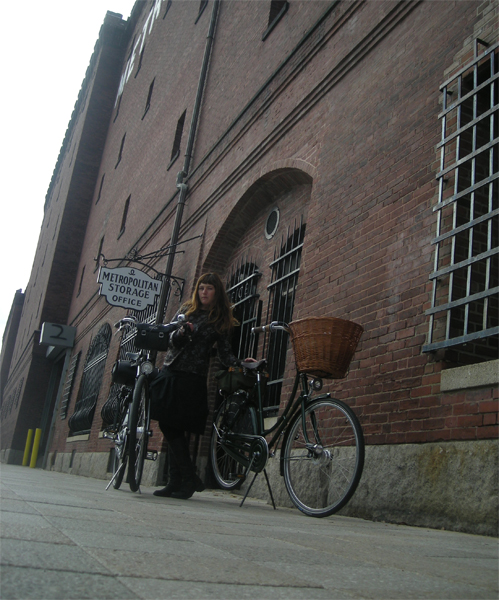
The weather here has been awful since I've returned from Vienna. So while I've used my bicycle to get where I need to go, the long "welcome home" ride I fantasized about does not seem to be in the cards. Stretches like this remind me to take advantage of good weather whenever possible, and so I offer these photos from one of the nicer cycling days we had at the beginning of the month.

These photos were taken in front of the Metropolitan Storage Warehouse in Cambridge, Mass., which is a local landmark of sorts and has been functioning since 1917.

We do not usually have a good reason to visit this area, but I was intrigued by the Vassar Street bike path controversy that I had read about on Chic Cyclist and I wanted to show it to the Co-Habitant. To summarise, the Vassar Street path is criticised because it is "European style" - running mostly on the sidewalk and therefore conflicting with both pedestrian traffic and with the cars that frequently pull in and out of the various parking lots that cross the path. Compared to what I had been expecting, the path is actually not so bad in person. In fact, it is set up like a typical bike path in Vienna. The main issue is that cyclists must keep to a fairly low speed in order to ride on the path safely during peak traffic times - and Americans are simply not used to cycling at such low speeds and continue to ride at a brisk pace.

I am not certain what my stance is on the Vassar Street critique; it is a complicated issue. But I do enjoy cycling through the MIT/ Cambridgeport neighborhood during non-traffic hours. When these streets are empty, I feel that the personalities of all the warehouses and industrial sites and contemporary constructions really come out, and the abandoned urban landscape becomes "communicative". Is it all in my head? Maybe so. But that does not make the experience any less interesting.

GRL and James Saiers

Having seen his name mentioned in the CRU emails as a possible "skeptic" needing to be removed from the editorial board of GRL, I contacted James Saiers, Professor of Hydrology at Yale University, to see what he had to say about all this. He emailed me the following response which I post with his permission:
I haven’t looked for, and don’t intend to look for, my name in the CRU emails, but one of my colleagues did alert me to an email written by Wigley in which he suggested that, if I were a climate skeptic, then steps should be taken to get me “ousted.” Wigley’s suggestion stems, I believe, from the publication of a GRL paper (by McIntyre and McKitrick) that criticized certain elements of Michael Mann’s Hockey Stick paper. This paper caused a bit of a stir and because I oversaw the peer review of this paper, I assume that Wigley inferred (incorrectly) that I was a climate-change skeptic. I stepped down as GRL editor at the end of my three-year term, long after the excitement over the McIntyre and McKitrick paper had passed. My departure had nothing to do with attempts by Wigley or anyone else to have me sacked.

Random Thoughts on Various Subjects

1. TIGER WOODS

Tiger was cheating on his wife, and she beat his ass with a golf club. That's my take. Will have to see how the story unfolds.

2. CAROLINA VS. CLEMSON

If Spurrier doesn't win, that fucker should be fired.