Sunday, December 10, 2006

Scott Boras and the Lack of Good Faith in Matsuzaka-Red Sox Negotiations?

Last month, Rick blogged on the posting system that enabled the Red Sox to obtain the right to exclusively negotiate with Japanese star pitcher Daisuke Matsuzaka. The Red Sox paid the Seibu Lions $51 million for a one-month window to negotiate with the 26-year-old Matsuzaka, who is under contract with the Lions. The window expires this Thursday. If no deal is reached, the Red Sox get their money back, but lose out on perhaps the best Japanese pitcher in recent memory.

And no deal may be the outcome. Matsuzaka is represented by Scott Boras and talks have gone nowhere. The Red Sox are said to be offering $8 million a year, while Boras believes that Matsuzaka's market value--in a market where free agent Jason Marquis, he of the 6.02 ERA and 14-16 record, can land a 3-year, $20 million deal with the budgetless Cubs--is worth at least $15 million and up to $20 million a year. Boras also contends that the Red Sox's $51 million posting payment to the Seibu Lions is not crucial to contract negotiations with his player, since his player isn't receiving any of that money. Boras also notes that the $51 million is not included in the luxury tax figure, and that the Sox would be able to write off some of the $51 million as a marketing cost. It is also thought that Sox would receive a less measurable, but nonetheless meaningful benefit by making in-roads in the Japanese economy and culture.

Today's Boston Herald features an anonymous Red Sox executive (Larry Lucchino?) blasting Scott Boras, even intimating that Boras is not representing the best interests of his client:
Negotiations between the Red Sox and Japanese pitcher Daisuke Matsuzaka have essentially broken down, a source familiar with the talks said late last night, adding that unless there is an abrupt change of course, Matsuzaka will not be signing with the Red Sox before Thursday’s midnight deadline.

Attempts to reach Matsuzaka’s agent, Scott Boras, were unsuccessful last night. However, the well-placed source blamed Boras for stubbornly being unable to get over the flaws in the Japanese posting system, saying that he has been unwilling to negotiate and that he has acted disinterested in even making a deal.
ESPN's Peter Gammons has more damaging commentary from the Sox, with the implication that the Sox believe Boras is not negotiating in good faith:
While Boras remains adamant in asking for close to a Jason Schmidt average annual value, Red Sox officials feel that the superagent prefers to keep Matsuzaka in Japan for two more years, then get $140 million for seven years after 2008.
So is Boras not making a good-faith effort to get Matsuzaka signed? Keep in mind, as noted by Professor Emily Houh in The Doctrine of Good Faith in Contract Law: A (Nearly) Empty Vessel?, 2005 Utah Law Review 1 (2005), the absence of "good-faith" in contract negotiations often does not have legal significance:
Section 205 of the Restatement of Contracts explicitly takes the position that it, "like the Uniform Commercial Code ... , does not deal with good faith in the formation of a contract." Thus, the common law obligation of good faith fails to reach the most troubling forms of contractual bad faith: those that occur during contract negotiation and formation.
But even if the absence of good faith is not legally meaningful, what about the practical implications of Matsuzaka returning to the Seibu Lions--the same team that gave him a farewell event in front of 36,000 fans and that presumably doesn't want to return the $51 million? Can he really go back? Hasn't that bridge already been crossed, if not burned?

Lastly, if Boras fails to reach a deal with the Sox, what might that do to his professional reputation as an agent in Japan? I suspect Matsuzaka might be his last Japanese client for some time if that were to occur.

Having said that, Boras recently placed J.D. Drew with the Sox and is also the representative of Jason Varitek, so he has enjoyed successful negotiations with Sox management, thus supplying some comfort to Sox fans with the Thursday deadline approaching (although don't remind those same fans of another of Boras' clients, some guy named Johnny Damon).

See also
* Boras Almost Steals Another One (9/1/2006)
* Mark Teixeira Blasts Boston Red Sox: Legality of Pre-Draft Negotiations between MLB Teams and Amateur Players (5/23/2006)

Saturday, December 9, 2006

Luminescent Basketball Uniforms Coming to an Arena Near You?

Tom Simonite from New Scientist Magazine has an interesting article on new basketball uniforms being developed that will indicate a player's statistics and other game information through luminescent bars:
The simple, coloured display panels are attached to each vest and connected to a small computer, about the size of an iPod, strapped to each player's body. These computers communicate wirelessly with a central control system, installed at the side of the court, which keeps track of all relevant statistics as the game goes on.

Luminescent bars running up the side of a vest indicate the points scored by each player, while lines on their shoulders show the number of fouls against them. Panels on each player's chest indicate when the game time or shot clock is running low, and panels on their back show which team is winning . . . this gives players greater confidence in their team's tactics, say the researchers involved.

"Team sports uniforms already communicate information visually," like a player's name, says Mitchell Page, who developed the system at the University of Sydney. "We wanted to augment the existing team sports uniform model to communicate more relevant information, such as a player’s stats and performance."
The uniforms--known as TeamAwear--are the creation of Mitchell Page, a University of Sydney student who "came up with the idea while playing computer sports games, which use graphics and icons to tie statistics to the virtual players and track their performance. He wondered how such on-screen graphics in sports telecasts could be made available to players and spectators at the ground."

We know the NBA is always looking for new sources of revenue, so maybe the league will find something here. And players would seemingly benefit by more easily knowing game information, such as how much time is left on the shot clock and the number of timeouts remaining. Other players, particularly those interested in their own statistics (such as one on the verge of getting a triple-double) might also find this information helpful. But I have a feeling Billy Hunter and the Players' Association would have some reservations, including those relating to workplace safety. After-all, what about the risk of electrocution or burns? But Mitchell counters these concerns on his blog when writing, "the risk of harm from electrocution is for all intents and purposes, zero" and players who have tested the uniforms "have reported no electrical shock whatsoever."

In any event, while reading this story, I couldn't help but recall that old NBA Jam videogame, where players would "heat up" both figuratively and literally:

Friday, December 8, 2006

Revenge of the Groupies, 46 years later

The type of story you don't see everyday:

An 81-year-old Texas woman named Ruby Y. Young was arrested last week on federal charges relating to letters she had sent to Hall-of-Fame Packers Quarterback Bart Starr (HT: Deadspin). According to a criminal affidavit, Young sent Starr, now 72, several letters demanding that he pay her $ 2 million or she would go to the media with reports of an "encounter" that they had in 1960.

From Deadspin, one letter reads, in part:

"And now, the time has come for you to pay -- to pay for the many injuries you caused me. ... No I am not a push-over Mr. Starr -- and no, I do not need the money -- but I intend to see that you pay for your wrong doings (sic) to me ...," said the first letter, dated Oct. 30, 2006, which an agent quoted in part in the affidavit. "How much is it worth to preserve this 'image' presented to the public these many years of who and what you are?"

"I am going to be vindicated one way or another," Young's first letter said, according to the affidavit. "You know very well that any and all tabloids, TV news casters (sic) such as ABC, CBS, NBC, would simply devour this story. ... And thereby, I would collect money from these sources. But, I first want to give you the chance to pay me back in dollars rather than exposure."


Among criminal law and free-speech theorists, the rational for the legal prohibition on extortion is something of a mystery. Think about it. Ms. Young had 4 options. She could have:

1) Gone to the press with the details of whatever Starr did to her. Nothing criminal about that. And nothing legally wrong with that if her story is true. If the story is false and she knew it was false when she said it, she might be liable for civil damages for defamation (I think Starr remains a public figure), assuming Starr decided to sue rather than letting the issue go away.

2) Sued Starr for $ 2 million based on whatever improper acts caused her injury. She might lose the suit, either because the claims lack merit and/or because the claims are 46 years old and the statute of limitations has expired (not many civil claims have 50-year limitations periods). And, if the suit is frivolous (i.e., laughably weak and totally lacking any and all merit), she might be subject to sanctions by the court, including having to pay Starr's attorney fees. On the other hand, bringing the lawsuit might have compelled Starr to settle to make the issue go away.

3) Threatened to do # 2 as a way to force a monetary settlement in advance. If done through an attorney and in a non-threatening way, such pre-suit notice and negotiation is actually favored.

4) Sent letters threatening to do # 1 unless Starr gave her what she could seek by doing # 2 (which is what she did).


All four have the same purpose and effect of giving Starr a choice between paying money or having the details of the ancient encounter publicized. But only # 4 is subject to criminal prosecution. And, as the prosecutor in the case noted, that is true regardless of the truth or falsity of Young's story.

The best theoretical arguments talk about the loss of autonomy, of free choice, that extortion inflicts on its victims. But it is an interesting dichotomy for theorists.

Thursday, December 7, 2006

Tom Brady [insert football pun here in place of the word "sues"] Yahoo

First he slammed BCS-championship-game-bound Florida. Now, Tom Brady is suing Yahoo over use of his image without permission, as reported by the Smoking Gun. The core of Brady's lawsuit, according to his complaint:
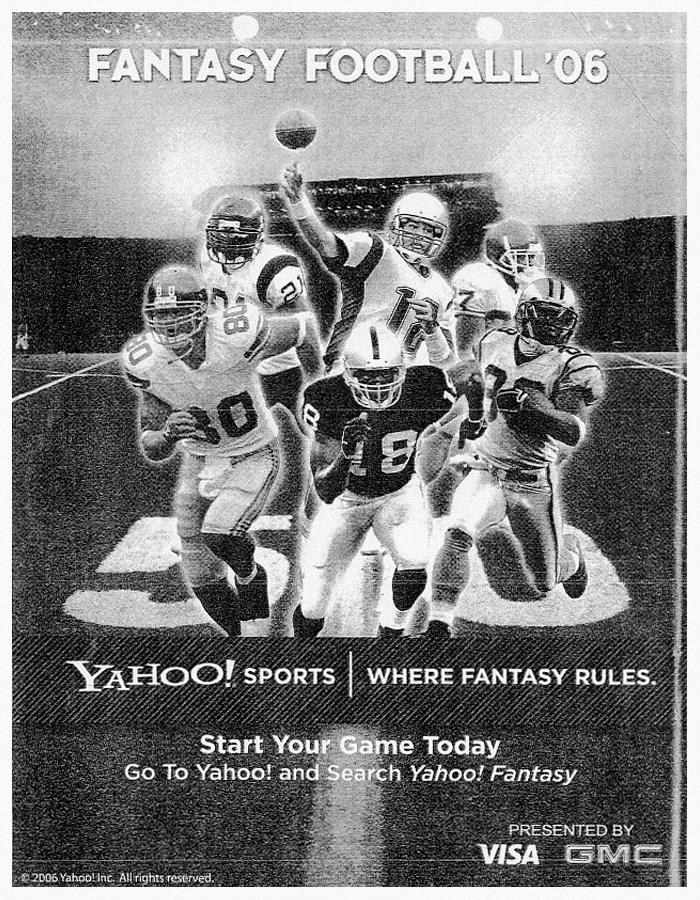
In September 2006, defendant Yahoo ran a full page color advertisement for its Fantasy Football goods and services in Sports Illustrated featuring Tom Brady's likeness, image and identity without permission or authority. . . . Defendant's unauthorized use of Tom Brady's image, likeness and identity are false and misleading and tend to falsely describe and represent that Defendant's goods and services are licensed, sponsored, endorsed or otherwise authorized by Tom Brady. . . . Defendant's unauthorized use of Tom Brady's likeness, image and identity . . . violate Plaintiff's . . . rights of publicity.
Fantasy sports providers recently earned a victory in the CBC case, as Rick noted here. However, that case involved the use of just names and statistics; here, the use of Brady's image gives the athlete a much better claim. In CBC, the court specifically emphasized that the fantasy provider was not using player images, just their names and statistics. Here, if Brady's allegations are true (i.e., Yahoo did not have a license to use his image), it would seem a fairly open and shut case. Another blunder by already struggling Yahoo?

How Would Reinstituting the Military Draft Affect Sports?

The incoming Chair of the House Ways and Means Committee, U.S. Rep. Charles (Charlie) Rangel (D-NY), has proposed that the United States renew the military draft, which has been suspended since 1973. Rangel sponsors a bill that would require military or civilian service for all American citizens ages 18 to 26. Many nations have similar laws, including Israel, South Korea, and Norway. If Rangel's bill became law, it could have sweeping effects on both college and professional sports.

But why would Rangel--a purple heart, bronze star veteran of the Korean War--support such a bill? Basically, he argues that spreading military obligations more equitably would encourage political leaders and opinion leaders to more carefully deliberate the deployment of troops into combat. After-all, of the 535 members of Congress, only 7 have children in the military who are participating or could be called to participate in the war. I'm not sure if there is similar data on the opinion-leader/think-tank types who championed the Iraq War, but I suspect a similarly small percentage did so with the prospect of personal loss. A more general analysis of the relationship between military recruitment and socio-economic status can be read here, which details how young men from poorer backgrounds are actively recruited, while those from more affluent communities receive much less attention. Rangel also has an op-ed in the New York Daily News which notes that persons of color bear a disproportionate share of protecting the country.

Rangel's proposal also goes to the absence members of Congress with military backgrounds. In fact, according to University of Maine law professor Donald Zillman, only about 30% of Congresspersons have military backgrounds, and only one in 10 of the newly-elected members of Congress served in the military. Back in 1978, about 80% of the members of the House of Representatives had military experience, and in 1985, about 75% of the members of the Senate had that experience. Times have indeed changed, and not many of the people who are entrusted with the decision to authorize wars do so with actual knowledge of what wars are like.

Of course, whatever conceptual appeal Rangel's plan may have, his bill is very unlikely to secure passage. Many influential members of his own party, including incoming chair of the Senate Armed Forces Committee, Senator Carl Levin, oppose it, and fewer than 20% of Americans are supportive. Perhaps most significantly, Rangel's plan will not be on the Democrats' agenda when they re-take control of Congress in January.

But let's say that Rangel's plan gradually gains support in 2007, eventually makes its way for a vote, passes, and President Bush signs it (or vetoes it, but his veto is overridden). Beyond many more important questions, what would happen to sports?

The specifics of the draft or compulsory service obligation would obviously prove crucial, as would the nature, extent, and duration of future American forces in Iraq (and/or other countries). But as a barometer, consider how compulsory military service in World War II substantially affected sports. In fact, 638 NFL players served during the war, as did more than 500 MLB players.

To see one specific effect, take a look at Matthew Algeo's fascinating new book Last Team Standing: How the Steelers and the Eagles - 'The Steagles' - Saved Pro Football During World War II. In it, he writes about how the Philadelphia Eagles and Pittsburgh Steelers, both having lost many players to military obligation, actually merged for the 1943 season and were called "The Steagles." They finished with a 5-4-1 record.

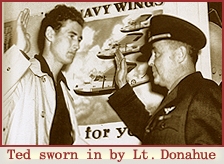
Much has also been written about star MLB players being drafted. Ted Williams, Joe DiMaggio, Hank Goldberg, and Bob Feller were among them. To the right we see a picture of Ted Williams--he of the 20:10 vision--being sworn into the Navy, for whom he would star as a fighter pilot (in both WWII and the Korean War). For some great background on "Wartime Baseball" be sure to check out Gary Bedingield's Baseball in Wartime website and also the Baseball during WWII website.

Another consequence of players being overseas was the rise of women's professional baseball. Between 1943 and 1954, we had the
All-American Girls' Baseball League, which according to historian James A. Percoco, is the only professional baseball league for women in American history. A similarly positive effect was a greater desire for desegregation in sports, particularly after soldiers from all racial/ethnic backgrounds fought together to defeat the Nazis.

The Vietnam War also entailed the drafting of professional athletes. For instance, Juanita Secor writes about Rocky Bleier, "who won four Superbowl rings with the Pittsburgh Steelers and drafted during the Vietnam War in the Army as an infantrymen. After his time in the war, he suffered severe leg injuries but he never lost sight of his passion for the game. He ended playing for 12 years more and was the go to guy for his team."

So what might happen to sports today with a draft? Would the legacy of Pat Tillman voluntarily giving up his NFL career and ultimately his life prove influential? Would the legacy of Muhammad Ali refusing the Vietnam War draft as a conscientious objector also prove influential? You can argue that both were courageous in their own ways, and I suspect their stories would be spotlighted should a draft be reinstituted.

Wednesday, December 6, 2006

Welcome Back: Mutombo, Richards, and Racist Cheering Speech

Good evening and thanks to Mike & Co. for inviting me back for another guest stint. Actually, the stint began a couple days ago, but this is the first chance I have had to post something.

There is nothing going on right this minute that is sports-related that peaks my legal interest. So let me backtrack to two pieces of old news: Michael Richards (no link or explanation necessary) and Dikembe Mutomo's heckler (earlier this year, a heckler in the crowd called Mutombo a monkey, causing Mutombo to almost go into the stands after the man and causing the NBA to ban the fan for the remainder of this season).

What do they have to do with one another? They together relate to the problem of racist taunts and chants at sporting events. In writing about fan speech, I suggested that pretty much all heckling and taunting is fair game, as long as it does not cross-over into the narrow category of "fighting words," meaning direct, targeted, close-up, face-to-face insults. For an example of racial speech, I proferred a protest during Jackie Robinson Day at Shea Stadium, in which White Supremacists chanted about "the good old days" of segregated baseball--an example of pure political speech (however offensive). For examples of heckling, I suggested that fans could call players on anything and everything, related to on-field performance, clubhouse problems, and off-field daliances.

But I did not consider the most-blatant example of racial heckling: a fan in the close rows of a small arena shouting a racist epithet at a particular player. And the Richards and Mutombo situations together suggest that as we move from racial/racist political messages into more directed racist taunts, epithets, and name-calling, the analysis gets skewed.

First, consider that most people thought it was OK for Mutombo to almost go into the stands after the heckler, something that probably would not have been tolerated if the fan had called him a non-racist name (compare the reaction to the Texas Rangers' Frank Francisco throwing a chair at hecklers in 2004). Because the insult was racial, the violent reaction was more acceptable.

Second (and this is a lesson I take from the Michael Richards debacle): Racist taunts are perceived not to target and insult only the individual at whom the insult is directed. Rather, racist insults have been "collectivized." That epithet targets and offends everyone of that racial group. And, to some extent, it offends every fair-minded member of society (regardless of race) who hears it uttered. This means that even a fan in the nosebleed seats who shouts a racist slur at a player far below (something that could not be "fighting words" towards the player under the generally understood definition) might become fighting words for anyone sitting around the fan who hears the word. That is what is potentially different about racial epithets and slurs

I plan to explore the entire scope of expression in sports in a future (hopefully book-length) project. I think the questio of racist speech, in the sense of epithets, may be its own chapter or article.

Rick Karcher Goes to Washington

Rick is travelling to D.C. today to speak before Congress relating to his excellent Sports Law Blog commentary on NFL agent Carl Poston and the proper role of unions in disciplining agents (see Rick's posts from 11/22/2006; 11/16/2006; 9/25/2006; 1/31/2006; also see his law review article Solving Problems in the Player Representation Business: Unions Should be the "Exclusive" Representatives of the Players). Here is an excerpt from a USA Today story on today's hearings:
WASHINGTON (AP) — New York Giants linebacker LaVar Arrington is tentatively scheduled to testify before Congress this week at a hearing involving his former agent.

Arrington, a three-time Pro Bowl player; NFL Players Association general counsel Richard Berthelsen; and a law professor [Rick Karcher] were on a "tentative witness list" e-mailed to The Associated Press on Tuesday by House Judiciary Committee press secretary Terry Shawn.

Arrington did not immediately return a phone message left for him by the AP on Tuesday night.

The Subcommittee on Commercial and Administrative Law has scheduled an oversight hearing for Thursday to examine the NFL Players Association's arbitration process. Lawmakers will be looking into the NFLPA's suspension of Arrington's former agent, Carl Poston, stemming from his handling of a contract the linebacker signed with the Washington Redskins near the end of the 2003 season.

Later today, Rick's statement should be available here. Good luck Rick!