Friday, June 16, 2006

Vecsey's Thoughts on Fortson v. Colangelo

I asked Peter Vecsey if he had any thoughts I could share with our readers regarding his victory in Fortson v. Colangelo, which I blogged about yesterday. Here's his response:
From: Peter.Vecsey
Sent: Friday, June 16, 2006 4:36 AM
To: Rapp, Geoffrey
Subject: RE: Fortson v. Colangelo

As a veteran NBA columnist/analyst, upon cringing at the sight of Danny Fortson, "The Flagrant Forward," unconscionably upend Zarko Cabarkapa in mid-flight, I couldn't help but insult him every way imaginable.

If you've played the game at any level, it's understood how dangerous it is to knock someone off balance or be knocked off balance while stretched out airborne holding the ball. You're completely vulnerable. It's like slipping on ice. You're walking gingerly and suddenly you're seeing your legs splayed above your head and your back and neck are about to hit the ground hard with scant reflex time to brace your fall, other than throw your arm back.

This is what Zarko did and, as a result, he broke his wrist. He lost almost the entire season a rookie year (maybe even a career) that had been very promising. While physically repaired, I'm still not sure if he has recuperated from the mental trauma. The Suns certainly didn't think he had because they traded him first chance they could.

In any event, the 6-8, 260-pound Fortson's intentional two-handed shove of a defenseless opponent was as dirty as it gets, especially since the game had long been decided. There was nothing to gain other than to show people how little regard he had for another human being. Had that happened in a playground, schoolyard, "Y" or whatever, and the submarined player was able to get up in one piece, there would've been a fight.

Fortson prides himself on being an enforcer. He relishes his role as a hit man. His eyes flash demonically after nailing opponents with forearms to the backs of heads. He loves that distracted opponents fear how far he might escalate his bent for violence. He revels they're always on the lookout. He wants us to believe he's the baddest bully on David Stern's block. He wishes there were no referees to protect them.

Next thing you know, Fortson, a multi-repeat offender when it comes to uncivilized behavior between the lines, is crying to the court because Jerry Colangelo and I branded him a thug...when, in fact, he is a broken down wanksta.

The court should have thrown out Danny Pigtails' frivolity at first base, not wait until it was rounding third and charging into home plate.

Outsiders may view the court's decision as merely a first amendment victory. Or, because Fortson is a public figure, they may believe proving slander against a columnist with an acutely negative opinion, is impossible. I find comfort in the cliche that there's no defense as unbeatable as the truth.

Peter Vecsey
Thursday, June 15, 2006

Taxonomy of Legal Blogs

Buckeye 3L Ian Best has developed a Taxonomy of Legal Blogs for those who might have an interested in law other than sports law.

Danny Fortson Loses “Thug” Suit Against Jerry Colangelo and Peter Vecsey

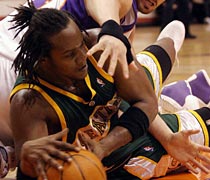
Last week, NBA journeyman and “flagrant foul machine” Danny Fortson lost his defamation suit against Suns owner Jerry Colangelo. The dispute concerned comments Colangelo made in 2003 after Fortson (then with Dallas) committed a flagrant foul leading Suns rookie Zarko Cabarkapa to break his wrist. At the time, the AP recounted:
Fortson was called for a flagrant foul on the play, and Suns owner Jerry Colangelo said he will ask the NBA to fine or suspend the Dallas player.

"Whether it's a fine or a suspension, it's not enough for him," Colangelo said. "He should be put down for every day that he (Cabarkapa) is out. I'll do everything in my power to see that happens. With the game over, there was no need for that."

The injury came with 2:58 left and the Suns leading 112-88.

"He's a thug," Colangelo said.

Before leaving, Fortson said he apologized to Cabarkapa.

"I had no evil intent," he said.

Cabarkapa was in tears in the Suns' dressing room, but later composed himself and said through a translator, "I can't comprehend it. I don't know exactly what happened. I just know I was trying to drive to the basket and Fortson pushed me."
In October, 2004, Fortson sued Colangelo, the New York Post, and Peter Vecsey (Vecsey characterized Fortson—directly or by implication—as “thugged out,” a “vacant lot,” a “wanksta” and a “meaningless mass” in his column in the Post). The District Court (S.D. Fla.) granted summary judgment on June 5 in favor of Colangelo and the Post’s holding company (the Westlaw citation is 2006 WL 1589793) (Vecsey was never served a copy of the complaint).

Mike has explained how hard defamation cases can be to win in connection with John Daly’s “Thug Life” case here and here Bob Lobel’s “drunk sportscaster” suit here.

Ultimately, Fortson was done in by the court’s characterization of Vecsey’s and Colangelo’s words as “rhetorical hyperbole” rather than fact. Rhetorical hyperbole falls on the non-actionable “opinion” side of the fact-opinion divide in defamation law. What the court calls Fortson’s “well-publicized history of overly aggressive play (fouls, ejections, fines, and suspensions)” didn’t help his case.

The court opined that “[t]o foreclose the use of hyperbole, under the threat of civil liability, ‘would condemn [sports commentary] to an arid, desiccated recital of bare facts.’”

While this story has been covered in the media in the past, no news outlet has yet reported the court’s opinion (as far as I can tell).

Wednesday, June 14, 2006

The Legality of Oral Promises by NBA GMs to Potential NBA Draft Picks

Jeff Clark of Celtics Blog e-mails me an interesting topic to consider: oral promises made by NBA general managers to potential draft picks. In these promises, a GM promises a draft-eligible player that if he is still on the board when the team selects, the team will draft him. Here are Jeff's thoughts:
What kind of agreement is in place here? Is it considered a oral contract? What are the ramifications of backing out? I believe the Celtics asked Orien Greene if they could back out of their promise last year when they saw that Amir Johnson was still on the board.
Clearly, oral promises are of great value to the players who receive the promises. Perhaps foremost, a promise indicates a "worst-case scenario" (i.e., at worst, the team making the promise will pick him). Moreover, for some underclassmen, a promise can help them decide whether they should remain eligible for the draft or return to school. The same is true of international players who already earn high salaries playing in Europe: remaining eligible in the draft only makes sense if they are going to be a high enough pick (and thus command a high enough salary). Others will use promises to help determine which teams to workout for--if you have a promise from, say, the Seattle Supersonics, who pick 10th in this month's draft (June 28), then you will probably spend your time meeting with teams picking 1-9, rather than those picking after 10.

Promises also supply important benefits to teams. For instance, they may convince the player receiving the promise to remain in the draft (if that is an issue). Or they may discourage the player from meeting/working out with other teams, thus raising the probability that the player is still on the board when the promising team selects.

And promises have clearly been influential. For example, in the 2003 NBA Draft, Celtics GM Danny Ainge promised high school senior Kendrick Perkins that the team would select him in the first round; without that promise, it is thought that Perkins would have matriculated to the University of Memphis to play for John Calipari. And Ainge kept his promise (by way of a trade with the Memphis Grizzlies). In that same draft, at least two other high school seniors received first round promises--Travis Outlaw (Portland) and Ndudi Ebi (Minnesota)--and those promises were also kept. Interestingly, one of the top high school players in the 2004 NBA Draft who did not receive a first round promise was LaMarcus Aldridge, who, without the promise, removed his name from consideration and matriculated to the University of Texas. Fast-forward two years, and Aldridge is expected to be one of the top three picks in this month's drafts. Brandon Roy--who is also projected to be a top pick--has a similar story from the 2002 NBA Draft. Promises were so influential in the 2005 NBA Draft that Sports Illustrated Ian Thomsen's recap of it was entitled "Behind the Curtain: Promises, Surprising Picks Quietly Shaped '05 Draft." In this draft, it is thought that international player Tiago Splitter won't stay in the draft unless he obtains a promise from a team picking in the lottery (apparently, the buyout in his European contract is too costly to take mid to late 1st round money).

But what happens when a promise isn't kept? And has that ever happened?

First off, I'm unaware of an instance where an oral promise to a potential draft pick was broken, although in a recent interview with the Portland Oregonian, Portland Trail Blazers President Steve Patterson said, "There can be promises that just don't work out to be so guaranteed." I'm not sure whether Patterson is alluding to broken promises in the past or the potential for broken promises (he was discussing Tyrus Thomas), but other than his statement, everything I've read suggests that teams do, in fact, fulfill their draft promises. However, if you know otherwise, please contact me--I would appreciate it. **UPDATE**: A couple of people commenting on True Hoop say that both Rashard Lewis and Vladimir Radmanovic were the victims of broken promises--and their agents were irate--check out the post.

Hypothetically, let's say that a team in the 2006 NBA Draft doesn't live up to its word. And let's try this hypo: Celtics GM Danny Ainge promises point guard Marcus Williams that if he is still on the board at #7 (when the Celtics pick), Ainge will take him. But on draft night, something strange happens: power forward LaMarcus Aldridge--who, as I note above, is projected by most draft experts to be a top three pick--is still on the board at #7. And Ainge decides to take Aldridge instead.

Can Marcus Williams successfully sue Danny Ainge and the Celtics for breach of contract or detrimental reliance? The answer is probably "no" but not without some decent arguments by Williams. Here's why:

Although many oral contracts are enforceable, the Statute of Frauds (adopted in some form by all 50 states) requires that there be a written contract for any contract that entails more than one year of performance. Here, Williams would have to sign a rookie first round contract, which would entail at least three years of performance, and possibly five depending on the exercising of team and player options. On the other hand, perhaps Williams could argue that oral contract between he and the Celtics only concerned the draft itself, and not the subsequent player contract he would sign. Under that interpretation, the Statute of Frauds would not apply.

But even then, Ainge could argue that the alleged agreement lacked "consideration," which requires that each party give something up for formation to a contract. Ainge could say that Williams didn't give up anything when he received a promise from him--Williams was going to participate in the draft no matter what (in contrast, with the Kendrick Perkins example described above, Perkins could argue that his consideration was in remaining eligible for the draft). But Williams could argue, perhaps, that he decided to not work out for certain teams after receiving Ainge's promise--and to the extent that hurt his draft position, he did give something up: his stock with certain teams. Such an argument would be consistent with a detrimental reliance (promissory estoppel) claim, which does not require consideration, but modern courts are usually reluctant to recognize it.

Yet even if Williams could argue that there was a valid oral contract, keep in mind that oral contracts are extremely difficult to prove. Did Ainge really promise Williams, with 100% certainty, that he would take him, or was it more of a "if you're still on the board when we pick, I think you might enjoy playing with Paul Pierce" type of statement? Contract law typically considers that kind of nebulous promise to be an illusory promise, which is not enforceable. And were there any witnesses? Would it simply be Williams' word versus Ainge's word? Or Williams' agent's word versus Ainge's word?

Alternatively, what happens if Williams is still on the board at #7 and Danny Ainge is about to select him when, suddenly, former teammate and Minnesota Timberwolves GM Kevin McHale calls Ainge up and says, "Danny, hold on a second! Look, we'll trade you Kevin Garnett for that pick, plus Al Jefferson, Gerald Green, and Dan Dickau." And Ainge decides to make the trade. And with the 7th pick, McHale selects center Patrick O'Bryant. Marcus Williams then free falls, until the Philadelphia 76ers select him at #13. Would Williams have a claim against the Celtics in that instance? Here, I think the answer is almost certainly "no," since an oral promise to draft a player is likely conditional on the player being there at that pick and that the team actually makes that pick--but you can see the interesting legal complexities of oral promises in the context of the NBA Draft.

This analysis shouldn't be limited to the "legal," however. Consider the possible reputational harm a GM might endure if he breaks a promise. He would lose credibility and possibly generate negative attention for his employer. He could also suffer a backlash from certain agents, which could affect his capacity to sign free agent players in the future. Those types of consequences may be far more powerful than any legal issues.

Also see: True Hoop's Henry Abbott discussing this post (6/14/2006).
Also see (2): Celtics Blog's Jeff Clark discussing this post (6/14/2006).
Also see (3): Contracts Prof Blog's Carol Chomsky discussing this post (6/14/2006).
Also see (4): Oral Promises & Professional Sports: The Carlos Boozer Saga (7/13/2004).

On Wednesday, U.S. Senate Honors Former MLBer Rick Monday

The United States Senate has passed a resolution honoring Rick Monday, currently a Dodgers broadcaster and formerly an outfielder with teams including the Chicago Cubs, Dodgers and Athletics. The full text of the resolution can be found here. The resolution honors Monday's memorable 1976 rescue of an American flag from two protesters intent on lighting it aflame in the outfield at Dodger Stadium (the event is is described here and here). A video of Monday saving the flag (with some interviews) is here. A press conference is being held today. HT to Ben Maller.

Tuesday, June 13, 2006

Jerry Rice Slams Deion Branch's Decision to Holdout

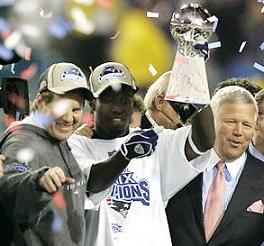
New England Patriot Deion Branch is one of the NFL's premier wide receivers and most clutch players (he was MVP of Super Bowl XXXIX). By all accounts, he's also well liked and respected by teammates, coaches, fans, and the media--and in the interviews that I've seen of him, he seems genuinely humble and appreciative. He's also overcome very difficult life circumstances.

But he's not happy about his salary for the 2006 season or the Patriots' unwillingness to assent to his demands for a new multi-year contract. Specifically, he is in the last year of his five-year rookie contract, which over the last four seasons has paid him about the league-minimum (plus a $1 million signing bonus), and he is slated to earn about $1 million this year. He wants a new contract that will pay him at least $12 million in bonus and gauranteed dollars. The team has refused, and to show that he's serious/angry, he's decided to holdout of Patriots' minicamp, which began today.

Earlier this afternoon, Branch's holdout generated a very harsh reaction from Hall of Fame wide receiver Jerry Rice, who was debuting as co-host of the new SIRUS radio show "Afternoon Blitz":
That’s crazy. You go to minicamp, show your loyalty. Get in there and fight and show them you’ve still got it and you just need them to step up to the plate now.

Why are you going to hold out? You are still under contract. It makes no sense. I did that once and I felt stupid. I really felt stupid because you are sitting on the outside looking in. You need to be there. You need that type of interaction with the team. You need to develop that chemistry.

Get in there. Work your butt off. Prove yourself. Let them know, ‘I still control this area. This is what I do. This is the area where I play the best football.’ And he’s going to get compensated for that. But don’t hold out. I think it’s a big distraction and I think it is going to hurt him down the road.

Is Rice right? Should Branch honor his contract? He did agree to it, after-all. And shouldn't Branch be loyal to his organization--the same organization that took a chance on him in the second round of the 2002 NFL Draft, even when most draft experts projected him as a 4th or 5th round pick?

Or is Branch right? He's vastly underpaid, his contract--like almost all NFL contracts--is not guaranteed (meaning one injury could obliterate his career at any moment), and he was likely pressured by the Patriots into signing a 5-year deal as a rookie.

Branch might also wonder (as we did here in February) why most fans don't seem angry when NFL teams force players into renegotiating their contracts, under the threat of being cut: If Branch isn't being loyal to the Patriots, then shouldn't we say that the Patriots weren't loyal to Willie McGinest and Ty Law and other popular veterans who wouldn't take pay cuts and were released?

So who's right?

World Series Home Field Advantage: Why Must It Be Negotiated?

Bob Nightengale of USA Today reports today that Major League Baseball has not reached an agreement with the players union that will reward the All-Star Game winner with home-field advantage in the World Series ("Status of All-Star Game still unsure").

The All-Star Game format was changed in 2003 after the previous year's All-Star Game that ended in a 7-7 tie when both teams ran out of pitchers. At that time, MLB and the union negotiated a two-year deal and extended the agreement last year. So now MLB and the union have no agreement in place, but Commissioner Bud Selig said he is optimistic an agreement will soon be reached to retain the 3-year-old format: "We're still hopeful because I think it's really good for the game. Everyone likes it. The owners. The players. The sponsors. It just adds a lot of meaning." MLB executive vice president Rob Manfred, like Selig, is "hopeful" they will have an agreement with the union: "I think originally we had hoped that we would have sort of a permanent resolution to this issue. Time has become pressing because we're getting closer to the game. We decided to focus on a one-year agreement and hopefully have a multiyear done with the next (labor) agreement."

However, according to union head Don Fehr: "We're still talking to them, so we'll see. It's something that has to be negotiated."

I wonder what Fehr means by saying that "it's something that has to be negotiated"? Why must it be negotiated? Why doesn't MLB just tell the union that the All-Star Game is going to dictate home-field advantage for the World Series? The National Labor Relations Act requires an employer to negotiate "mandatory subjects" with the union. The NLRA defines mandatory subjects as those dealing with "wages, hours and working conditions". For once I'd like to see MLB stand up to the union and say that home-field advantage for the World Series is not a mandatory subject, and, thus, there's no negotiation.

In case you're wondering why maybe the MLBPA is the strongest union in professional sports....