Friday, January 13, 2006

Old Age and NFL Coaching

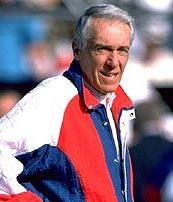
A week after taking over as the Buffalo Bills' general manager, 80-year-old Marv Levy has emerged as a possible replacement for Mike Mularkey, who resigned earlier this week as the Bills' head coach. Levy, a Hall of Fame coach for the Bills back in the 80s and 90s, would become the oldest coach in NFL history. That distinction currently belongs to . . . Marv Levy, who was 72-years-old when he last coached the Bills in 1997 (George Halas was also 72 when he coached the Chicago Bears in 1967).

Is an 80-year-old Levy "too old" to be an NFL head coach?

By mere virtue of his age, absolutely not. A blanket categorization of "80-year-old persons" would reflect stereotypical thinking and naiveté. There are productive and energetic 80-year-olds just as there are incapable and lazy 40-year olds. In part for that reason, age discrimination laws would likely prevent the NFL (or any pro sports league) from imposing an "age ceiling" on coaches. Though Levy serving as both GM and Head Coach would be challenging and perhaps regrettable, that may be true regardless of his age. Moreover, whether Levy is the right person for the job is a decision that Bills' owner Ralph Wilson should make and not the NFL through imposition of an arbitrary age ceiling.

It is interesting, though, that we have age restrictions on entry as a player, yet coaches and staff can presumably be of any age. Granted, player age restrictions more precisely reflect "age floors," but the same underlying premise remains: leagues would rather use age proxies than to allow players and teams to make their own decisions, presumably because leagues would rather engage in stereotypical thinking than analytical thinking.

High School Basketball: A Right or a Privilege?

At the risk of being accused of flooding the Sports Law Blog with another story out of Massachusetts (home of the 2 time defending Super Bowl champion Patriots), here's a newsworthy one from the western part of the state. An interesting issue presented itself in Springfield MA concerning the right of a high school student arrested on felony charges to play on his team’s varsity basketball team.

Nicholas Tokarski, a Springfield high school senior and four other teens were arrested and charged with damaging cars and buildings in Springfield over a four-month period that ended last July.

Citing an unwritten school policy that prohibits students charged with felonies from being involved in certain school activities, the high school principal apparently blocked Tokarski from further participation on the school's basketball team. He and his family went to court in December and were granted the right by a judge to continue playing basketball for the time being. The ruling allowed Tokarsi, who was a co-captain on the team and apparently quite good, to play in games while the judge ruled on his request for a permanent injunction against the school.

A family lawyer argued that Tokarski's chances of a college scholarship or financial aid would be harmed if Tokarski couldn't play this season. A city solicitor argued there is "no right under the constitution to play basketball," and that due process was granted by school officials, through meetings with Tokarski's parents. "Education is a right, basketball is a privilege," the city solicitor said.

Tokarski was actually indicted on these charges (which seems severe). His case is now pending in Hampden Superior Court on one count of malicious damage to a motor vehicle and six counts of wanton and reckless destruction of property valued at $250 or more. Apparently, 300 students have signed a petition in support of Tokarski's playing basketball this season.

Shameless Book Plug

I am the author of a chapter in a new book edited by Professors John Norton Moore and Robert F. Turner of the University of Virginia School of Law, and also Attorney Ross Fisher of Kaye Scholer. The book is entitled "To Oppose Any Foe: The Legacy of U.S. Intervention in Vietnam." My chapter postulates the possible geopolitical effects of an earlier withdrawal of American troops, and concludes that such a withdrawal may have proven "worse" than having remained in Vietnam. By incorporating behaviorism, I examine political trends in nearby nations (e.g., Thailand, Singapore, Malaysia), as well as those in Latin American nations. Was the "Domino Theory" valid or was it the product of an exaggerated "Red Scare"? Well, I do not assert a conclusive answer, but I find that it did have some evidentiary support and has probably been dismissed too easily by many contemporary historians.

The book has received some positive and noteworthy reviews:
“A remarkable work . . . that will contribute to a more mature and balanced perspective on the tragedy of Vietnam.”—Professor James MacGregor Burns, Williams College (emeritus), winner of the Pulitzer Prize and National Book Award

“A serious and refreshing relook at America's engagement in Vietnam and its longer term consequences.” — The Honorable James Schlesinger, former Secretary of Defense and Director of Central Intelligence during the Vietnam War
For those interested in military history and military law, I believe it would make an excellent read. It is available through the Carolina Academic Press.

Thursday, January 12, 2006

The Baseball Hall of Fame and Multi-Year Eligibility

In an e-mail, Sports Law Blog reader Thomas Santanello raises an interesting and timely point about voting for the Baseball Hall of Fame:
Why would a player be eligible for more than one year? What does he do for his career . . . during the years he is retired? What makes him more deserving one year than the next? My view is a player played his time, therefore if he is not deserving in 2002, what makes him deserving now. You are either a Hall of Famer or not, you are either the elite of the elite or not.
This year's Hall of Fame vote took place this week, with only Bruce Sutter earning election. Under Hall of Fame rules, any player with 1) at least 10 years of major league experience and who 2) passes a preliminary screening committee is eligible to be elected by long-time members of the Baseball Writers Association of America ("BBWAA"). Players only gain election if they receive at least 75% of the casted ballots, while those who receive fewer than 5% are dropped from future elections. Players receiving between 5.0% and 74.9% of the ballots remain eligible for the following year's vote. If a player fails to obtain membership under this system, he may still be elected by the "Veterans Committee"--a group of living Hall of Famers--provided he fails to be elected by the BBWAA within 20 years of his retirement. The Veterans Committee votes every two years.

Should a player be able to become "Hall of Fame worthy" when he has already been rejected? After all, he was retired when he was first rejected; what could he have possibly done in the interim to enhance his already-complete playing career?

Well, I imagine there are several arguments in favor of this system. Obviously, one might argue that statistics are viewed differently in different eras, and a player should not be penalized for playing in a particular era. A good example of this might be when homerun records were broken in the late 90s, and 35 homeruns in a season no longer seemed very impressive, but now that homeruns have dropped down a bit, perhaps 35 homeruns becomes impressive again.

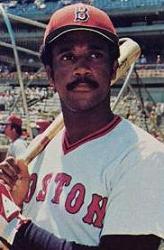
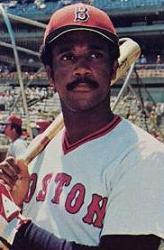
Another obvious reason is that "electibility" often depends on the other names on the ballot. Why should an "almost-outstanding" player be denied eligibility in a year when there are three or four outstanding candidates while, in another year, a player with identical credentials might "squeak in" when surrounded by a weaker field of candidates? For instance, while former Red Sox great Jim Rice (pictured above) failed for the 12th time to gain election into the Hall of Fame this year, he did much better this time around in part because he was among a less-than-stellar group of candidates.

A more subtle reason may rest in the expected characteristics of voting. According to the Hall of Fame, "voting shall be based upon the player's record, playing ability, integrity, sportsmanship, character, and contributions to the team(s) on which the player played." Are "integrity, sportsmanship, and character" limited to when the player played in the big leagues, or are we to read those attributes as not connected to the word "contributions"? I'm not sure, but if not connected, then presumably a player may become more "hall-worthy" by enhancing his "integrity, sportsmanship, and character" after his career ends.

But the opposing view may also prove compelling: Shouldn't Hall of Fame players stand out regardless of time or era? Why have a Hall of Fame if it is so situationally-dependent?

Which side do you take: should players be eligible for only one year, or should they remain eligible in future years?
Wednesday, January 11, 2006

Athletes and the criminal justice system

Do athletes get preferential treatment in the criminal justice system? That was a question being asked by some in the aftermath of Jeff Burns’ arrest by Boston police for driving under the influence of alcohol.

Burns, a 22 year old back-up defensive end, was arrested in late December after allegedly spending a night on the town drinking. Reports indicate that Burns then got behind the wheel of his car and crashed it into a stone wall. Officers smelled alcohol on his breath and arrested him after he failed several field sobriety tests. When Burns posted bail, he was ordered to appear in court on Dec. 26. The problem was that he was scheduled to be in Idaho that day to prepare for the MPC Computer Bowl (which by the way is a meaningless bowl game played in Boise on a blue carpet).

Without the permission of a judge, Burns hopped on a Boise-bound team plane the day before his arraignment. It was not until the team arrived in Idaho that he informed the school of his scheduled court date. Rather than issuing a warrant for his arrest when he failed to appear in court, Burns’ court date was rescheduled. Some lawyers argued that Burns got special treatment because he played on a high-level college program. They contended that under normal circumstances if a person didn’t show up for their arraignment, a judge would issue a warrant for their arrest.

Others were infuriated that the coach didn’t send him directly back home to honor his court appearance and instead allowed him to play in the game. Burns’ lawyer and other prominent criminal defense attorneys have indicated that short continuance dates like the one given in this case are common place and that Burns is actually being vilified because he is an athlete.

Tuesday, January 10, 2006

The Arrogance of the NFL and Other Lessons Learned in 2005

As 2006 enters its second week, it may be instructive throughout our stint as guest bloggers to pause and look back upon some of the more interesting legal issues or stories in the worlds of sports in 2005. As co-hosts of Sports Court, a weekly radio show, we had the good fortune of examining many topics. Although, given the time constraints of our show, admittedly we did not delve into our topics as deeply as we would have liked. Additionally, our “during the week jobs” do not always allow to examine legal issues in the world of sports.

In any event, the NFL’s arrogance in two separate cases was quite notable. First, the NFL showed how little it does to protect its players during the course of the suit brought by Kelci Stringer, the widow Korey Stringer. As you many will recall was an offensive lineman for the Minnesota Vikings. He passed away during training camp in 2001. As the indicated by family attorney Paul DeMarco of Waite, Schneider, Bayless & Chesley, the standard of care that Stringer received in the moments leading up to his death was tragically inadequate. DeMarco related his frustration in dealing with NFL. One cannot blame that the NFL for being defensive about actions that may have occurred and for being diligent in its defense. However, from what we have seen, the league has done little to improve the quality of care or to issue any significant guidelines. How many more tragedies will occur before the league acts to protect its players?

In Tampa, high school civics teacher Gordon Johnston was offended by the notion that he would be subject to pat-downs on the way into Raymond James Stadium prior to a Tampa Bay Buccaneers game. Surprisingly, Circuit Court judge Perry A. Little agreed that the searches violated Johnston’s Constitutional rights. As a result Johnston won injunctive relief. We are not aware of the current status of the case, however, thanks to the Tampa Bay "offense" the issue is no longer urgent.

What was curious in that case was what we learned about the NFL’s policy relative to pat-downs. Apparently the league required additional security measures, but at the expense of whatever entity operated the stadium. As a result, the taxpayers in Tampa were left with significant additional cost. Faced with this reality, one politician argued the merits of complying with the new policy, reminding his colleagues that to do otherwise could damage Tampa’s relationship with the NFL prior to hosting the 2009 Super Bowl. The NFL apparently received similar cooperation in most other venues, thereby allowing the league to pass along the cost of the added to security to already cash-strapped public agencies.

Monday, January 9, 2006

A New Year

This is my first post of the New Year, and there's not much to report except that everyone on my new job is a whiner. In addition, none of them seems to give a damn about the other guy. Of course, this has been true everyplace I have worked. People think only of themselves.
 
I've always admired Dennis Rodman both as an athlete and as an individualist. One of the unique things he did was to be a loner on the team. He pretty much stuck to himself. He was a selfless player letting others do the scoring while he did the blue collar work of defending, rebounding, and scrambling for loose balls. He was also an animal when it came to his fitness. But overall, he remained separate from his teammates. They didn't like him, and he didn't give a damn.
 
That's how I am on my present job. I try to bust my ass and be as blue collar as possible. I'm doing all the shit nobody else wants to do. But I'm also learning to stick to myself. These people aren't my friends, so there's no use pretending they are. I'm a teamplayer, but these people aren't. I will make my contribution just like Rodman did, but I'm going to be myself and be by myself. I'll save the socializing for my private life which is way more interesting.
 
As for my social life, I don't have one, but I think I'd like to change that. I need to get out more and have some fun. I might even do some drinking. I wish I still had my friend Scott Pallotta to hang out with. That guy was a lot of fun to have at a bar or wherever. Great drinking buddy. But I'm also torn by my desire to keep my life on the level. I don't really know if I am someone who likes to party or be a teetotaller. You can't have it both ways, that's for sure.