Showing posts with label safety. Show all posts

Sunday, July 29, 2012

When Spouses Worry About Cyclists

Ipswich, MA
I get a fair number of questions from readers - and, interestingly, only heterosexual men so far - asking for advice on how to deal with spouses worrying about them cycling. Some describe situations where wives implore them not to go on club rides, or are against them riding for transportation. Other stories are less dramatic, but nonetheless involve an overabundance of spousal distress that in turn makes the cyclist feel guilty. Doesn't my husband worry, they ask? What do I say to ease his mind? 

Of course my situation is different, in that my husband is himself a cyclist. His understanding of what riding a bicycle entails is based on reality and not on the negative portrayals of it in the media. Still he does worry about me at times, especially when I go off with riders whose speed and skills far exceed my own. He deals with his concerns by asking me questions and trying to gauge how prepared I am for the ride and how well I myself understand the risks. And I admit that I worry about him too. While he rides considerably fewer miles than I do, I would describe him as more of a risk-taker. If he is late coming home from work, I worry. 

It could be that this is the essence of spousal worry: Perceptions of risk. Do wives tend to perceive their husbands as risk-takers more so than the other way around? It would explain why I never hear from women complaining that their husbands worry too much. It could also be that, for whatever reason, female cyclists are more likely to have spouses who also ride bikes. 

Either way, unfortunately I am not certain what to suggest here. You could reason with your spouse using statistics, descriptions of how safe your route is and how careful you are - but when fears are irrational this does not always work. Attempts to get your spouse into cycling could do the trick, but could also backfire if they try it and find it frightening. Showing them entertaining materials (films, books, pictures, blogs?) that depict cycling as safe and fun could be a way to go, but how exactly this could be implemented is not clear to me. 

While we all want to be free to do as we like, we also don't want to drive our loved ones sick with concern for our safety. It would be good to hear from readers who've gone through this type of situation and resolved it successfully. 

Saturday, March 3, 2012

Reflective Paint - the Ultimate in Hi-Vis?

image via BikeSafeBoston
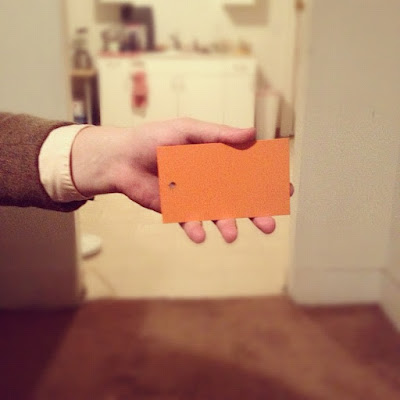
I've been documenting the making of a new bike for Josh Zisson of Bike Safe Boston, and he has this crazy idea to make the entire bicycle reflective - as in tire sidewalls, wheel rims and even the frame itself. Apparently there is a paint and powdercoating company in Indianapolis called Halo Coatings and they've developed a way to add an ingredient to powdercoat that would make it reflective under direct light ("halo patented retro-reflective powder coating"). I had a hard time believing this until I saw it in person. The orange paint chip above would be the colour used on his wheel rims. And watch what happens to it when it's photographed with flash:

image via BikeSafeBoston
Neat, isn't it? Examining the colour chip up close, it's got these tiny mirror-like particles embedded in the powdercoat and they create the reflective effect. The technology is very new, and so far there is only one bicycle I know of that it's been used on - a cargo bike by Tsunehiro Cycles that won 2nd place at the Oregon Manifest last year. Here is what that bike looks like in the dark. The potential of this product is exciting - though personally I can't decide whether reflective paint is a genius idea for city bikes, or whether it's sensory overload. I would need to see it in person I guess. What do you think - would you want a reflective bike?

Thursday, November 17, 2011

Dusk in the Afternoon

Dusk at 4pm
Cycling home the other day, I caught a glimpse of a clock in a storefront window. At 4 pm it had already grown dark. Like other signs of winter's approach, this gave me a pang of anxiety. The early onset of darkness restricts my mobility, and after two winters as a cyclist I still have not found a good solution. 

The main issue for me, is that the two major "commuter trails" we have in the Boston area - the Charles River Trail and the Minuteman Trail - are completely unlit. When it gets dark they turn pitch black. This directly affects my long-distance bike travel, because I regularly use these trails as "highways" to get to suburban destinations 8-12 miles away, both for transportation and for roadcycling. At one point I was determined to conquer the darkness with super bright lights. I was pleased to find that it was indeed possible to cycle on the trails after dark with a strong enough headlight. I would go slower than usual, but it was good enough. However, the one issue I had not considered seriously enough was safety. On the Charles River Trail, I've now been startled several times by intoxicated men in my path. And on the Minuteman Trail last week a group of highschool boys stuck branches in my spokes as I cycled past them. There were maybe six of them, and they'd been sitting on the edges of the narrow path, smoking and waiting for a cyclist to ride by so that they could do this. Under the cover of darkness people who are capable of violence tend to lose their inhibitions, which makes unlit trails problematic. But the alternative routes to the destinations to which the trails take me are along busy roads, and I do not find them viable to use on a regular basis.

So what am I planning to do about this?.. Probably nothing, other than making sure to make it home before dark if I am using the trails, which basically means restricting my mobility again for the duration of winter. Oh I know, I know. I could "be braver" and do those long trips on busy roads. Or I could become a "bring lights to the trails" activist and dedicate my life to getting petitions signed and funding allocated. But the reality is that most cyclists who find themselves in this position simply give up. We should not be faced with those choices just because we want to continue cycling safely and conveniently as the days grow shorter. 

Monday, July 18, 2011

Bicycle Safety: My Perspective

Stop
Every so often I am asked to state my views on safety with respect to transportation cycling*. Though reluctant to raise this topic in the past, after more than two years I feel ready to share my perspective. So here it goes, and I ask in advance that you help me keep any ensuing discussion civil:

When it comes to bicycle safety, I draw a categorical distinction between two facets that are often mushed together, but for me are entirely independent: (1) safe behaviour, and (2) protective gear. I believe that safe behaviour is essential and a matter of social responsibility. I believe that protective gear is secondary and a matter of personal choice. This distinction and prioritisation governs (i.e. biases) the views on transportational cycling that are expressed throughout this blog.

To clarify what I mean by "safe behaviour" on a bicycle, here are the points I consider crucial:

Riding a bicycle that is functional and road-ready
Taking reasonable steps to ensure one's bicycle will not fail on the road. This includes making certain that the wheels are secured and that the brakes, lights, and other crucial components are functional. Riding a bike with known mechanical problems, insufficient braking capacity, or any unusual features that make it intentionally difficult to operate, can have disastrous consequences in traffic.

Being in possession of basic bike handling skills
This includes being able to start and stop without faltering, to maintain a line of travel without weaving, to reduce speed when appropriate, and to safely maneuver around obstacles. It helps to ride the type of bike one is comfortable with and in a way they are comfortable with, depending on skill level and personal preference. Those who do not yet possess adequate handling skills should practice on trails and quiet side streets before mixing with traffic.

Adhering to traffic laws
Knowing and following local traffic laws, as they pertain to bicyclists. This includes respecting lane directionality, street lights, stop signs and right of way, signaling turns and intentions to merge, and in general behaving predictably.

Knowing safety maneuvers
Awareness of various crucial safety maneuvers and the ability to execute them. For instance: not positioning oneself in the blind spot of a car that could turn into one's line of travel, not cycling in the door zone of parked cars, and not passing other cyclists on the right.

Being visible
Having sufficient lighting on one's bicycle, so as to be clearly visible to others on the roads in the dark and in inclement weather.

Being vigilant
Paying attention while cycling; being cautious and attentive to what goes on in one's peripheral vision while resisting distractions. This includes not being engrossed in conversation with fellow cyclists, not chatting on one's mobile phone or texting, and otherwise not engaging in activities that detract from an awareness of one's surroundings.

You might not agree with me on some aspects of these points, but I believe in them and try to adhere to them to the best of my ability. In my view, this makes me a conservative and safe cyclist.

As for protective gear (helmets, knee pads, steel-toed boots, padded vests, pre-emptive neck and back braces, etc), these things are simply not relevant to the safe operation of a bicycle. We all have the right to expect safe behaviour from each other, when the behaviour impacts other road users. But we do not have the right to decide what each other's personal comfort levels ought to be, when this comfort has no effect on us.

In addition, I think that protective gear - whether we believe it to be useful or not - is secondary to safe behaviour to such an extent, that to stress it above the other stuff (as I feel is routinely done in safety campaigns) is misguided and even, dare I say, dangerous. As I write this, out of the window I can see a helmeted cyclist making a left turn onto a one way street against traffic, riding a bicycle with no handbrakes and no lights. I think this sort of thing is a direct result of promoting protective gear instead of safe behaviour, and I think it's evidence that we have our priorities backwards. I do not find that my views on this matter are radical, although sometimes I am made to feel as if they are. Whether you agree or not is entirely up to you.

--
*a small group of us (Dave from Portlandize, Matt from Bicycles, Books and Bowties, and myself) are working on a transportation cycling brochure, where the topic of safety will be covered. However, I am not the person who is writing that particular section, and the opinions expressed here - though congruent with those in the brochure - are my own.