Showing posts with label fixed gear. Show all posts

Monday, July 23, 2012

Fixed Gear Mercian, Freed and Re-Tyred

Mercian with Freewheel, Altered Gearing and Grand Bois Cerfs
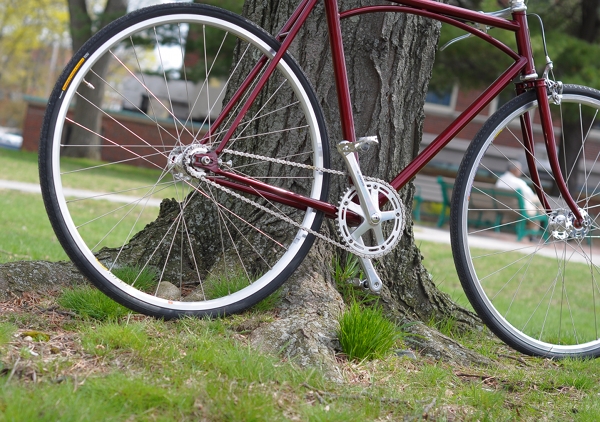
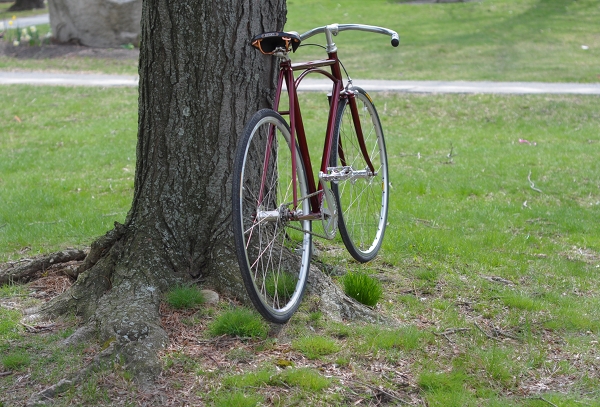
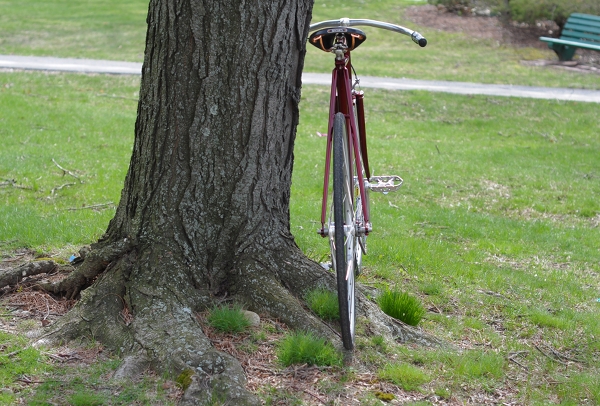
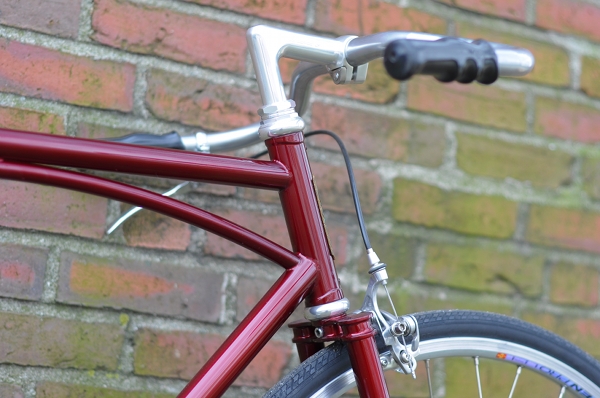
I've had a Mercian Vincitore since last Fall, riding it as a fixed gear fitted with 28mm Panaracer Pasela tires. Those tires are not known for their raciness, but honestly that suited me just fine, since my fixed gear riding style is best described as "pottering about." Still, eventually I got curious what this machine was capable of if fitted with faster road tires. I also wanted to feel what the bike was like to ride non-fixed. Now the Mercian sports 26mm Grand Bois Cerf tires and has temporarily been turned into a freewheel single speed.

Mercian Vincitore Lugwork
The bike rides better than ever. The tires have a lighter feel to them and the ride quality - which I didn't think needed improving at all - is nonetheless improved. I should note that right now I have an old cheap flip-flop hub wheelset installed and not the nice Phil Wood wheelset we originally built it up with. This does not seem to make any difference. The bike feels as if I am riding on narrow balloon tires, with the speed and maneuverability of a fast roadbike.

Mercian Track Ends
"Freeing" the drivetrain changed the feel of the bike in several ways. It made me more aware of how responsive it is to pedaling efforts. It made me want to alter my positioning - namely to move the saddle back a bit and lower the handlebars. It also made me wish the bike had gears! I didn't miss them at all in fixed gear mode, but now the bike seems to "want" them. It's probably just because I have never ridden a non-fixed single speed roadbike before. It will be interesting to experience it this way for a bit. After that I will change it back to fixed. 

Mercian with Freewheel, Altered Gearing and Grand Bois Cerfs
I will also be making some component changes in the coming year. The gearing has been lowered twice already and it's clear that it needs to be even lower to suit my pedaling style. The Campagnolo crankset makes that impossible, since the smallest available ring is 49t. I will replace the drivetrain with something that will afford a categorically lower gear. Also, now that the bike is no longer fixed, I realise that the (Veloce) brake calipers aren't just "a bit weak" as I thought before, but simply do not work here; I must have been compensating with my feet more than I realised. We will try replacing the brake pads, but I doubt that will make enough of a difference. A better solution seems to get a set of plain ol' Tektro medium reach calipers. The initial build was based on the parts that were available to me at the time more than anything, but I like to spin fast and I like brakes that work well, so the components will have to change.

Crankbrothers Candy 2, Mercian
I've enjoyed riding this bike tremendously over the past year and think it was the right choice for me for a fixed gear bike. I like the versatility and can see myself putting fenders and a rack on it in some distant future. In the nearer future, I am curious how a radically lowered gearing will affect my experience of the bike, in particular when I use it for recovery rides. I think it's the right way to go. 

Monday, May 7, 2012

Clipless Pedals on a Fixed Gear

Crankbrothers Candy 2 Pedals
For the final phase of my transition to clipless pedals, I've now installed them on my fixed gear roadbike. I knew that clipless would be trickier on fixed gear than on a freewheel bike, since you have to clip in and out while continuing to turn the pedals. I expected to have two specific problems: getting my left foot clipped in once I got going (I start with the right), and unclipping. For obvious reasons, the latter one worried me especially: What if I could not unclip with the pedals revolving constantly?

Now that I've done it, my impressions of the whole process are different from what I'd imagined. Clipping in my left foot is not as tricky as I thought. Yes, the pedal keeps going. But at least I no longer have to fish around for a strap with my toe as it rotates. Instead I just hang on and keep pressing into it even if the cleat doesn't engage right away; eventually it does. And clipping out is fine. Some cyclists say that they can only unclip when the pedal is in a specific position, but I guess I have been spared that problem. Sure, some positions are more awkward than others, but I can still unclip from them. 

So that's the good news. The bad news, is that starting is surprisingly challenging. I guess I didn't think this part through very well ahead of time. On a freewheel bike I clip in my starting foot on the downstroke, then pull the pedal up to start. Within a fairly short amount of time, this process has already become automated. Of course on a fixed gear you can't pull the pedal up without lifting the rear wheel, which I've never managed to learn how to do. So when I try to start I nearly topple over, because I automatically try to pull up on the pedal and all this does is jerk the bike violently. It's kind of funny that I do this every time, even though I know that you can't pull up on the pedal in fixed gear. Habits form quickly!

Anyhow. So I am not quite there yet with clipless in fixed gear, but I am enjoying the challenge. I either need to learn how to quickly lift the rear wheel while pulling up on the pedal, or reprogram my brain to clip in my starting foot on the upstroke, the way I used to do with Power Grips. Suggestions from fixed gear cyclists most welcome. Is there a way to make this easier on myself?

Tuesday, March 6, 2012

Fiddling with Handlebar Height

Dialing in the Mercian
I've been riding my fixed gear bike ("Mercy Anne") fairly regularly since we put it together in September. Not long rides, but frequent short rides. Unlike my geared roadbike, I never stopped riding the fixed gear over the winter. And of all my bicycles with drop bars, for whatever reason this one is the most ridable in regular clothing, so if I don't feel like wearing cycling clothes on a short ride I don't have to. I've even ridden it in skirts and semi-high heels a few times; it is surprisingly tame and versatile. 

Maybe it's because of that versatility that I find myself constantly fiddling with this bicycle's handlebar height. It's not that my positioning doesn't feel right, but more like all the positions feel equally right and I can't decide which one to settle on. When we first assembled the bike, I had the stem "slammed" and the bars considerably below the saddle. It felt perfectly comfortable, but over the winter I started riding in the city more and decided to experiment with being more upright. So I raised the bars to saddle height, and that felt great also. Then one day I lowered them again just for the heck of it, and that too felt good. 

Strange that on other bikes I feel a distinct "sweet spot" as far as handlebar height goes and on this one I do not. Not sure how many times I've raised and lowered the bars now thanks to the easy up/down adjustability of the threaded stem, but it's probably time to settle on one position and stop the madness. How do you decide on handlebar height, and do you tend to fiddle with it after the initial set-up?

Wednesday, January 11, 2012

Why Fixed Gear?

January Mercian
I have been riding fixed gear bicycles for about a year and a half now, and enjoy it so much that it is hard to talk about without getting embarrassed. Here in the Boston area, fixed gear is associated with a distinct cultural attitude and fashion sense, and I do not fit the mold. Seeing me on a bicycle with a fixed drivetrain often seems to surprise people, and I've been told on more than one occasion that I "don't seem like the type." While I suspect this is mostly used as a conversation starter by men, it still succeeds in making me self-conscious. What is it about fixed gear that I like so much and why do I "need" this type of bicycle?

I first tried a fixed gear bike in June 2010. I was staying in Vienna and pining over the nearby velodrome's summer closure, and a friend offered to teach me to ride a track bike so that I could ride around the velodrome building (this seemed very funny at the time - around the velodrome, get it?). I was afraid to try it at first, but as soon as I got on the bike I didn't want to get off it. It felt so natural and intuitive. My friend ended up leaving the bicycle with me for the duration of my stay in Vienna and I rode it in the park after work every chance I got. Cycling slowly due to the lack of brakes, I must have looked like an idiot, but didn't care. I discovered that on fixed gear, my bicycle handling skills somehow improved. I could make tighter turns, cycle through narrow spaces, control my speed better, and just be more in control. It felt as if I suddenly gained a better understanding of how a bicycle worked. The custom Italian track bike made for a now-retired racer felt unexpectedly comfortable, save for the curvature of the handlebars. I could ride this thing for hours with a silly smile on my face. It became clear during those rides that I needed a fixed gear bike of my own once I returned to the US. A friend of a friend sold me a good road frame for fixed gear conversion, and I mailed it to myself in Boston before leaving Vienna. 

Waiting for the road frame to arrive (it took over 3 weeks!) I couldn't stop talking about my experience with fixed gear, and just for the heck of it one weekend the Co-Habitant and I converted the Motobecane mixte I then owned to a single speed with a fixed/free flip-flop hub. Doing this was easy and inexpensive. We picked up a budget wheelset, modified the existing crankset, shortened the chain and that was pretty much that. I rode this bicycle around the city and out to the countryside, and it was great fun. But I mostly thought of it as a novelty. On an upright bike, I preferred a freewheel. This bicycle was a great hit around the neighbourhood though, especially when I fitted it with some colourful dressguards. The woman who later bought it planned to use it as a freewheel single speed, but liked the idea of having the fixed option by flipping the wheel.

Finally the vintage road frame I'd bought in Vienna arrived in the mail, and we quickly put it together. You might recognise this as the previous incarnation of the Moser I now ride as a geared roadbike. The tires here look huge, but they are 28mm Panaracer Paselas - the frame had just enough clearance for them if I did not use a rear brake. I rode this bike a lot, and particularly enjoyed it once it began to get cold. There was something about cold and dreary days on a fixed gear that was just magic. But while I loved riding the Moser, it became apparent over time that the frame was not really suitable for fixed gear conversion due to its very low bottom bracket. As my speed on the bike increased I started to get pedal strike when cornering on bumpy or uneven roads, and did not feel that this was safe. Last winter I began to look for another frame, which did not prove to be very easy given my criteria (lugged steel, horizontal dropouts, high bottom bracket, small size, and no toe overlap). I considered getting a frame from Royal H., but could not afford it. I considered the new SimpleOne from Rivendell, but learned that they would not be making one in my size. And that is how I came to be in possession of a Mercian.

By the time I ordered this bicycle from Mercian, I had a good idea of what I wanted in a fixed gear. I did not want a track bike, but a comfortable and somewhat relaxed roadbike that just happened to have a fixed gear drivetrain. I wanted to fit it with 28mm-32mm tires for road and occasional trails. I wanted it to have tame handling without feeling sluggish. All of this was done. When I began to ride this bicycle after we put it together, it was just the feeling I wanted. It is comfortable, intuitive, has no toe overlap or pedal strike, and I can ride it for quite a long time without getting tired.

So why fixed gear and what do I like about it so much? If I have to pin it down, there are two distinct elements of this type of bike that I enjoy. First, I simply find it soothing and pleasant. The motions my legs make on a fixed gear feel different - more circular and rhythmical. In that sense it is really not about speed at all, but about being able to ride with smooth and regular pedal strokes and enjoying the state of mind this puts me in. I find this to be very relaxing when I am stressed out. Even just riding in circles around the neighbourhood, the magical sensation of the drivetrain never fails to calm me down and clear my head. 

January Mercian
Second, I feel that riding a fixed gear roadbike helps me with technique. My movements feel more elegant and precise, and I can sense that I am developing a more intuitive sense of balance. I play games where I try to keep the bike going at all costs - slowing down to a crawl before a traffic light rather than stop as I wait for it to turn green. I also like to see how fast I can accelerate under different circumstances, and play "sprinting" games until I get out of breath. This is much more interesting to do on a fixed gear than on a freewheel bike, because once you get the drivetrain going it feels as if it "helps" you. All this may sound silly, but somehow I feel that things like this really help. Fixed gear bikes feel playful and very safe, which encourages me to try all this stuff that I would not normally try. Slowly but surely, I can tell that it improves my geared roadcycling skills - including the somewhat "duh" realisation that if I continuously pedal and feather the brakes instead of coasting, then I will feel more in control of my geared roadbike as well.

But all this talk of technique is probably beside the point. When it comes down to it, we do things that we enjoy and fixed gear is for me simply one of those things. I can't imagine not owning a bike like this. I begin to get fixed gear cravings if I don't ride one for more than a week. Luckily, that should not be a problem. 

Saturday, December 10, 2011

Quiet Winter Mornings

Last Ride of November
Riding a comfy fixed gear roadbike on a crisp December day, I realise that I know few better ways to achieve the feeling of all being right with the world. Something about the rhythmic motion of my legs and that perfect "wheels go round and round" sensation of fixed gear, just seems to make my body happy. I don't ride very fast and Mercy Anne is an even-tempered bike; a bike that does not demand I push myself but is happy to adjust to my mood.  

I have been trying to get into the habit of riding earlier in the morning. There is almost no traffic getting out of town, and for a little while I enjoy the illusion that the streets belong to me. The sun shines weakly at first. The frost on the grass casts a bluish tint over the landscape. It is freezing and I can see my breath in front of me. I try to keep my mouth closed as I breathe. My eyes are tearing up and I remind myself to wear sunglasses next time. I wear two layers of medium-weight technical wool and a windproof jacket, finally having "gotten" how to dress for winter after 2 years. Still, brrr!

And then, almost all at once, it feels as if nature turns up the thermostat. Is it me, having gotten warmed up, or has it actually grown warmer? I look and suddenly there is no more frost on the grass. Probably a bit of both. The sun has risen higher now, and shines a warm yellow. It is almost 9 in the morning. Time to head home .  

Wednesday, November 2, 2011

Mercian Vincitore: First Impressions

Mercian Vincitore, Nitto Noodles
At this point some of you know that my new fixed gear bike is a Mercian. It was meant to be part of a "his and hers" pair, and I tried to postpone writing about it until the Co-Habitant's bike was set up. But it looks like that won't be happening for a bit, and hiding mine in the meantime felt wrong. So here is a less dramatic introduction that will hopefully still be informative for those curious about this legendary manufacturer.

Mercian, Lillies
In the Fall of 2010 we began talking about getting the Co-Habitant a nice touring frame, and at the same time I started looking for a fixed gear frame for myself to replace my vintage conversion. After considering the kinds of bikes we wanted (lugged steel, comfortable, fast, fairly lightweight) Mercian was one option we gravitated towards. A small manufacturer in Derby, England, Mercian has been building custom frames since 1949. With pricing for a lugged steel frame made with Reynolds tubing starting at under $1,000, the value is hard to beat. And their waiting times were not absurd. I happened to know a handful of Mercian owners who were experienced cyclists and whose tastes I respected, and they all raved about the bikes - some being repeat customers. Finally, it appealed to us that Mercian Cycles are made in England, toward which we both feel some personal attachment. We considered other manufacturers and custom builders, but found that they were either unaffordable or did not offer quite what we wanted. After several months of research, contemplation and budgeting, we placed an order with Mercian in Winter 2011.

Mercian, Lillies
The way the order process works, is that they send you a form to fill out that is similar to their online framebuilder (warning: use at your own risk; has been known to result in frame purchase). You then submit it along with a deposit and get in the queue. When it comes time for the frame to be made, they confirm the specs and proceed. Afterwards the frame waits for paint (two tone liquid coat and lug lining are included in the price), and when everything is done you pay the remainder of your balance and the frame is shipped to you. When we were placing our order, it was estimated that the frames would be ready by summer. The actual time of completion ended up being in autumn. There was a small adventure with US Customs, but that was soon resolved and the frames arrived at our door in the end of September.

Mercian Vincitore, Headtube
While allowing for custom geometry specifications, Mercian offers more than half a dozen lugged frame models, each in a choice of several different tubesets. From the beginning, we both knew that we wanted the Vincitore Special model, because of its distinct handmade lugwork.

Mercian Vincitore, Seat Cluster
We were less sure about the tubing, but after speaking to several Mercian owners settled on the 631 - the modern version of Reynolds 531

Mercian, Lillies
I wanted my bicycle to be a comfortable and versatile single speed/ fixed gear, not a track bike. So I asked for the "Sportive" (sports touring) geometry with track ends. This is an entirely normal request for Mercian, as almost any model can be built as a fixed gear - they just need to tweak it to make the bottom bracket higher. I also asked for braze-ons for fenders just in case I'd want to use them in future. 

Mercian Vincitore, Cambridge MA
There was a myriad of other choices, such as threaded vs threadless steerer (threaded), maximum tire size (32mm), where to route the brake cable (braze-ons are along the top), how many bottle cage bosses (just 1), and whether to drill for brakes front and rear (yes to both). Aside from this, the only real custom thing I asked for was making sure there was no toe overlap - which caused them to make the top tube longer than they normally would on a frame this size. 

Mercian, Lillies
After agonising about the paint colour, I finally settled on a subdued lilac with white panels and white lug outlining. I wanted to make sure that the colour came out subtle, and not like a garish purple. I sent Mercian pictures with a description of what I wanted it to look like, and the result is pretty much spot on.

Vincitore Lugwork
The one thing I would have done differently here, is not use black lining where the lugs meet the white head tube panel (black is so harsh, why not gold?) - but this is stylistically typical for Mercian and ultimately fine with me. Sadly, there is no space on the headtube for a headbadge emblem, due to my small frame size. Maybe later I can get a miniature one made. 

Mercian Vincitore
My frame came out as I specified. It fits me well and there is no toe overlap with the 28mm Panaracer Paselas (more like 30mm in actuality) that I now have it fitted with. But it's close, so if I install fenders in future, I will have to consider my tire and fender choice carefully. When I mentioned earlier that the Co-Habitant's frame is not ready, it is because the one he received did have overlap despite its large size and his request for no TCO. He has spoken with Mercian about it, and they have agreed to resolve it. Once his frame is ready and he wishes to review it, I will write more about his experience; until then I will stick to discussing my own bike.  

Mercian Vincitore, Headtube Lugs
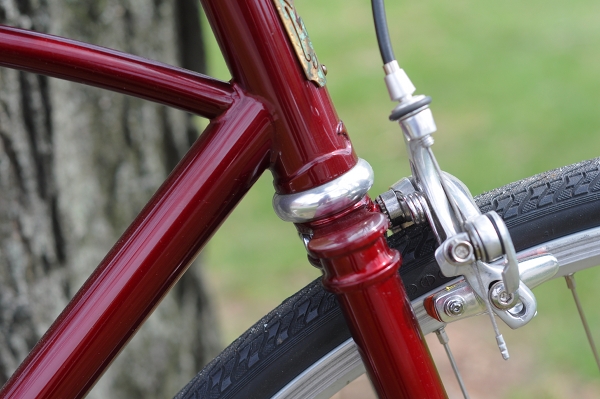
When it comes to construction, the main gist of my first impression is that the Mercian Vincitore frame is strikingly "different" from other currently made lugged frames I have seen. I don't mean the shape of the lugwork, but the craftsmanship itself. Different how... All right, the best way I can describe it is that it looks like a vintage frame in mint condition and not like a currently made lugged frame. In fact, every single (knowledgeable) person who's seen the bike in person so far was certain it was an older frame until I'd point out the Reynolds 631 decals. It's difficult to pinpoint what exactly creates the vintage impression, but it's everything from the finishing to the close-up look of the paint and outlining. Mercian's production methods for their classic frames have remained unchanged for decades, and that is probably what we are seeing. It's quite uncanny actually, and when we first received the frames we kept staring at them and running our fingers along the tubes and edges of the lugwork in disbelief. You really have to examine this bike next to, say, a Rivendell to see what I mean. 

Mercian Vincitore, Cambridge MA
We built the bike up with a medley of mostly high-end, gently used components that I either already had or managed to get a good deal on. I am still not sure what's staying and what will ultimately be changed, so I will include the component list when I write a proper review at a later stage. 

Mercian Vincitore, Cambridge MA
I have the bars about 2" below the saddle at the moment - which may ultimately be too extreme for me, but feels surprisingly okay for now. Initially the bike had 49x16 gearing due to the wheels and crankset I ended up with, but from the very beginning I intended to change it. After absorbing a great deal of advice, I decided to switch the rear cog to a 19t. The gearing now is quite low, and hopefully the spinning will keep me in shape during the colder season.

Mercian Vincitore, Cambridge MA
Having only ridden the Mercian a few times so far, it is much too early for anything resembling a review. But I can say a few things: The ride is not harsh at all - which was a top concern for me, as harshness causes me a great deal of pain. I also like the "feel" of the tubing, in the sense that it's just the right amount of flex for my taste. On the 20-30 mile rides I've taken so far, I've experienced less fatigue on this bike than on other fixed gear bicycles I've ridden, which may be related to both of the above points. One thing to be aware of, is that the 631 frame is not spectacularly "lightweight" by contemporary standards, and part of me now wonders whether I should have paid more and gotten lighter tubing. But would I get the same ride quality with the lighter tubing? In a fictional dream-world I would be able to try an identical bike with 725 or 853 tubing, then decide. Until then, if I am happy with how the bike feels, it seems silly to wonder about different tubing options. [Edited to add: We've weighed this bicycle and it's 22lb with the build shown, not including saddlebag.]

Mercian, Lillies
Well, that is all I have for now. Despite our early snowfall, I hope to have much more time with this bicycle before winter really hits. It is basically my roadbike for the rest of the year: With the shorter days, I no longer have time for long rides and for me a fixed gear is ideal for 20-30 mile jaunts. The bicycle is of course beautiful, and I am looking forward to getting to know it better. If you are looking for a traditionally made steel frame with custom geometry at a reasonable price, Mercian Cycles are worth exploring.

Friday, October 28, 2011

Winter Follows Me Around

Snow in October?...
When I complained about the unseasonably cold weather in Vienna, the Co-Habitant comforted me with tales of 60 degree temperatures back in Boston. Imagine my dismay when I came home to this. 

Snow in October?...
Snow, in October! I went for a 25 mile ride wearing layers of wool and a down vest, my nose running the entire time. 

Snow in October?...
The sun helped me warm up, but even as late as mid-morning there were some icy patches on the Minuteman Trail, and cycling over slippery wet/ frozen leaves was especially treacherous. 

Snow in October?...
But I realise that I've reached a level of being comfortable on the bike where I will actually cycle over slippery leaves and frost-covered brickwork intentionally, just to see what happens. So far, nothing. Once my rear wheel skidded a little, but that was all. I am trying to develop a feel for traction on a fixed gear bike, so that I can be more confident once it starts snowing properly... but I am not sure I understand it.

Snow in October?...
Last winter the transition from riding a roadbike almost daily to not at all was very difficult for me, and I am trying to mentally prepare myself this time. I had been counting on at least another good month of cycling before the snow, but apparently nature has other plans and I will have to adapt (i.e. get the trainer out from under the bed). Of course I will still keep cycling for transportation, but last winter that did not feel like enough. What are your winter cycling plans?

Wednesday, October 5, 2011

A Country Ride in 49x16 Gearing...

Angie, Maiden Voyage
We've finally set up my fixed gear bike, and the build came out much spiffier than I initially planned. Concerned citizens saved me from putting cheap components on a nice frame and I was able to get good deals on a very nice crankset and wheelset. One tiny problem however: the crankset has a 49t chainring and the wheelset came with a 16t cog, so the bicycle is geared insanely high. I decided to keep the cog and replace the chainring, most likely with a 44t. But that has to be special ordered, and in the meantime I really wanted to ride! Opinions are split on whether it is wise to ride on the road in such a high gear, but the consensus is generally "no." Having tried it, I agree - though it wasn't nearly as bad as I anticipated.

Riding in traffic was fine: It was not difficult to start at intersections, and to stop I simply used the brakes. Braking with my legs would have been out of the question after accelerating, but with good brakes this isn't an issue. I then went on a 20 mile ride on the Minuteman Trail, which is pretty flat but with a sustained upward/downward incline depending on the direction of travel. The gearing was doable. I felt it in my leg muscles, but not in my knees, and was fine the next morning. But while doable, it wasn't much fun - in the sense that I prefer to cycle at a high cadence and most of the time that wasn't possible in this gearing.  It was exciting how fast the bike accelerated on flat stretches, but the upward inclines felt like walking up an endless staircase. It was neat to experience just as a way of physically understanding how different gear ratios work in fixed gear, but I would not want to ride that way on a regular basis.
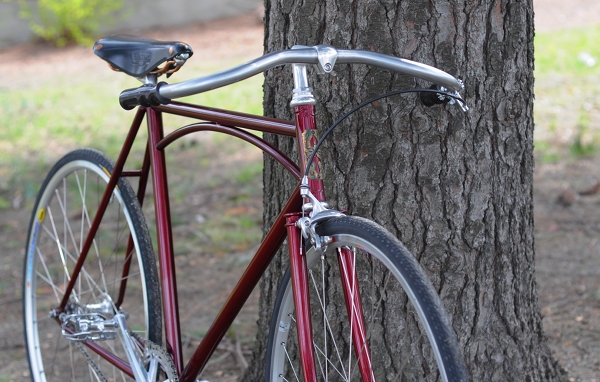
On my previous bike the gearing was 48x18, which felt slightly too low toward the end. So I am thinking 44x16 on this one should feel just about right. The bike is great and I am looking forward to many country rides in an appropriate gear in the coming months. Don't know why, but it feels really good to ride fixed gear when it's cold outside!

Thursday, September 22, 2011

Thoughts on Fixed Gear Cranksets?

Fork Ends
I am guessing you would welcome a break from Interbike at this point, so I am going to take advantage of that by asking for advice. Just in time for the cold season, I finally have a dedicated fixed gear frame to replace my Moser conversion. I will tell you about the new frame later, as it's part of a larger story. But suffice to say I have it and it's nice. My plan was to simply move all the parts from the Moser onto this frame. The parts are rather plain and cheap-ish, but they will do for now and maybe in a year I will upgrade to something fabulous and Phil Woodsy. But the one thing I forgot is that the crankset I have on the Moser (Sugino RD2) has the wrong length cranks for the new frame. The Moser had a low bottom bracket, so the cranks I have on it are 165mm, but the new frame has a high bottom bracket and I want to use 170mm. So I need a new one and therein lies my dilemma: I am clueless about single speed cranksets.

Royal H. Stainless Rainbow Bike
For example, one option would be to just buy another inexpensive Sugino RD2. However, I am told that this is ultimately an iffy idea for a fixed gear roadbike, because it's not made for a track chain. Also, if I do plan to upgrade the components, it doesn't make sense to buy cranksets twice - maybe I should get the nicer version already.

ANT Truss Bike, Sugino 75
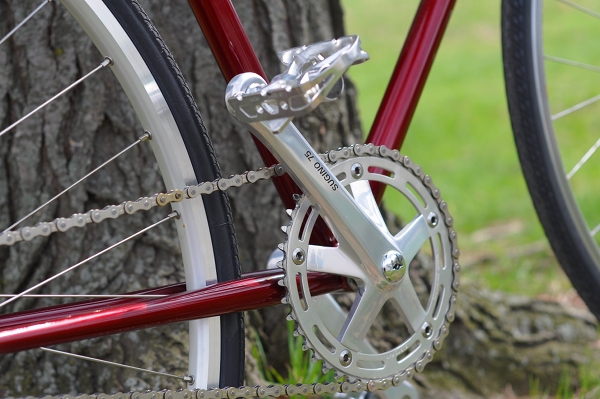
And the "nicer version" is apparently the Sugino 75. It is a Keirin-approved track crankset and is extremely expensive. Why I need it, I couldn't tell you - since my fixed gear frame is not a track frame and I won't be racing on it. Even in terms of aesthetics I don't find it all that spectacular. A friend might have one to sell secondhand, in which case it may be worth it - but otherwise I don't get the appeal of the Sugino 75 for non-racers.

White Ind crank
image via antbike
There are also the American made cranksets, such as this one by White Industries. Expensive, but less so than the Sugino 75. And while beautiful in its own right, I can't decide whether it will look right on my frame - the design seems a bit busy.

Cranked
image via Winter Bicycle
The Paul's "circles" crankset is simpler, but part of me thinks it should go on a bike with Paul's  drop-outs, which mine does not have. Is that silly?

It is also worth noting that the "nice" cranksets call for equally "nice" bottom brackets, so the real price differential between these options and the Sugino RD2 set-up is even greater than it seems initially.

Of course my ideal scenario would be not to go with any of these, but to find a beautiful vintage Campagnolo Pista crankset - for a miraculously low price, of course, and with just the right length cranks. No such luck though, after months of looking.
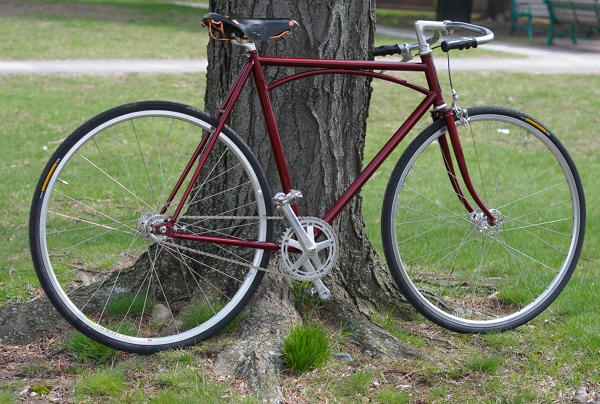
So, dear readers: Any thoughts? What is your preferred crankset for a fixed gear roadbike and why? My frame is lugged and fairly lightweight and I'd like the crankset to look classic. The bike is not for the track, so all the debates about tiny differences in stiffness are not really relevant. Beyond that, I have no idea. Help?

Monday, May 2, 2011

ANT Truss Bike: My Dream Test-Ride

A little while ago I finally test rode an ANT Truss Bicycle for the first time, and the memory now seems like a dream. I cannot describe how much I love this frame design, specifically as executed by ANT. I have a separate post about truss frames, so I won't go into it again here. But something about that truss, in combination with the double plated fork crown, just "hits the spot" for me visually, and I've fantasised about riding one more times than I care to admit.

Luckily, I know Jim A. - a great mechanic at Harris Cyclery - who owns a glorious truss frame ANT, which I was able to ride. In retrospect, I can just kick myself for not taking the pictures before lowering the saddle, because the bike looks better with more seatpost showing. But in my excitement I was not thinking clearly and I hope you can overlook this aesthetic blunder.
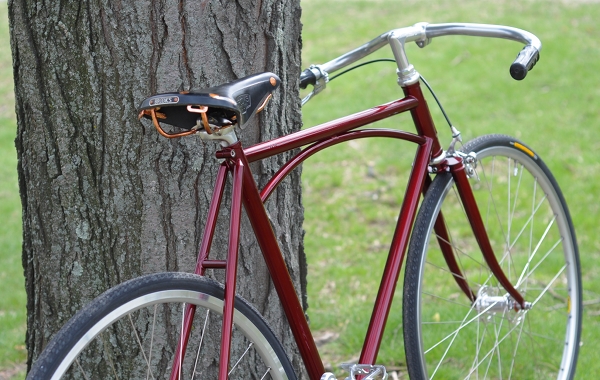
Jim's ANT was built in 2007. It is a 53cm frame with 700C wheels, built for fixed gear.

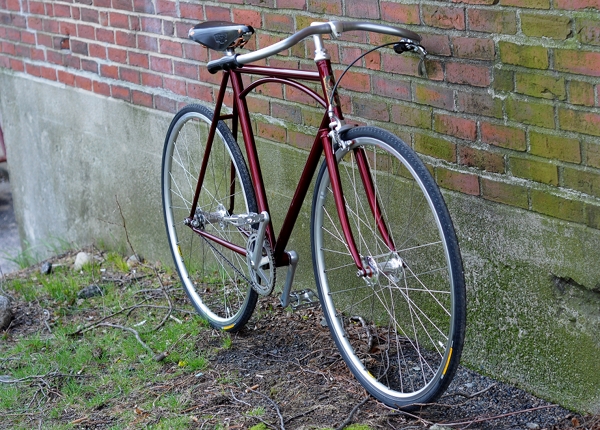
The paint is liquid coat and the colour is a shade of dark cherry that appears to drip seductively as it catches the light.

Photographing this part felt a little wrong, but I decided an invasion of privacy was in order here to show the full darlingness of this sexy creature.

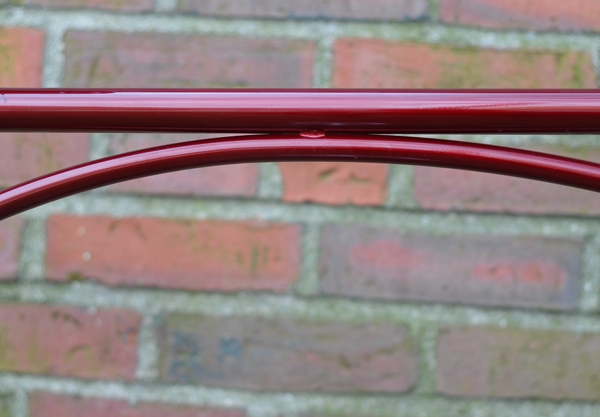
As I've written before, the truss frame is one design that I actually prefer to be TIG-welded (or fillet-brazed) as opposed to lugged, because lugs - to my eye - would look too busy here. The key for me is that these welds to be cleanly done, and this frame does not disappoint in that respect.

Jim A. set up this bicycle very similarly to the way I would have done. The upside-down Nitto Albatross handlebars strike the perfect balance between aggressive positioning and comfort. The single front caliper brake and the fixed gear rear wheel are uncluttered, simple to operate, and in keeping with a vintage look. I would put the brake lever on the right handlebar, but otherwise would set everything up just the same.

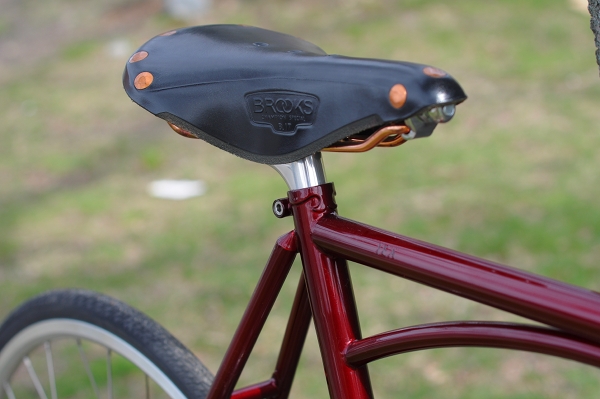
The copper rails and rivets on this Brooks B17 complement the frame beautifully. Those are Jim's initials carved into the toptube, in case you spotted them.

Rear brake(less) bridge. Though I have seen some truss frame bicycles equipped with fenders, racks and all sorts of extras, I think it looks best without - pathracer style.

The Sugino 75 is a really nice track crankset that the Co-Habitant thinks I ought to get, should I ever upgrade my fixed gear roadbike. Truthfully, I kind of don't get what the big deal is with this particular crankset, but sure - it looks nice enough.

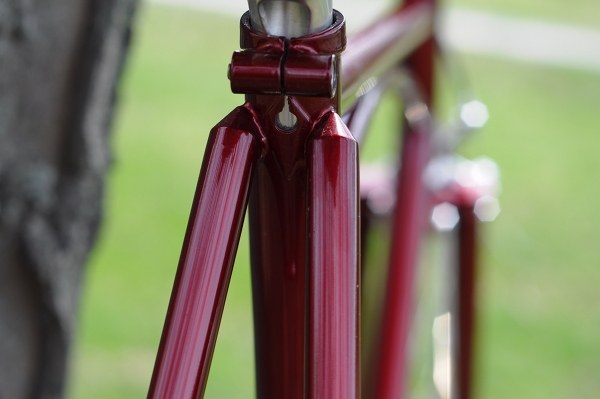
These Paul dropouts are beyond "nice" though: I'm afraid I will salivate if I look at these for too long. Mmmm!
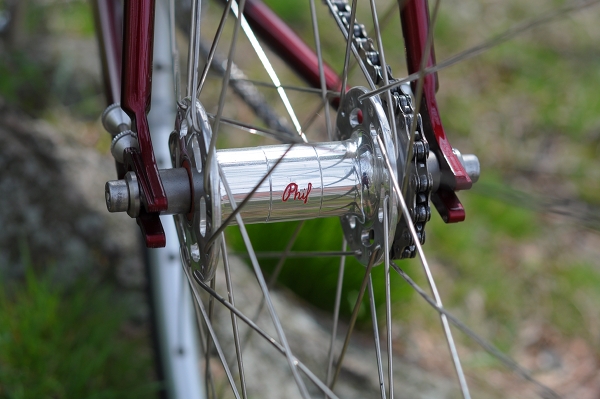
I wasn't especially attracted to Phil hubs until I saw this on Jim's bike. Gosh, this just looks so perfect.
And from another angle...

I rode Jim's truss bike briefly and slowly - It was in such perfect condition, that I was scared to death to let anything happen to it. Sadly, there was no one around to photograph me, as Jim was working and the Co-Habitant was busy buying components. But just imagine me looking both ecstatic and terrified as I pedaled this graceful machine along West Newton side streets, past pensioners and mothers with baby carriages... Of course they all wanted to ride it. As their eyes followed the glistening Phil hubs with longing and admiration, I felt like the luckiest girl in town.

I don't know how useful it is to review a custom-built bicycle, and one ANT truss frame may not necessarily feel or handle like another. But in case you are curious...

The first thing I noted, was that the bicycle felt significantly lighter than I expected it to. I guess because of the truss construction, I assumed that it would be on the heavier, clunkier side - more like a roadster. But this truss was whippet-sleek, lightweight, elegant and compact.

I got on and was surprised at how far forward I had to lean in order to reach the handlebars - Jim must have used a long stem to compensate for the swept-back Albatross bars. The aggressive posture made it easy to accelerate once I began riding and to go faster than I had intended. It was at this point that I realised how unaccustomed I'd gotten to riding fixed gear without foot retention, and also to the brake being mounted on the left. Thankfully, I figured it out in time to stop for the next red light - but after that I slowed down and was more careful. The ride was comfortable - nothing hurt and there was no excessive strain or pressure on any part of my body. For a bicycle with 28mm tires, it did not feel harsh over bumps. It felt stable, but then I tend to feel more stable on fixed gear bikes in general, so I don't know how telling that feedback is. Having never ridden a vintage pathracer, I cannot compare it to one - but I am fairly certain that the geometry of the ANT truss frame is modern and does not emulate actual vintage pathracers.  If I had to categorise the handling, more than anything it felt like a light and fast "casual" bicycle for those who are used to roadbikes but want something a bit gentler and more upright for Sunday afternoon rides with friends.

While some might question the practicality of a vintage-styled pathracer in an era when racing is done with dropbars and commuting is done with fenders and racks, I think that's beside the point. The classic truss frame pathracer is an idealised examplar of what ANT can create, and I find that appealing. Not all bicycles need to be versatile and practical in every respect. When I get my ANT, it will be almost exactly like this one - just because I want to support and celebrate what I believe to be Mike Flanigan's craftsmanship at its best.

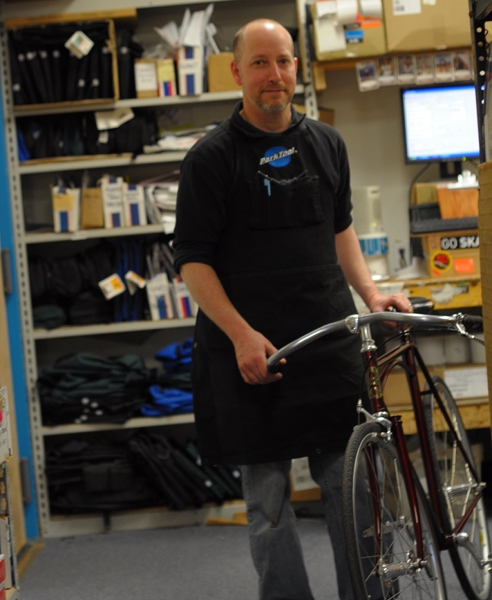
Though I only managed to take this shabby picture of Jim A. with his bike, some day I will meet him outside of work and take a nicer portrait. Until then, I thank him for entrusting me with his Truss. This is truly one of my favourite bicycles.