Showing posts with label fashion industry. Show all posts

Wednesday, June 13, 2012

Bicycles in Product Branding

Having dabbled in marketing in the past with an emphasis on branding, I am always interested in the associations manufacturers use to add appeal to their products. And of course when bicycles are involved I take notice. Looking at how bikes are presented in product branding, there are multiple themes. For instance here is a cycling cow selling ice cream. It's a cute image but why that specific cute image? Well, let's see... The cow is riding a vintage delivery trike loaded with steel dairy containers. So the idea here is to associate the brand with old fashioned methods of production and distribution. This is echoed by the word "creamery" in the name.

And here the idea of cycling is subtly used to associate the "zero calorie" lemonade with weight loss, while the penny farthing imagery goes nicely with lemonade's old fashioned appeal. There's the "honest" thing as well, which I've noticed in other foods that picture bicycles on the label. Do we associate bicycles with honesty?

Wholesomeness maybe, or nature - suggesting that the food is organic and "honestly" obtained regardless of whether that is so? Could be.

Penny farthings are used as symbols of old timey-ness across product categories. This perfume manufacturer uses it to suggest vintage elegance, congruently with the antique look of the bottle and the distressed label. Curious, I smelled the perfume. Sort of floral and dusty, but not too heavy. I suppose it goes with the vintagey presentation, though personally I associate cycling with fresh air and not perfume.

At the same time, bicycles can just as well be used as symbols of contemporary culture. 

I see more and more clothing and accessories where bicycle references serve as shorthand for a "hipster" identity.  "This garment is for the cool urbanite who rides bikes, or wishes they did."

The bicycle can also suggest fun, whimsy, levity. Drinking from these cups promises to be fun because of that bicycle imagery. To some extent this might also be behind the increasing popularity of bicycles on alcoholic beverage labels.

Do bank notes qualify as a product? I guess they do. Someone designs them after all, with both function and aesthetics in mind. While in Antrim, I was intrigued to discover there is an antique path racer on the Northern Ireland 10 pound note. I looked it up, and learned it is in honour of John Dunlop, who invented the pneumatic tyre whilst living in Belfast. So here the bicycle is part of a narrative about heritage - with additional implications of self-sufficiency and freedom of travel. More than anything, I find it delightful to know that about a million people in Northern Ireland are walking around with pictures of vintage bicycles in their pockets.

There is always talk among bicycle activists about how to create positive associations with cycling in the public's eye. Meanwhile, other industries harness the already existing positive associations to enhance the appeal of non-bicycle-related products. Interesting how these things connect, overlap and feed off of each other. 

I wonder to what extent it is cyclists who find bicycle-branded products appealing because they identify with the bicycle, as opposed to non-cyclists whose imagination is engaged by the mere idea of the bicycle. I suppose it is probably both. 

Friday, September 16, 2011

Song, Dance and Bicycle Romance: The Interbike Fashion Show 2011

Interbike Fashion Show, Linus Bikes & Chrome Apparel
bicycles: Linus, outfits: Chrome, models: unknown
Now in its 4th year, the Interbike City Style Fashion Show, presented by Momentum Magazine, was a production in true Las Vegas style. The models - all real bicyclists with healthy body mass indices and mischievous grins - didn't just cycle down the runway. They pranced, twirled, froze in fetching tableaux, and performed choreographed little dance numbers worthy of a small scale musical - against an ever-changing backdrop representing North American cities.

Interbike Fashion Show, Polka Dot Scarf, Cruiser
model: Susi Wunsch of VeloJoy, dress: Nona Varnado, bicycle: unknown 
Each model would begin with the standard runway walk, then, seemingly spontaneously strike an outrageous pose or break out into a full on dance routine. Could this have been inspired by Glee?

Interbike Fashion Show, Sun Atlas
bicycle: Sun Atlas, outfit and model: unknown
Whatever the inspiration, it was a great display of showmanship, keeping the audience entertained and energized.

Interbike Fashion Show, Bella Ciao Superba, Basil Pannier
bicycle: Bella Ciao Superba; panniers: Basil, outfit and model: unknown
After doing their thing on the stage, the models would ride down a ramp and proceed along a cycle path marked with sharrow decals that wound through the spectators' area, adding an interactive element to the show and creating multiple focal points.

Interbike Fashion Show, DJ
The DJ did an excellent job keeping the energy levels high, and even while taking photos I found myself moving and snapping to the beat.

Interbike Fashion Show, Bella Ciao Superba, Christiania Cargo Trike
bicycle: Christiania cargo trike; model and outfit: unknown
It was all great theater, though on a critical note I am not sure how well it worked as a fashion show per se.

Interbike Fashion Show, Gazelle and Ortlieb
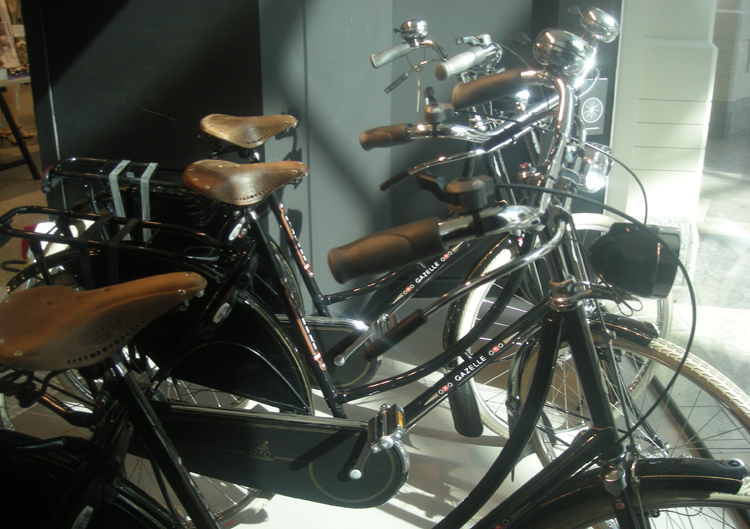
bicycle: Gazelle Basic, model and outfit: unknown
I found it surprising that the designers were not named and the pieces worn by the models were not vividly described. If the point of the fashion show was to exhibit new lines of cycling-specific apparel and introduce the audience to new designers, I did not really feel that happening. It's possible there was a brochure I missed where this information was provided [edited to add: yup, there was - someone's just emailed me a copy and I've posted it here], but even then I feel that it should have been a prominently vocalised part of the show itself.

Interbike Fashion Show, Biomega and Neo-Baroque Dress
bicycle: Biomega, dress: Sheila Moon, model: unknown
This neo-Edwardian dress - which is difficult to photograph but looks stunning in person - was my favourite piece, but unfortunately I did not know who made it or anything else about it at the time of the show. I've since been told it's by Sheila Moon, but I do not see it on her website - link to the dress anyone? I have a dozen photos of it, but as luck would have it most of them came out blurry!

Interbike Fashion Show, Handsome Bicycle
bicycle: Handsome Cycles, trench: Madame de Pe
Another piece that stood out was this cape-like trenchcoat, with its unusual tailoring. I imagine the tent-like shape is to keep the knees dry in the rain.

Interbike Fashion Show, Will of Boxcycles on E-Bike
model: Will of BoxCycles, bicycle: Styriette Pedelec,  outfit: unknown
In general, I would have loved to learn more about the clothing, and to know what exactly makes each outfit conducive to cycling - especially since some of the designers must have worked hard on that aspect.

Interbike Fashion Show, Yuba Longtail
bicycle: Yuba, outfits and models: unknown
All in all, I think the show was more about fostering a positive, even romantic image of the bicycling lifestyle than about displaying specific pieces of apparel - which I don't have a problem with in the least, but which I don't believe is technically a fashion show. Then again, who wants to be technical about it if the audience is having a good time.

Interbike Fashion Show, Linus
bicycle: Electra, outfit and model: unknown
One concept that the show brought across quite successfully, I thought, was the possibility for variety. Some pieces did seem to be bicycle-specific designs, while others appeared to be just regular clothing. Some models were wearing helmets and others were not.

It seems that many manufacturers are trying their hand at cycling-specific street apparel nowadays: everything from jeans and dressy trousers to button down shirts and blazers. And while some believe that to ride for transportation one need only look in their closet, others welcome these bicycle-specific inventions. The Interbike Fashion Show seemed to embrace both views - encouraging cyclists to wear whatever makes them comfortable and to have fun with it.

Wednesday, November 10, 2010

Reaching a Non-Cycling Audience

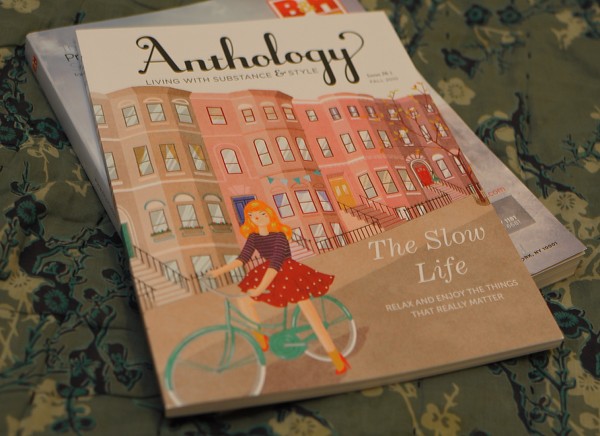
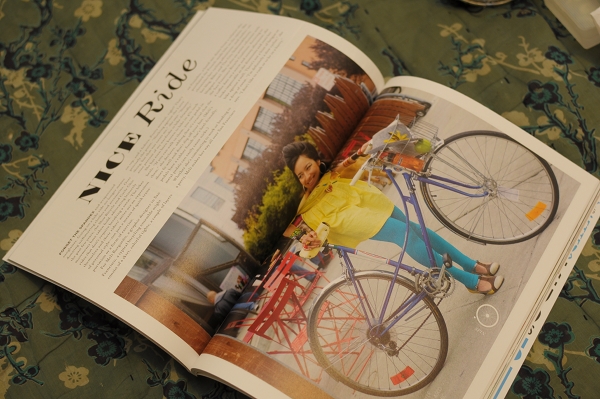
I received a copy of the first issue of Anthology magazine in the mail today - sent to me, because they ran a feature on Lovely Bicycle. I knew they'd made some illustrations based on my photos, but I did not expect to see a cartoon version of myself and the Pashley Princess (depicted complete with cream tires!) cycling through a cartoon version of Boston. Funny! Unlike the real me, my cartoon self likes to cycle in high heels - so perhaps she can teach me a thing or two!

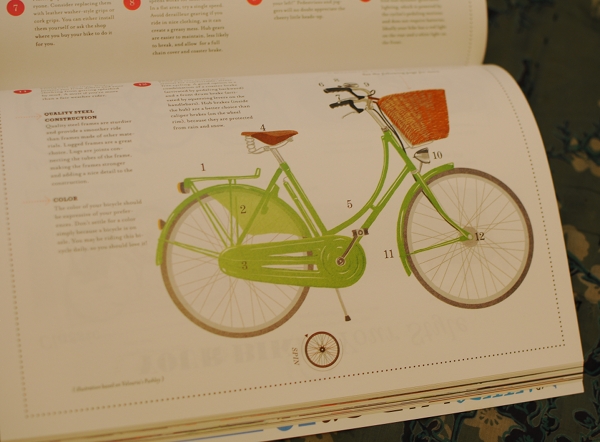
The story they ran included an edited version of my "Bicycles for Everyday Cycling" page, which I hope will be helpful to readers of the magazine who are considering purchasing their first bike.

I think it's neat that Anthology presented the information as an "anatomy lesson" and made its own hand-drawn illustrations (by Kris Atomic). This makes the text a lot more engaging than my original version (I read it with interest!) - and achieving that is important for print publications trying to compete with online media. I can imagine somebody who is not into cycling at all picking up this magazine in their local coffee shop or book store and getting drawn into the article, becoming curious about bicycles as a result.

In addition to the "Anatomy of a Lovely Bike" article, there was also a beautiful feature on Meligrosa of Bikes and the City with her cool mixte, as well as a helpful piece on shopping for bicycles and accessories.

One reason I am pleased to be featured in Anthology, is because they are not a cycling publication, but a more general lifestyle magazine. Before I began Lovely Bicycle, there was a period of a year or so when I vaguely wanted  a bike but did not know how to even begin looking for one that was right for me. There was a disconnect between the sort of bicycle I wanted and what was available in most bike shops at the time, and I simply did not know where else to get information. A series of bike-related articles like the ones Anthology published would have helped me, and I hope that they can now help others. Besides, I just love the idea of things like dress guards, chain cases and "lugged steel construction" being presented as standard features. I hope that women walk into bike shops and ask for them, as casually and matter-of-factly as they would ask for cake in a bakery.

Friday, July 30, 2010

Excess in the Bicycle Industry: Explanations and Implications

[Aurumania crystal and gold track bike, image via forbes.com]

A couple of weeks ago, Forbes published an article on "The World's Most Expensive Bikes".  Readers have been sending me links to this article asking what I think, until finally I gave in and read it. 

[Golden Brompton, image via forbes.com]

Glancing over the pictures, I noticed a strong trend for gold plating, crystals and diamonds - the usual when it comes to "luxury bikes". It made me wonder how much of these bicycles' price was due to ride quality (can they even be ridden?) and how much was due to the decorative elements. 

[KGS custom Parlee bicycle, image via forbes.com]

I was also surprised to see that I actually know someone whose bicycle is on the Forbes list (not my cup of tea, this bike, but I understand that some people like to race on such things).  Kevin Saunders of KGS Bikes is an acquaintance (now also a sponsor, but initially an acquaintance) and the proprietor of a custom bicycle shop in San Antonio, Texas specialising in roadbikes that promise the "perfect fit." While admittedly high end, I did not think that most KGS bikes fetched the kinds of prices featured in Forbes. So I asked Kevin about it. His answers were pretty straightforward, and I include them here in response to this discussion on Chic Cyclist (see the comments section):
Velouria: Kevin, how do you justify your $32,000 bicycle that was featured on the Forbes list?
Kevin Saunders: The bicycles in that price range that we have created were commissioned as one-offs. (They were also done prior to the Recession that started in 2008.) A price of around $18.000-20,000 is where we find the line between premium (where more expensive components actually perform better) and luxury (where more expensive components may have a special finish or paint job but do not actually perform better). 
V: So special paint can cost over $10,000?...
KS: Yes. Some fringe exotic components and one of a kind paint jobs (that includes not only the frame but all the components as well) can mean the difference between a $22,000 and a $32,000 bike. Our price for this is based on actual cost plus a reasonable markup.
V: And performance-wise, would a client even notice the ride quality difference between, say, a $10,000 bike, a $20,000 bike, and a $32,000 KGS bike?
KS: Performance wise, the difference between a $10,000 and a $20,000 bike is significant. There is almost no performance improvement to get to the next level (up to $32,000 or more). The only value above the $22,000 price point  is artistic.
So, if I understand this correctly, even if you try to build a top of the line bicycle for competitive road cycling with full custom geometry and the highest performance available, the price will top out at $22,000. Anything beyond that will be mainly decorative. Keeping this in mind, consider that some of the bicycles on the Forbes list are priced at over $100,000. 

[Montante gold-plated bike, image via forbes.com]

So what are the implications of such bicycles existing?  The "designer bicycle" not only goes beyond the typical prices of custom builders, but specifically presents itself as a luxury good - incorporating costly decorative materials and accessories from haute couture houses. The "Fendi Abici Bike" I wrote about last year is one such example. There have also been similar products from Hermes and Chanel. Based on the feedback I have read about such bikes so far, cyclists in the blogging universe tend to be critical of excess in the bicycle industry. And this applies to accessories as much as to the bicycles themselves: When ecovelo wrote about a Brompton leather briefcase that retails for $600, some readers questioned that such an expensive bicycle accessory was allowed to exist.

[Formigli track bike, image via KGS Bikes]

My view however, is that the trend for "luxury bicycles" is great. Bring on the gold-plated framesets, the diamond-encrusted derailleurs, and the haute couture panniers! Even though I would not buy any of it, I am glad it is there. The trend for cycling-related luxury goods is a positive one, because it successfully combats that stereotype we all know: The stereotype of cycling being something people do because they either cannot afford a car, or are part of some weird fringe subculture. Rather than making people feel guilty about materialism - which is after all, a basic trait of human nature - this trend takes advantage of materialism to make bicycles appealing for people who otherwise would not have been drawn to them. Think about that the next time you curse that luxury car cutting into the bicycle lane. Wouldn't you rather they were riding a luxury bicycle?

Tuesday, March 2, 2010

Dutch Bike Wars

A couple of days ago I received a message from Muna Whitfield, owner of A Black Bike in New York City, informing me of her company's lawsuit against Club Monaco and Royal Gazelle for unfair business practices. The allegation is that the well-known Club Monaco campaign picturing two happy ladies riding a Dutch bike, featured a Black Bike bicycle while representing it as a Gazelle bicycle.

[Club Monaco advert, Spring 2009. Image via BikeRumor]

Here is an excerpt from an article describing the lawsuit:
A Black Bike, Inc., a small scale bicycle distributor based in Brooklyn, New York, filed a lawsuit in federal court today against the clothing and accessories retailer Club Monaco, Inc., and Koninklijke Gazelle, alleging false advertising, unfair competition, deceptive acts and practices, and trademark and copyright infringement. The complaint alleges that Club Monaco, a subsidiary of Polo Ralph Lauren Corporation, used images of A Black Bike's bicycles as the centerpiece of its Spring 2009 advertising campaign, without A Black Bike's authorization, and while publicly representing that the images were instead bicycles manufactured by the Dutch bicycle company Koninklijke Gazelle.

... In January of 2009, following the upswing of A Black Bike's publicity, the complaint alleges that Club Monaco purchased a bicycle from A Black Bike and discussed a national advertising campaign that would feature A Black Bike's bicycles. Although a deal was never reached, ... the complaint alleges that the A Black Bike bicycle was prominently featured in Club Monaco's Spring 2009 advertising campaign, without A Black Bike's authorization. Furthermore, instead of crediting A Black Bike, the complaint alleges that Club Monaco confused consumers by falsely representing that the bike in the campaign was a "Gazelle," manufactured by the Dutch company, Koninklijke Gazelle, a competitor of A Black Bike.

... Following these events, A Black Bike suffered a large drop in sales due to Gazelle's benefit from the advertising campaign in the U.S. market.

The complaint was filed in federal district court for the Southern District of New York in Manhattan, by A Black Bike's attorneys at Shlansky & Co., LLP. The case is docket number 10CV893.
In their recent post about the lawsuit, Bike Rumor features pictures of a Gazelle and a Black Bike side by side and states that "the only difference between the bikes appears to be the decal and logo placements" and that "the key discrepancy seems to be the logo on the [headbadge]". They go on to note that the logos and headbadge in the Club Monaco advert appear to resemble those of A Black Bike rather than those of Gazelle.

[Gazelle Toer Populair bicycles in Club Monaco, Boston. Image by Lovely Bicycle]

After examining images of both bicycles, I notice an additional difference that no one has mentioned: the fork crown. Gazelle bicycles have a chromed, flat-top fork crown, like the ones in the photo above.

[A Black Bicycle bicycle. Image via Bike Rumor]

A Black Bicycle bikes, on the other hand, have unicrown forks, as pictured above. If you look at the Club Monaco ad again, the bicycle pictured clearly has a unicrown fork like A Black Bicycle and not a chromed, flat-top-crown fork like Gazelle.

I hope the lawsuit is settled fairly.

Tuesday, February 23, 2010

Experts in Skincare

I saw this life-size display in a Marionnaud storefront a couple of days ago. It is a German-language Clarins advert and the text reads: "your experts in skincare".

You can't quite see this here, but the model's underpants are semi-transparent. And the poster is sized and positioned in such a way, so that the viewer's gaze is directed at the space above the bicycle saddle. Right.

In terms of the psychology of advertising, I think this poster is very Austrian: freikörperkultur, health as the path to sexiness, sun worship, golden hair, long legs, lean muscles, and a symbol of an active lifestyle - in this case a sporty bicycle. Whoever came up with the ad was clearly trying to evoke stereotypical cultural ideals. I don't suppose too many people notice that the saddle is set too low...

Friday, January 22, 2010

Featured

Yesterday I was pleased to learn that my mad little velo-world was featured in an article called "Bicycle Glamour: Everyday Cycling vs. Competitive Sport" on deepglamour.net. This was most unexpected - first, because Deep Glamour is not a bicycle-related publication, but even more so because I am familiar with the author's writing.

Deep Glamour is a weblog run by Virginia Postrel, who is a contributing editor of the Atlantic Monthly and the author of several books including The Substance of Style: How the Rise of Aesthetic Value Is Remaking Commerce, Culture, and Consciousness. I like Ms. Postrel's work very much, and so you can imagine how nice it was to discover that she wrote about my website. To my further delight, the article mentioning Lovely Bicycle was not only interesting in itself, but quoted me properly and did not distort the meaning of my words. I've had bad experiences with journalists in my non-bicycle life, and frankly I expect the worst when anything is written about me in publications - so Hurray for journalistic integrity!

Deep Glamour is a cultural commentary blog that "explores the magic of glamour in its many manifestations" - something I suspect many of my readers might find appealing. I appreciate Ms. Postrel's writing about bicycles in the way they deserve to be written about - in the context of glamour and romance.

Thursday, September 10, 2009

Pashley Princess with Mayor & Model

A reader sent me these images from a photoshoot promoting the Car-Free Day that will be happening on September 20th in London.

London's Mayor Boris Johnson is pictured on his own bike, and model Kelly Brook poses on a black Pashley Princess Classic.

Personally, I find the pictures of her on the Pashley somewhat unconvincing and I am not sure that choosing her was the best form of advertisement. Several news sources reported that she was having difficulties when trying to actually ride the bike, and now discussions have sprung up regarding whether her skirt and heels were appropriate for cycling.

A caption in the Daily Mail reads: "Maybe this isn't the right outfit! Kelly struggles to keep her modesty after wearing a dress and heels." I have nothing against beautiful models. But it may have been nice to find one who, like the Mayor himself, is actually comfortable riding a bike...

Sunday, August 23, 2009

Cynthia Rowley Bike on Newbury Street

Including bicycles in shop window displays seems to be the new thing, and some fashion designers are even making their own. Cynthia Rowley beach cruisers are now available for sale in her shops, including the one on Newbury Street in Boston.

Cynthia Rowley clothing has a flirty, girly, 1950's-era feel to it, so the beach cruiser seems an appropriate complement. I wonder how many people out there are buying designer bicycles. The Rowley cruiser is certainly a more affordable alternative to the Fendi Abici!

Saturday, June 6, 2009

Can We "Ride Away" from Marketing?

[image from goldenoldy.com]

An article appeared today on Copenhagen Cycle Chic discussing the ironies of advertising "cycle chic" gear and merchandise, when the whole point of the movement is, in fact, not to do or purchase anything special for cycling. "Looking for cycling clothes, Girlfriends? Open your f---ing closets!" suggests the author; "If anybody tries to sell you cycling clothes... run... or ride away!"

Personally, I agree. However, I am not surprised at the development against which Copenhagen Cycle Chic laments. The way I see it, the explanation lies in American culture and its perception of cycling. The US-EU cultural differences in this respect should not be underestimated. Let's explore the central assertions made by Copenhagen Cycle Chic:

1. Cycling in regular clothing is not a new concept

One point that the article stresses, is that the idea of riding in regular clothing isn't new, citing that it has been done in Europe all along and even in the US at the turn of the 20th century. I have heard this remark before from my European friends, and I think it is mis-applied here. Keep in mind that most Americans never have a chance to visit Europe (especially beyond the context of being a tourist), and also most of them certainly were not alive at the turn of the 20th century. So for the collective memory of mainstream American culture, the idea of "chic" cycling is fundamentally very new, very shocking, and difficult to fully process. Until two years ago, most Americans did not know that bicycles with dress-guards and chain covers still exist.


2. It's as simple as "getting a bike and riding it"

I would say that riding a bicycle elegantly has been more difficult in the US than in Europe, for several reasons:

Availability of comfortable bikes: Until very recently, American bike shops only sold very sporty types of bikes: basically, road and mountain bikes, with the hunched-over seating position, male horizontal bar, no fenders, no chain covers, no lights, etc. I invite you to try riding such bicycles in your office clothing or pastel summer dress!... Even today, purchasing chain covers and dress-guards in the US is not a simple matter. Two years ago it was nearly impossible.

Geography: Most American cities have more hills than Amsterdam and Copenhagen. Also, typical commuting distances are much longer. In the US it is entirely normal to work 30+ miles away from where you live. Try arriving to work fresh and dignified in your office clothes after a 30 mile ride up and down hills! On the blogs out there, I have read comments from several American bike shop owners, stating that customers who buy heavy Dutch bikes are often not satisfied with them -- they find using them in their local terrain too physically challenging.

Infrastructure: Cycling on American roads is more intimidating and dangerous than on European roads. This causes people to feel that it is necessary to outfit themselves with athletic gear and helmets, in order to feel up to the challenge and be less vulnerable.

3. The advertising industry is using the "cycle chic" movement to sell us unnecessary stuff

I am not so sure that I would blame it on the predatory advertisers. Keep in mind that the United States has a more consumerist culture than Europe. When people have a new hobby or interest, part of the fun is buying lots of special stuff for it, and manufacturers oblige by providing that stuff. The idea that you do not need any special accessories for chic cycling is sad and boring American consumers. They don't want to open their closets, they want a reason to go shopping. Pushing the anti-consumerism aspect of cycling might actually reduce the rising public enthusiasm for the activity.

It might seem that I paint an unflattering picture, but really I am just being realistic. Cycling in North America has its own unique set of historical, cultural and geographical influences that must be recognised. The recent articles and advertising campaigns that may seem ridiculous to the European mind, make sense when the American point of view is considered.

Wednesday, May 27, 2009

The "Fendi Abici Bike" in Vogue Magazine

A friend sent me this great scan from the June 2009 issue of American Vogue:

"Girls, go tell the groom that we've found the gift of all gifts to give his bride on the big day. (He does know that one's in order, right?) The Abici Amante Donna city bike now comes fitted with Fendi's luxest Selleria leather accessories. Seat, handles, thermos case, and GPS holder are all cut and sewn by hand. In front, the fully outfitted picnic basket -- which, you might tell him, doubles as a beauty case -- bears the house's signature stamp. There's also a splash catcher (he'll know this isn't its technical name, but "mudguard" is so unsexy) on the back wheel. The course of true love never ran more smoothly!
"

The price of the Fendi Abici is $5,900 and the detachable travel case on the front rack is $975 extra.


This is a gorgeous bicycle and a lovely wedding gift, but is the Fendi version worth six times the price of the standard Abici Amante Donna? I guess that is a matter of personal choice and depends on how much you like Fendi. Personally, I'd rather keep the Brooks saddle. The travel case is rather nice though (any idea on the weight?).

[image from abici-italia.it]

Pictured above is the standard Abici Amante Donna in cream with original saddle and handles, and without dress guard, racks or thermos holder. I believe the cost is about $1,000 MSRP. Not being a fan of the rod brakes, I prefer Abici's Granturismo model. Still, the Amante is quite beautiful, and I think that Fendi had the right idea to add some dark warm contrasts to all that white.

Friday, May 22, 2009

In Defense of the "Frivolous" Bike Craze

[J. Crew catalog excerpt; image from pink-to-green.blogspot.com]

During the past two years, traditionally styled bicycles have gained considerable popularity in the US. Fashion models in ad campaigns have been featured riding Gazelle and Jorg & Olif, celebrities have been photographed cruising around on their Electras, and there is over a dozen weblogs now across North America dedicated to cycling and fashion. The New York Times made it official by referring to the stylish bicycle as the current must-have fashion accessory.

It is hard not to notice that some of the discussions of the “Dutch bicycle craze” come with a degree of scorn. There is an assumption that those who are buying such bicycles are not actually interested in bicycles, but merely want the latest “It” item -- a frivolous, consumerist attitude that is embarrassing to the real, authentic bike lovers. I have gotten this response form several shop owners when I told them what kind of bicycle I was looking for, as well as from some acquaintances who have been riding road bikes for years. Surprised and disappointed to encounter this sentiment, I offer two lines of argument in response.

[Gazelle Toer Populair for Club Monaco; image from thisislavie.com]

First off, those rolling their eyes at the girls who supposedly must have a Dutch bike as a fashion accessory, may be misunderstanding the situation. If you read the first post on this weblog, I think you will get a pretty good idea of why many women in the US do not ride bikes, and how introducing them to traditionally styled bicycles can change that. When I saw a Gazelle on the street for the first time, I did not know what it was. I had no idea whether it was new or vintage and whether it was considered popular in the public eye. What I did know, was that finally I was seeing a bicycle that I would be willing and able to ride.

The point is, that before the Dutch-style bicycles began to be imported in the US, it was simply not possible for fashion-conscious and unathletic women to ride a bike. There were no products for them to buy that would have accommodated their lifestyles. Now there are, so they are buying them. Therefore, to say that they are buying fashion accessories that happen to be bicycles is to misjudge the situation. They are buying these bikes, because finally the kind of bicycles that suit their tastes are available.

Second, even if some persons are interested in these bicycles only because they have been deemed a fashion must-have, I do not understand why this should evoke criticism. Is it not the ultimate victory for cycling advocates and environmentalists, that it is suddenly possible to get even the most unlikely suspects interested in commuting by bicycle? Wouldn’t it be an ideological coup for the go-green movement, if all those glamour girls previously driving enormous SUVs now think that cars are totally uncool and anyone who is anyone must have a Dutch bicycle? I can assure you that the majority of the population is far more likely to be influenced by these giggly spokespersons than by the earnest Green activists. It really seems like a win-win situation to me.

So please, hard-core cyclists: do think twice about criticizing those who you think want a bicycle “for the wrong reasons”. Consider instead what a fabulous thing it is, that they want a bicycle at all.