Showing posts with label books. Show all posts

Tuesday, December 4, 2012

We're All Doing It Right: Thoughts on Grant Petersen's Just Ride

Just Ride by Grant Petersen
Earlier this year, Rivendell founder Grant Petersen published a book, Just Ride - a collection of short essays serving as a "radically practical guide" to cycling. After reading Just Ride over the summer I was not sure how to review it, so I held off. But at this stage I've been asked so many times whether I've read it, or been told that I ought to read it, that I figured I should share my thoughts. 

To provide some background, I am a huge fan of Grant Petersen's writing; can't get enough of it. I have been an avid follower of the Rivendell Reader and "blug" over the past 4 years. I'll even read the product descriptions on the Rivendell website just for fun. My admiration of his writing has nothing to do with whether I agree with everything he has to say; these are two separate things. But as a writer, I think he is uniquely gifted at creating engaging narratives and at establishing a sense of a shared perspective between himself and the reader. Just Ride has some of that magic, and that's what makes it stand out amidst the other bike books out there. At the same time, the book is quite short and largely reiterates what some of us have already read in Rivendell's literature over the years. I would like more! When discussing the book, Grant has mentioned that initially he had written a much longer, rambling manuscript that he and his publisher later nixed. I can't help but be curious about that earlier version. Maybe a longer, more in-depth book is in the future? I sincerely hope so. Grant Petersen is more than a bike industry guy; he is a writer.

But getting back to Just Ride: I would describe it as a friendly, engaging guide to cycling that is aimed at beginners and those getting back into riding later in life. Just Ride aims to portray riding a bicycle as a fun and uncomplicated activity, and seeks to free it from the seriousness that has been imposed on it by the racing, fitness and advocacy cultures. Each chapter offers advice on some concrete aspect of cycling. For the most part I agree with the advice, and the details I don't agree with don't really matter: You get a handful of bike people in a room and there is seldom a consensus. The important thing, as I see it, is that the advice feels accessible and appealing to beginners and makes them want to start riding, makes them feel that cycling is for them. Once they get into it, they can form their own preferences about specifics. The main thing is to make them feel inspired and comfortable in the first place, and Just Ride does that. 

The one thing that distracts from this, is that the book described as "the manual for the unracer" in fact focuses too much on racing, in my view. Even the term "unracer" itself suggests that racing is really the dominant type of riding, so much so that regular riding must be described in terms of what racing is not. Why not just call bike riding "bike riding," instead of turning it into a negative? It seems that the author assumes his readers have already been inundated by the racing culture and all the lycra/clipless/carbon/laterally stiff clutter that entails. But while this may have been true 5+ years ago, today I think it is far less likely. With plain-clothes bicycle commuting being covered by major US newspapers, I do not think racing is necessarily the prism through which novices perceive cycling these days. By mentioning racing constantly Just Ride makes it seem important, sending a mixed message to readers.

But my more serious critique of the book has to do with its interpretation. Namely, I notice that some readers are interpreting Just Ride to mean that there is a very specific way to "just ride," and that those not following Grant Petersen's advice to the letter are doing it wrong. Seriously: Since this book came out, every time I mention clipless pedals, a carbon fork, padded cycling shorts, riding with a club, or enjoying watching a bicycle race, sure enough someone will throw the book at me - telling me that I must read Just Ride and mend my wayward ways. I am pretty sure this is not the spirit in which the book was intended by Mr. Petersen, but nonetheless that is how some folks are seeing fit to use it. And to them I have this to say: We do not need more "you're doing it wrong" narratives in this crazy, fragmented bicycle culture. What we need is more inclusivity. As far as I am concerned, if you are enjoying riding your bike, you are doing it right - regardless of how high your handlebars are or what material your bicycle is made of. Let's all just ride our bikes in ways that make us happy, and not pass judgment on others. 

Just Ride may be available at your local bike shop or book store, or it can be purchased from Rivendell direct

Thursday, November 1, 2012

Reading and Riding

Rack Full o' Books
When I started cycling I never dreamed of getting into bicycle-themed literature. In fact, I intentionally avoided it. I guess I wanted to think of myself as "normal," didn't want to get obsessed, you know?.. Just a person who rides bikes, and not a person who is so defined by them that even her reading list is bike-themed. Fast forward several years, and my coffee table is littered with books and magazines about... you guessed it, cycling. My laptop has browser windows open to cycling-themed reading material. I'm a goner for sure. And you know what's worse? For some reason, most of the stuff I like is roadie themed. Let me explain: There is some truly excellent writing in this genre. Not just writing that seems good because I am into bikes. But writing that is so genuinely compelling in its own right, that it has gotten me interested in topics I had otherwise been indifferent to. Here is a sampling of my favourites, by category:

Book: The Rider by Tim Krabbé. I posted a sort-of review of it last winter and it remains my favourite. It is ultimately a novel about human introspection. That just happens to also be about bicycle racing. By the end, you may not be able to separate the two.

Writer: Limiting myself to just one, I would have to say Graeme Fife. "I'm not greatly interested in results, frankly but the metaphysics and aesthetics of cycle racing excite me enormously," this man once said in an interview.

Magazine: I started reading Rouleur because it was available at the Ride Studio Cafe library and I was looking for something to leaf through with my coffee. After a couple of issues I was hooked. The articles have an unexpectedly brooding, almost dark tone to them that lured me right in. I had no idea what I was reading about half the time, but it was gorgeous, so I kept reading until it gradully began to make more sense. That's how they got me.

Blog: Red Kite Prayer. This is a roadie blog that I really have no business reading. But the entries are so thoughtful and well written that I keep checking in and finding common threads, sometimes even patches of common ground.

Blog Entry: Favourite cycling blog post of all time is a masterpiece by a girl named Beth Newell. Now, this is a girl who went from riding her first roadbike to turning track national champion in just a few years, all the while documenting it hilariously. But my favourite post of hers has little to do with cycling, and focuses instead on a student exchange trip to Hungary. So, if you're having a dull night, do yourself a favour: Pour a nice glass of wine, click here, then search for the phrase "perhaps the most traumatic story about my calves dates back age twenty" and start reading from there. You will not regret it.

Tuesday, August 7, 2012

Second Life: on Cycling and Aging

On My Own Two Wheels, by Malachi O'Doherty
Reading On My Own Two Wheels by Malachi O'Doherty*, I am transported from the North Shore of Massachusetts back to the Antrim coast of Northern Ireland, where I spent some weeks on my bike this past Spring. The Belfast-based author describes many of the same roads I traveled on - the same challenging hills, treacherous weather and glorious scenery - making me long to return there even more than I do already.

But the main theme of the book - whose subtitle is Back in the Saddle at 60 - is that of the author's return to cycling after an absence of three decades, and of the relationship between cycling and aging. Overweight and diagnosed with diabetes at 60, Malachi O'Doherty turned to what had been a favourite pastime of his youth in attempts to regain his health and energy. What follows is a complex and engaging personal account that is part memoir, and part commentary on what it is like to ride again as a changed man in a changed world. It is no longer the 1980s and the author is no longer in his 30s. Confronted with a new breed of bicycles, high-traffic roads, newfangled cycling infrastructure, and a society where cycling is far from a normative behaviour, the author finds himself in a state that is a mixture of wonderment, disappointment, frustration, and delight.

On My Own Two Wheels is a personal narrative. It makes no generalisations, gives no advice, offers up no lessons to the reader. But I suspect the experiences described will be widely relatable. I would estimate that as many as a quarter of this blog's readers are middle aged men and women who had cycled in their youth and have recently gotten back into it, or are attempting to do so. I have met many such cyclists riding for transportation in Boston, and more recently at randonneuring and club ride events. I recall reading that the average age of a Paris-Brest-Paris participant is in their 50s. 

There are some specifics in Malachi O'Doherty's story that I find intriguing. One is the way he faces changes that have taken place in the bicycle industry during his time off the bike. Of those who return to riding after decades of absence, many gravitate toward the type of bike that had been popular in their youth - seeking out vintage or classic machines, even taking pains to refurbish them with period-correct components. Some want to ride an exact replica of the bicycle they raced or toured on in their 20s or 30s. Others purchase the kind of bike they had dreamed of, but could never afford back in the day. But the author falls into the category that prefers a clean start and turns to contemporary industry standards. He went to a bike shop, asked for advice, and purchased a modern touring bike - fitted with brifters and clipless pedals in leu of the downtube shifters and toe clips he had used three decades earlier. The new aluminium bike is a size smaller than the steel bike of his youth. It handles differently. Far from feeling at home on the alien machine, O'Doherty nonetheless accepts the new technology and the challenges it presents. I get the sense that for him this is part of the deal: As fondly and nostalgically as he recalls the spirited rides and long touring trips of his 30s, reliving the past is not what he is after; he intends to start a new chapter. 

Another choice the author makes early on is to stay away from the racing and club cycling cultures - or any particular bicycle culture, for that matter. He describes his preferred riding style as "tootling," or simply wandering around by bike. And yet, he notices contradictions in himself - competitive impulses and cravings for speed that seem to come out of nowhere and undermine (or enhance? it's not always clear) his experience of the two-wheeled journey. He relates these paradoxes in cycling to paradoxes in life. Perhaps cycling offers a means of understanding himself better.

At the time of writing this post I am 33 years old. What draws a person to the bicycle at the age of 50, 60, 70 and beyond I can only speculate. Some are motivated by health and fitness-related concerns. Others take it up as a hobby after retirement. For others still it seems to be a matter of nostalgia. But regardless of the motive, a not uncommon result is that cycling becomes more than just an interest, but a way of life. A "second life," as one local cyclist in his 70s put it, throwing a slender muscular leg over the top tube of his racing bike and giving me a meaningful wink: "I am in better shape now than I was thirty years ago and my mind is sharper." I believe him. Riding with some exceptionally strong cyclists in their 60s and 70s has made me look forward to that age in a way I hadn't done before. I'd like to be like them when I grow up. 

----
*Malachi O'Doherty is an online acquaintance, and I am a great fan of his political books and commentary. A reviewer's copy of On My Own Two Wheels was sent to me by the publisher. 

Monday, July 9, 2012

In Appreciation of John Forester

Browsing the DFW Point to Point blog the other day, I learned about the recent release of the 7th edition of John Forester's Effective Cycling - that classic tome espousing the vehicular cycling philosophy. Thinking about this book, I feel great affection toward my own tattered blue copy.

When it comes to bicycle infrastructure, Metro Boston has changed considerably since I first began riding here. In Spring 2009 the majority of my routes involved traveling along streets with no infrastructure what so ever. When I discovered Vehicular Cycling, I thus interpreted it not as something that was a matter of agreeing or disagreeing with, but as a necessary tool for the realities of my environment. John Forester believes that bicyclists should behave like vehicles, sharing roads with motorised traffic. Effective Cycling gives precise and detailed instructions on how to do that.

As an absolute beginner, I purchased an older edition of the book and found it immensely helpful. It educated me about traffic maneuvers from the bottom up: Starting with very basic concepts that I was able to implement right away, then getting into more nuanced ideas that became useful once I gained a bit of experience and courage. And just as importantly, Effective Cycling got me into an "I can do this. I have a right to do this." frame of mind. It seems almost hard to believe now, but at the time I was often the only bicyclist out on the roads and there were no social or infrastructural cues to indicate that it was okay to ride a bike on the street. No sharrows, no "share the road" signs, no other people on bikes. Drivers would routinely shout "You're not supposed to be here!" at me, incredulous at my very presence. Effective Cycling gave me the confidence and the skills to operate in that kind of environment, and to do it safely.

Today there are bike lanes, sharrows and signage along most of my routes through the city. There are also many other cyclists out on the roads. The combined effect of this has been an increased awareness and acceptance of bicycling. The infrastructure here is far from perfect. The drivers are still far from nice. But nonetheless things are much better than they were three years ago. There is less hostility, less stress. It no longer seems abnormal to ride in the city, and cycling feels more accessible to beginners.

Extreme proponents of the Vehicular Cycling philosophy are against bicycling infrastructure of any kind, believing that separated paths and bike lanes are not in the best interest of cyclists. Often they will actively fight against infrastructure, making it a point to attend town meetings and speak out against it. Conversely, those who favour infrastructure tend to position themselves against Vehicular Cycling, viewing it is a discredited philosophy and a lost cause. But from where I stand, this battle manufactures an unnecessary and ultimately damaging dichotomy.

While I have experienced the benefits of cycling infrastructure firsthand, I nonetheless find the principles of Vehicular Cycling indispensable in environments where said infrastructure is unavailable or imperfect - or when I choose to operate a bicycle on the open road for other reasons. I do not agree with John Forester on every point, but I value much of his advice on riding in traffic. I would encourage cyclists of all persuasions to keep an open mind and give Effective Cycling a read.

Wednesday, March 28, 2012

Reading Bill Strickland's Ten Points

A little while back, someone suggested that I read Bill Strickland's Ten Points, and before I knew it I was interacting with Bill Strickland himself and he sent me a copy. When the book arrived, the cover alone induced a pre-emptive sense of nostalgia. A cyclist walking his bike into the fading sun, beneath the overhanging trees, as if savouring the sweet devastation of defeat. Of course this would be on the cover of Bill Strickland's memoir.

Bill Strickland is the editor of Bicycling Magazine. He lives in Pennsylvania. He races for Kapelmuur Independent. And he writes, a lot. Articles for various cycling and sometimes non-cycling magazines, a few books, blog posts. The first time I read something by him was maybe in Rouleur a year ago, and then I began following him online. I remember it initially surprised me that a person who wrote like Bill Strickland was the editor of Bicycling. Those guys are all about nutrition and training and race coverage and roadbike reviews. Strickland's writing is evocative and sensual and self-consciously sentimental. And that's just on his instagram account.

Ten Points is an unconventional memoir. It's inextricably tied to bicycle racing, but is not really about it. Bicycling is more of a metaphor, an explanation, a case study in magical thinking. At the start of the book, the author tells his little daughter that he will score 10 points during a single racing season, then proceeds to participate in criterium races and fail spectacularly week after week.

But this plot line merely serves as a trajectory for the real story - a story of surviving childhood abuse, emerging damaged, then wondering for the rest of your life whether you're human or a piece of garbage. In adulthood, the author considers himself cursed, a monster. He struggles to stay in control, but the past haunts him and he worries about being a fit parent and husband. He believes that cycling keeps the monster in him at bay. And winning 10 points for his daughter might just have the power to lift the curse entirely.

Reading the memoir and trying to process it as such, I must admit that I found the 10 points theme to be overbearing and at times distracting. The writing is good. Bill Strickland excels at creating a visceral sense of understanding between himself and the reader. Repeatedly I found myself lost in his past, in his life, in his very sensations. In contrast to this, the overarching storyline of the 10 points feels forced, packaged. Like maybe the author had written the book differently, and then some editor swooped in and tried to make it more marketable for those who like the "top 10 ways to tackle hills" types of articles. I don't know how else to explain it.

Could the story have been told without the 10 points theme being so overt? I honestly think that it could. The book is really a rich collection of snippets, flashbacks to various incidents in the writer's life, and there are other ways in which these could have been tied together. The narrative style is jewel-like, seductive, while somehow also managing to come across as sparse and reserved. It is part American Gothic, part John Updike, but replete with its own, uniquely Stricklandian, characteristics.

In a way Ten Points reads more like a novel than a memoir, and some characters feel more believable than others. The incidents from the past, despite how dramatic some of them are, read as believable, as do the parts about racing. But in the present-day dialogue with the wife and daughter, the things they say are sometimes too well-phrased, too conveniently meaningful. In those instances I could practically feel the author trying to wrangle them into the 10 points plot.

At his best, Bill Strickland is the sort of natural storyteller who can engage an audience with a description of an Idaho cornfield. He can stir the reader into alternating states of wistfulness and fear within a single paragraph. He is a master of subtle foreshadowing. I want more of all that, less meta-narrative.

Writing about this book, I find myself wishing I hadn't interacted with the author prior. Because now I am hyper-aware of him as a real person and nervous about how he will feel reading this. But maybe that's arrogant. After all, who the heck am I and what does it matter what I think. I am describing the book as a reader, not as a critic. And I continue to follow Bill Strickland's writing with interest.

Sunday, March 25, 2012

In Print

I wanted to share that this Spring I have two pieces of writing coming out in print publications. An article on my impressions of a classic randonneuring bike will appear in the Spring 2012 issue of Bicycle Quarterly. And a reworked version of a post from last December, "Emotional Landscapes," has been included in Taking the Lane, Volume 6: Lines on the Map. If you are interested in reading these pieces and the excellent works alongside which they appear, both issues are now available to order.

Since the start of this blog I've been reluctant to commit my bicycle-related writing to print. I did not feel the writing here was good enough, and I also didn't think the style really flowed outside of the blog format. But working on the Bicycle Quarterly article and interacting with Jan Heine made me aware that I've accumulated material - stories, thoughts, ideas - that do not fit the blog format and would work better in print.

Posts like Emotional Landscapes and this earlier one about Vienna are examples of writing that really should have been longer and more nuanced, adapted for the blog only because I had no other outlet for it. Publishing a slightly altered version of the former in Taking the Lane allowed me to test the waters as to whether I felt comfortable turning non-committal blog snippets into real pieces of writing.

I think that one of my readers, who comments here as "Spindizzy" (aka Jon Gehman the rackmaker) is a genius writer who owes it to the world to write a book about life and bicycles. His comments alone are literature as far as I am concerned. I've also been inspired by the writing of Tim Krabbé, Grant Petersen and Bill Strickland (in a way I see the latter two as flip sides of the same coin), and reading their stuff has made me realise that distinguishing "bicycle writing" from "literature" is silly and a defense mechanism. I've written stuff that has been published before. But with this blog I wanted to de-stress and take the pressure off with what I initially thought was a lighthearted topic. Imagine my surprise.

The Spring 2012 issue of Bicycle Quarterly and Taking the Lane, Volume 6 are now available, and those who order should receive theirs some time in April. I derive no financial benefit from the sales of either, but invite you to support these small, independent publications.

Wednesday, February 1, 2012

The Emptiness of Those Lives...

Over the weekend I read The Rider by Tim KrabbĂ©.

This is not a review of the book, but I will summarise it as a stream of consciousness account of what goes through a middle aged cyclist's mind as he takes part in an amateur bicycle race in southern France in 1978. I did not know very much about The Rider before reading it, which is probably why I was caught off guard by its apparently famous opening:

"Hot and overcast. I take my gear out of the car and put my bike together. Tourists and locals are watching from sidewalk cafes. Non-racers. The emptiness of those lives shocks me."

After reading these lines, I shut the book and put it away. Needing something to do, I immediately busied myself with making tea. Was I annoyed? offended? angry? and by whom or what - the writer himself or by the feeling he managed to communicate so successfully?

I review the scene in my mind's eye. So here are the racers, getting ready. And here are some spectators who came to support them. I imagine that one is a school teacher, another an emergency room doctor, another a firefighter, another a war veteran, and so on and so forth. And then I replay it: "The emptiness of those lives shocks me."

In the course of my own life, I've been fortunate enough to live and work in the midst of various "important" people - researchers dedicated to finding treatments for diseases, rescue workers in war-torn countries, politicians who have the power to effect change with a single signature, and fine artists whose work is exhibited in the worlds' greatest museums. Not once have I heard any of them refer to others' lives as empty. If anything, they often question their own choices and complain that their work is not as fulfilling in reality as they had imagined it would be. I've also known serious athletes, who, while passionate about their sport, were not consumed by it to the exclusion of all else. But I do know roadcyclists whose thoughts reflect that famous sentence in The Rider. In fact I've met quite a few.

Amateur bicycle racers and racing aspirants have a reputation for arrogance, for "taking themselves too seriously" and truly believing that cycling is the most important and fulfilling thing in the world. For some time now this has fascinated me. Is it posturing? Are those drawn to roadcyling seeking to construct a life narrative of hardship and heroism in the absence of true hardship in their lives (poverty, illness, war, rape, ethnic persecution)? or, in some cases to distract from that hardship? Or is it the other way around - that something about cycling (what? a chemical it releases?) has such a powerful effect on the body and mind that it eclipses all else and turns perfectly sane people into crazed Ahabs on two wheels? 

My curiosity about this is mingled with fear, and ultimately that is probably what made me put down The Rider after the opening passage. Sometimes, when I spend too much time on my roadbike I can feel myself lose perspective in a way I've never lost it before. Not in terms of arrogance per se - for someone with my abilities there is nothing to be arrogant about. But, I don't know, it's as if I can sense the existence of another dimension that I am not sure I want to cross into. Some cyclists I know, they are already there and they are "different." The narrator of The Rider (which I've since read to completion) is certainly there, and he describes that state in devastating detail. 

Monday, January 30, 2012

Taking the Lane with Elly Blue

Following the online presence of Portland-based bike activist Elly Blue over the past year, her perspective seemed so different from mine that it was as if she wrote from another planet. Critical Mass, relentless activism, political organising, and the accompanying stylistic elements - It's not my world and it's not my way of thinking. But when faced with swathes of difference, it often happens that the littlest suggestions of a common thread begin to stand out and attain significance. For me, the first of these was Elly's post My So-Called Out of Control Life - a non-bike-related essay that expressed my own unease with the hyper-confessional style of writing so popular with females of our generation. It was odd to read my own thoughts echoed in this piece, and to recognise our shared cultural references.

Shortly thereafter another common thread emerged: We both decided to quit facebook, independently and at around the same time. But what's more, is that right before I quit I noticed with amazement that Elly Blue appeared to be a "friend" of one of my real-world friends. How could they know each other? My very good friend L. has nothing to do with cycling, activism, or Portland. She does not read bicycle blogs (and, like most of my friends, has no idea that Lovely Bicycle exists). So how were they connected? I didn't feel comfortable asking at the time, but found myself paying closer attention to Elly Blue as a result of this discovery. When she announced the publication of Taking the Lane Volume 5: "Our Bodies Our Bikes," I bought one with intent to review it. She then included a couple of other volumes, so that I could get a better feel for the zine as a whole. I will be distributing those locally once I am done with them.

"A zine is like a small book or a large pamphlet, but with extra magic," explains the editor. And that it is. The compact format and eye-catching cover design make each zine inviting, pick-up-and-readable. My first thought: Is this a subversive tactic? Are these zines essentially vehicles for political agitation, which the attractive exterior and diminutive size are meant to ease the unseasoned reader into? But the Taking the Lane zines (a quarterly publication "about women and bicycling") are not quite that.

If I had to choose two words to describe my impression of the Taking the Lane zine, they would be "feminine" and "folkloric." Feminine because the various pieces of writing come across very strongly as being written by female authors and for a female audience. And folkloric, because the tone of each piece is narrative and subjective. The authors do not attempt to speak for everyone, and they do not attempt to convince; they simply share their own experiences and thoughts - in a manner that is almost alarmingly unguarded in an era of self-conscious and self-defensive blog writing we are all growing increasingly used to. It is essentially lots of stories, told in lots of individual voices. In each zine, a theme emerges - and this emergence is organic, not forced. Reading a zine is like seeing the pattern reveal itself in a woven tapestry or piece of knitting, which comes back to the "feminine" feeling again. While I realise that associating femininity with folklore and traditional craft is loaded, nonetheless it is what went through my mind when reading the zines - I had the sense that I was listening to stories told in a knitting circle of contemporary-minded women.

"Our Bodies Our Bikes" (volume 5) contains snippets of personal experience as diverse as surviving cancer, worrying about body image, and having orgasms while cycling downhill. "Unsung Heros" (volume 3) contains some of the most compelling and disarming descriptions of bicycle activism I have ever read, precisely because it focuses on human experiences and not on the activism itself. "Sexy on the Inside" (volume 4) is an entire issue dedicated to the analysis of the bicycle dance troupe the Sprockettes that goes off on interesting tangents about the history of punk culture and various types of feminism. To explain the content of the zines in any more detail than this seems impossible, because by its very nature the content is resistant to summary. When there is no one succinct point, the writing is unskimmable, and the reader ends up reading everything. The message in Taking the Lane sinks in slowly and stays with you - even if you're not sure what that message is.

Whether these descriptions are making the zine seem good or bad, interesting or dull, I am not sure. It is a unique publication and reactions to it are bound to differ. Most if not all of the contributing writers seem to be from Portland, OR and the surrounding areas, which gives the zine a local feel, and as an East-coast resident I find myself not always sure that I "belong" in the audience. If this is something the editor wishes to change, she could invite writers from other regions to contribute. Based on the subject matter covered and on the glimpses we see of the writers' background, there is also a distinct sense of cycling being portrayed as a fringe subculture, which some readers may find difficult to relate to. As someone who feels passionate about cycling and bicycles, but whose style of dress, social life, and political views do not revolve around cycling, I sense that I am different from the zine's writers and intended audience. If this is not intentional, then perhaps some diversity on that end could be introduced into future issues as well. [Edited to add: East-coasters and non-cycling-subbaculturalists are welcome to email submission inquiries to "elly[at]takingthelane[dot]com"]

Publishing content in the form of a zine in itself signals that the content is of an "alternative" nature, and there are so many ways to play with that idea - which Elly very much does. How she develops the zine in the future depends mainly on what type, and how large of an audience she seeks.

As I read through the volumes of the Taking the Lane, the final question for me was whether these publications "needed" to exist in printed format. Can the same not be said online, in a blog? What would compel the reader to pay $3 per pamphlet when there is so much free content around covering many of the same topics?  In the end my impression is that this writing would not in fact exist in an online format, simply because the internet discourages it. Whereas print was once a means to disseminate information as widely as possible, it can now function as a means of limiting our audience. In that context, the writers feel safe to express themselves in a manner they perhaps would not in a blog post, and the reader benefits from thoughtful, unself-conscious writing offering new perspectives on cycling, women and activism.

When I read Elly Blue's blog and twitter feed I disagree with her as often as I agree, but I am also fascinated with the way she expresses herself. Who knows, maybe one day we will meet and will either get along or not. Until then, I enjoy her writing online and in print.

Saturday, October 8, 2011

Copenhagen, City of Bicycles: the Book

CPH: City of Bicycles
When the Bicycle Quarterly Press asked me to review Copenhagen, City of Bicycles, I could not help but wonder what this book could offer that the world of bicycle blogs has not already familiarised us with. In 2007 a certain Mr. Colville Andersen flung open a virtual window into the pedaling soul of the small Scandinavian city with Copenhagenize and Copenhagen Cycle Chic, establishing its worldwide reputation as a cycling mecca. Since then, Copenhagen has become synonymous with cycling - with fashion-oriented bicycle bloggers paying homage to its style and progressive city planners eager to emulate its infrastructure. Given the wealth of imagery and information on the topic readily available online, what can a book about Copenhagen and bicycles tell us that we don't already know?

CPH: City of Bicycles
Of course, it's not always in the "what," but in the "how." In Copenhagen, City of Bicycles Cecilia Vanman presents a comprehensive, colourfully illustrated introduction to the city's cycling culture and history, painting a portrait of a magical, happy place that the reader will long to visit. The photography (by Robyn Maddock) makes liberal use of fading sunlight, infusing the images with a warm, dynamic and nostalgic feel. The layout is clean, contemporary and easy to follow - despite the side-by-side placement of Danish and English text. Divided into 9 chapters, it maintains a clear sense of structure and direction from beginning to end. The narrative flows easily, steering clear of dry technical talk and empty "fluff" in equal measure. The tone is friendly and never condescending.

CPH: City of Bicycles
While those uninformed about Copenhagen's cycling culture will undoubtedly benefit from this book the most, it is not without novel information even for readers who've been browsing bicycle blogs for years. I found the chapter about manufacturers and framebuilders informative, and many other random interesting tidbits throughout. I also enjoyed the pictures of some unique vintage and modified bicycles and wished there were more of those.

CPH: City of Bicycles
The one part of the book that did come across to me as redundant, was the chapter consisting of photos and brief bios of Copenhagen cyclists. This is a tactic that I feel is best left to the realm of blogs and flickr - it is more effective there than in print. But overall, I would say that City of Bicycles summarises and supplements, rather than competes with, the Copenhagen-oriented bicycle blogs.

CPH: City of Bicycles
Copenhagen, City of Bicycles is published by Nyt Nordisk/ Arnold Busck, and distributed in North America by the Bicycle Quarterly Press. If you would like to receive my reviewer's copy for free, please leave a comment by Sunday 11:59pm US Pacific time (with a functional email address where I can readily reach you - this proved to be a problem again for the last give-away) - and I will choose the recipient at random. Enjoy the long weekend!

Tuesday, July 19, 2011

Pop-Up Tour de France! A Book About a Race That Put a Smile on My Face

Pop-Up Tour de France
When Paintbox Press asked me to review Pop-Up Tour de France: the World's Greatest Bike Race by Pamela Pease, I agreed out of sheer curiosity - expecting a children's picture-book. Having now read it cover-to-cover, I must say that this is the most comprehensive and captivating explanation of the race I have come across, as a novice follower of the sport. Oh yes, and the pop-up illustrations are adorable!

Pop-Up Tour de France
Written in a way that can be read by adults and precocious children alike, Pop-Up Tour de France begins with the history of racing and of the Tour itself, before plunging into a step-by-step explanation of how the race is organised and held today.

Pop-Up Tour de France
Everything one might care to know - descriptions of the stages, explanations about how teams work together, race tactics, etc. - is spelled out in language that is interesting and understandable to a layperson, without being condescending or simplistic. Illustrations are done in what looks like pencil and gouache, occasionally combined with photos and logos collage-style. The pictures have a whimsical, half-finished quality to them that adds textural interest and a sense of spontaneity: Pencil marks are visible and the density of brush strokes is uneven. While parts of the same image might be rendered in great detail, other parts look almost like abstract colour blocks. Combined with the pop-up features, it all comes together well to attract the viewer's eye to even the most minute details of the illustrations. The book is exciting and succeeds in portraying the Tour de France as a very real and very appealing event.

Pop-Up Tour de France
Then of course there is the cute factor. There are tiny cut-outs of jerseys for the various race stages.

Pop-Up Tour de France
And things like this, where you get to see who's inside the team car by pulling on the tab, or who rides in the caravan by rotating a spinning wheel. Overall, the book comes across as well researched, though I am sure Tour aficionados would find plenty of slip-ups. The only thing I found off was a reference to a "back derailleur".

Pop-Up Tour de France
Held since 1903, the Tour de France is the most famous bicycle race in the world and takes place every year in July - In fact it is happening right now, and today is Stage 16. This year is the first time I've felt inclined to follow the Tour and I am not ashamed to admit that this wonderful pop-up book has contributed to my enjoyment and understanding of the coverage. Whether a novice or a seasoned follower, a child or an adult, the Pop-Up Tour de France is certain put a smile on your face and rev up your enthusiasm for cycling - be it on a racing bike across France or on a 3-speed around the block. I am delighted that a book like this exists about a sport that does not receive as much publicity as its fans would like. Thank you, Paintbox Press, for the opportunity to review it.

Wednesday, December 22, 2010

Bicycle Quarterly: The Art and Science of Velo-Fetishism

[Edited to add: Bicycle Quarterly became a sponsor of this website in December 2011. This post was written 1 year prior to that time.]

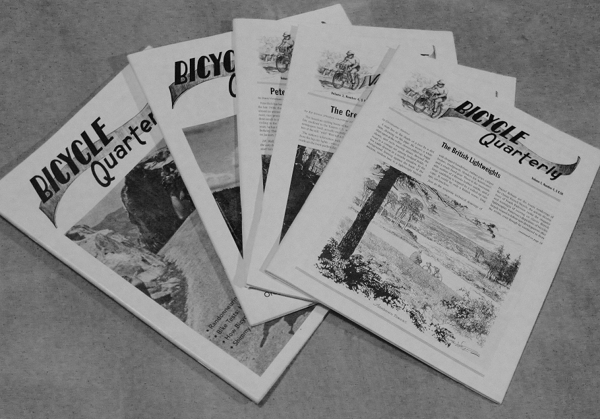
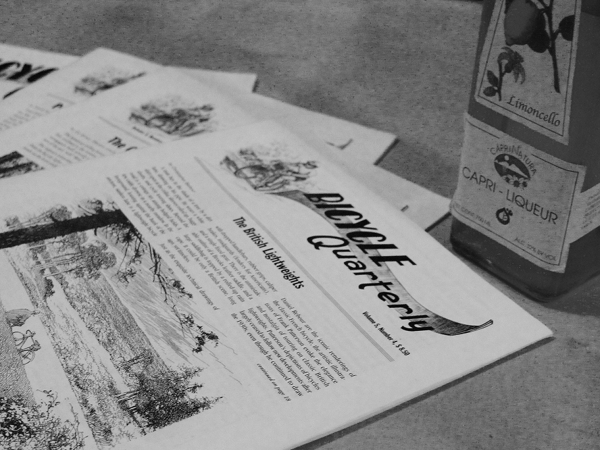
As a holiday gift, I received a subscription to Bicycle Quarterly and a set of back-issues containing articles I had been wanting to read for some time. The Winter 2010 issue and the older set arrived a little while ago, and I have been in a BQ-induced trance ever since. To describe this publication is challenging, as it defies easy classification. Part quasi-scholarly journal, part illustrated adventure book, something like this could only have been created by somebody with the mind of the relentlessly tenacious scientist and the spirit of the boy explorer. The result is wild, spectacular, engaging and maddening all at once - which is probably more emotion than any periodical has gotten out of me, ever. For that alone, the Bicycle Quarterly is worth every penny of its $30/year subscription fee.

Bicycle Quarterly focuses on randonneuring and cyclo-touring, and on the classic and vintage bicycles designed for these forms of cycling. Its content includes elaborate bicycle reviews, detailed historical articles, technical articles on frame building and ride quality, travel stories, book and product reviews, and much more in the same vein. But to leave the description at that would be to understate the unique nature of this magazine. First, there are the hand-drawn black and white illustrations. And then, there is the inimitable narrative voice of Jan Heine - both the publisher of Bicycle Quarterly and the author of most of the articles. Dr. Heine writes like a research scientist who, without the pressure of having to publish in peer-reviewed academic journals, has given free reign to his poetic side. With scientific phraseology interwoven with florid descriptions and subjective assertions, it is like some fantastic tapestry that draws me in with the eccentricity of its patterns.

To be sure, the Bicycle Quarterly contains a wealth of carefully researched information, which I find invaluable to my own learning experience. The author is detail-oriented and analytical, conducting in-depth research and getting to the very heart of the matter in every topic he explores. In particular, I have found the rare historical information, and the many articles examining the geometries of classic bicycles extremely useful. The information provided is not something that can easily, if at all, be found online, and so it is a priceless resource. I will be storing these back issues carefully and using them as reference material in the future.

At the same time, Dr. Heine has a very distinct perspective, which must be kept in mind when reading his assertions, reviews and critiques. He favours a specific kind of (1950s French randonneuring) bicycle design and is convinced of the superiority of this design to a degree that, in my view, makes him deeply biased. He also has a number of theories - such as that on "planing," on the virtues of low-trail geometry, and on the superiority of flexible frames - which he tends to treat as fact, or at least as self-fulfilling prophecies. As a trained researcher myself (psychology and neuroscience), I cannot agree that the tests and reviews printed in Bicycle Quarterly are "scientific" - Yet they are presented that way to readers, and that is my biggest criticism of the magazine. Bicycle Quarterly has much to offer - as long as the author's assertions are not taken as gospel by the eager novice.  It is the art and (pseudo-)science of velo-fetishism at its best, and I am addicted.

Wednesday, November 10, 2010

Reaching a Non-Cycling Audience

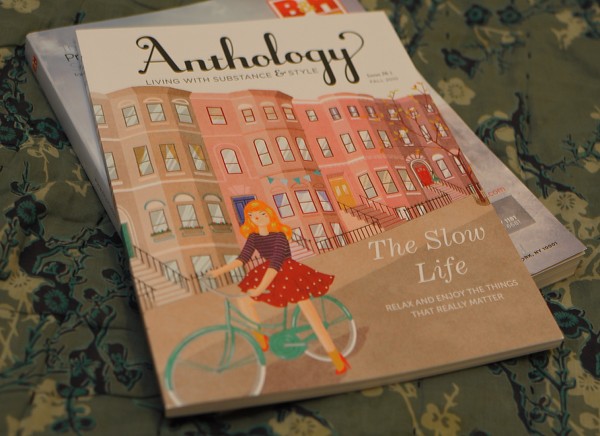
I received a copy of the first issue of Anthology magazine in the mail today - sent to me, because they ran a feature on Lovely Bicycle. I knew they'd made some illustrations based on my photos, but I did not expect to see a cartoon version of myself and the Pashley Princess (depicted complete with cream tires!) cycling through a cartoon version of Boston. Funny! Unlike the real me, my cartoon self likes to cycle in high heels - so perhaps she can teach me a thing or two!

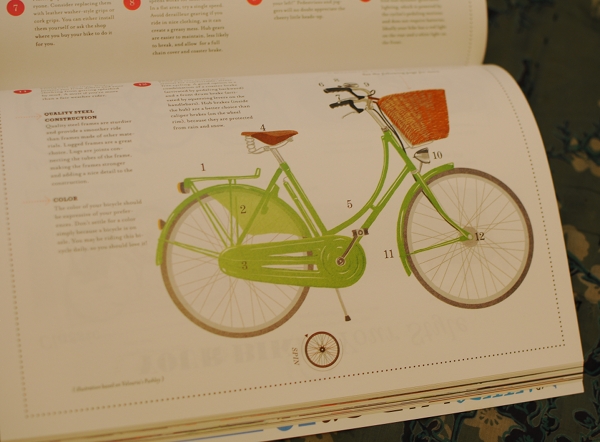
The story they ran included an edited version of my "Bicycles for Everyday Cycling" page, which I hope will be helpful to readers of the magazine who are considering purchasing their first bike.

I think it's neat that Anthology presented the information as an "anatomy lesson" and made its own hand-drawn illustrations (by Kris Atomic). This makes the text a lot more engaging than my original version (I read it with interest!) - and achieving that is important for print publications trying to compete with online media. I can imagine somebody who is not into cycling at all picking up this magazine in their local coffee shop or book store and getting drawn into the article, becoming curious about bicycles as a result.

In addition to the "Anatomy of a Lovely Bike" article, there was also a beautiful feature on Meligrosa of Bikes and the City with her cool mixte, as well as a helpful piece on shopping for bicycles and accessories.

One reason I am pleased to be featured in Anthology, is because they are not a cycling publication, but a more general lifestyle magazine. Before I began Lovely Bicycle, there was a period of a year or so when I vaguely wanted  a bike but did not know how to even begin looking for one that was right for me. There was a disconnect between the sort of bicycle I wanted and what was available in most bike shops at the time, and I simply did not know where else to get information. A series of bike-related articles like the ones Anthology published would have helped me, and I hope that they can now help others. Besides, I just love the idea of things like dress guards, chain cases and "lugged steel construction" being presented as standard features. I hope that women walk into bike shops and ask for them, as casually and matter-of-factly as they would ask for cake in a bakery.

Tuesday, June 15, 2010

Inflight Entertainment

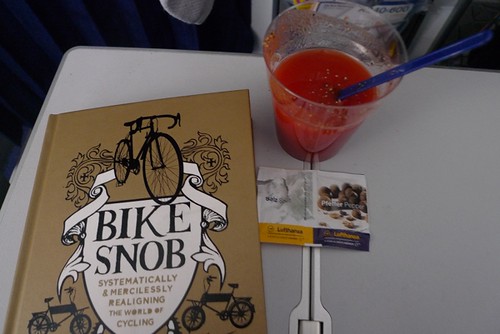
Leaving for Austria again, I bought the new Bike Snob book to read on the plane in hopes of distracting myself from my terror of flying. I like the BikeSnobNYC blog, but what made me buy the book was Grant Petersen's review on Rivendell's website. I have to admit that I am a sucker for Grant Petersen's writing and find myself reading all sorts of things he wrote that I have no interest in, just for the narration. If he wrote a 2-page description of bathroom tiles, I'd probably read it. His enticing endorsement of the book put me over the edge.

And if this isn't proof of the existence of the Collective Unconscious, I don't know what is: No sooner did I stuff Bike Snob into my carry-on, then mention of me appeared on his blog. Scroll down to the bit about the Boston Globe story on sweat stains and fabrics with patterns. Right...

Bike Snob proved useful during my flight, as I was seated between two mothers with babies on their laps. The babies not only wailed for the duration of the flight, but now and again would reach out to pull my hair, poke my eye, or chew on my jacket. Noticing this, the mothers would smile at me generously - as if to say: "As a female of childbearing age, surely you must be delighted at the opportunity to interact with babies!" Trying not to start wailing myself, I took deep breaths and concentrated on Bike Snob.

If I had to use one word to describe the book it would be "heartwarming". It is gently humorous, and reading it feels like wrapping yourself in a warm and fuzzy sweater with cute little patterns of bicycles all over it. Though Bike Snob argues that there is no such thing as "bike culture," he contradicts himself by creating a sense of one - to the extent of even referring to cyclists as a distinct breed of people. He also contradicts himself by railing against the fetishisation of the cycling experience, only to go on and fetishise the heck out of it himself in later chapters. I am pretty certain that these contradictions are intentional, meant to illustrate his own hopeless love for bicycles and to demonstrate that he too is susceptible to the very things he mocks.

As for the contents, they are surprisingly straightforward. The chapters address such topics as bicycle history, bicycle ownership, bicycle maintenance, and road rules. There is also a part on "Velo-Taxonomy" where he categorises cyclists into various types and explains the differences in detail. According to his taxonomy, I would be a hybrid between the "Retrogrouch", the "Lone Wolf", and the "Beautiful Godzilla" (though the only thing in common I have with the latter is the type of bicycle I ride).

The Bike Snob book is generously illustrated, in a manner that evokes Kurt Vonnegut's Breakfast of Champions and Antoine de Saint-Exupéry's The Little Prince. The design and layout make the pages almost seem edible. In a way, the presentation can be described as having a pre-packaged "cult status feel." Whether the book will actually attain cult status, only time will determine.

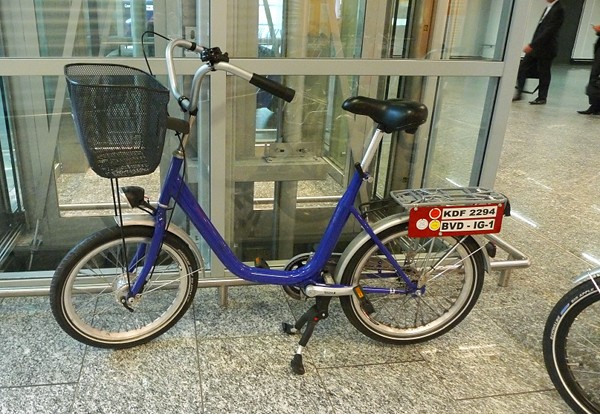
In other velo-news I can report from my travels, I saw these neat bicycles during my layover in Frankfurt Airport. These bikes have fenders, dynamo hub lighting, a the double-legged kickstand, a bell, a Basil front basket, a Pletscher rear rack, Schwalbe tires, and what appear to be license plates. From what I could tell, they are for the airport employees and not for flight passengers. Too bad, I would have liked to ride one around the airport!